Cut open a racing yacht’s hull, a spacecraft panel or the floor of a modern airliner and you will find the same unlikely structure inside: a sandwich of two thin skins with a core that looks like a beehive. It weighs almost nothing, yet it is stiff enough to walk on and strong enough to hold an aircraft together. That core is the honeycomb, and it is one of the cleverest tricks in materials engineering — strength borrowed from geometry instead of from mass.
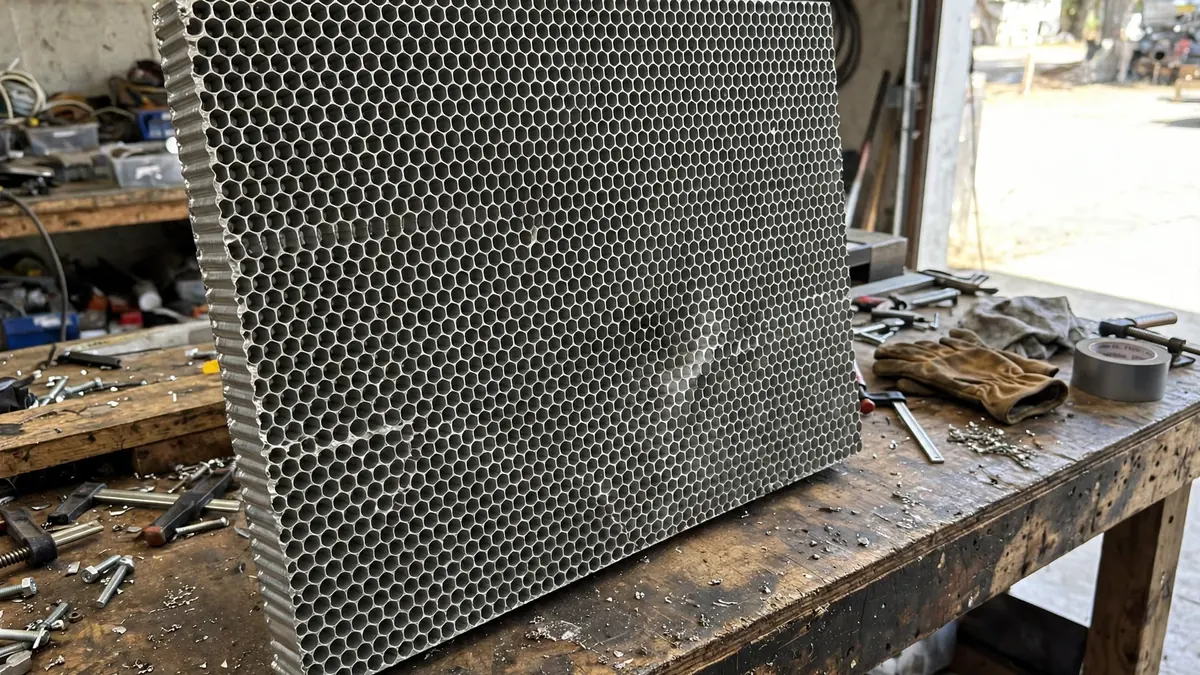
A honeycomb core is a sheet of hexagonal cells, usually made from aluminium foil or from aramid paper dipped in resin, bonded between two face sheets to form a sandwich panel. The cells are mostly empty air, which is why the panel is so light, but the hexagonal walls resist crushing and bending with remarkable efficiency. Bees discovered the shape millions of years ago; engineers merely copied it.
The Materials Behind the Honeycomb Core
Two families of honeycomb dominate. Aluminium honeycomb is made from thin foil, usually an alloy in the 3000 or 5000 series chosen for corrosion resistance and formability, glued and expanded into hexagonal cells and then bonded to aluminium or composite skins. Aramid honeycomb — sold under the Nomex name — is made from paper woven from aramid fibres, the same family of fibre as bulletproof vests, dipped in phenolic resin and cured into stiff, fire-resistant cells. Aluminium is stronger and stiffer; aramid is lighter, will not corrode, and survives fire far better.
Step 1: Aluminium foil and the expansion trick
Aluminium honeycomb starts as foil only a few hundredths of a millimetre thick, printed with lines of adhesive and stacked into a block of hundreds of sheets. The block is sliced to the thickness of the finished core, then pulled apart — expanded — so the glued lines open into hexagonal cells, like a paper concertina unfolding. The geometry is precise: cell size, foil thickness and alloy grade are chosen together, because a smaller cell or a thicker foil makes a stronger core at the price of weight. The expanded block is then trimmed, and the same aluminium know-how that shapes an aluminium forging — alloy choice, temper, corrosion protection — decides whether the core survives decades of service or corrodes from the inside out.
Step 2: Aramid paper and phenolic resin
Aramid honeycomb begins as paper, but paper like no other. The fibres are aramid, a polymer whose molecules line up in stiff chains, giving the paper high strength and an almost total refusal to burn. The paper is printed with adhesive, stacked and expanded in the same way as aluminium foil, and then dipped in phenolic resin and cured, which turns the floppy paper cells into rigid hexagonal walls. The resin is the difference between a paper decoration and a structural core: it stiffens the walls, seals them against moisture, and gives the finished honeycomb its fire resistance. The result is a core that can sit in an aircraft cabin wall, meet strict flammability rules, and still weigh less than the aluminium equivalent.
Step 3: Bonding the sandwich together
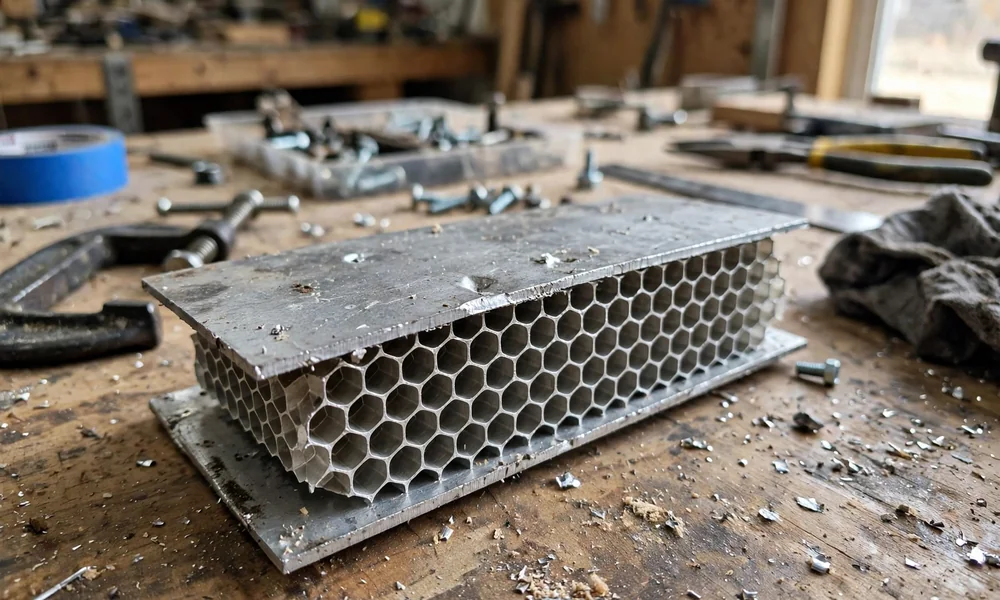
A honeycomb core on its own is fragile — you can dent it with a thumb. Its strength appears only when it is bonded between two face sheets, turning it into a sandwich panel. The skins are usually carbon fibre, glass fibre or aluminium, glued to the core with a film adhesive and cured under heat and pressure in an autoclave or a heated press. The bond is everything: if the skin peels away from the core, the panel loses its stiffness instantly. The sandwich idea is the same one that makes an e-bike carbon frame so light: thin, stiff skins held apart by a light core, each doing the job it is best at.
Step 4: Shaping curves and edges
Flat panels are easy; real parts are curved. Honeycomb can be formed to gentle curves by bending it before bonding, or machined to shape with a router or a five-axis mill after the core is made. The edges need special attention: a honeycomb panel cannot simply be cut and left open, because the hollow cells would fill with water and the thin walls would crush under a bolt. Edges are filled with a potting compound — a lightweight paste, often epoxy mixed with hollow glass microspheres — that hardens into a solid rim the panel can be bolted through.
Step 5: The skins — carbon, glass or metal
The face sheets decide what the panel feels like and what it can do. Carbon fibre skins give the highest stiffness for the lowest weight, and their woven pattern is familiar from any carbon fibre weave — the same cloth, here as a skin rather than a solid laminate. Glass fibre skins are cheaper, tougher against impact, and transparent to radio signals, which matters for radar covers and antenna fairings. Aluminium skins are the simplest of all, easy to repair and easy to bond, and still the default for many aircraft floors and doors. The skins are laid up ply by ply, each layer angled to carry loads in a different direction, then cured onto the core in one operation.
Step 6: Inspection, repair and water
The great enemy of a honeycomb panel is water. A damaged skin lets moisture into the cells, where it sits, adds weight, freezes at altitude and expands, and quietly corrodes an aluminium core from the inside. Inspection is therefore a routine: tap testing, where a technician listens for the dull thud of a disbonded skin, thermography, where a heat camera reveals trapped water, and X-ray for critical parts.

Honeycomb Core at a Glance
| Specification | Detail |
|---|---|
| Core materials | Aluminium foil (3000/5000 series) or aramid paper with phenolic resin |
| Cell sizes | About 3–25 mm across, chosen by load and weight |
| Core density | About 20–200 kg/m³, mostly air |
| Face sheets | Carbon fibre, glass fibre or aluminium |
| Key processes | Adhesive printing, stacking, expansion, autoclave bonding |
| Edge treatment | Potting compound and inserts for fasteners |
| Main uses | Aircraft floors and walls, yacht hulls, spacecraft panels, racing cars |
What Does It Cost?
Honeycomb core is cheap for what it does, but never cheap in absolute terms. Aluminium honeycomb costs roughly tens of dollars per square metre (estimate) for standard cell sizes, while aramid honeycomb costs several times more (estimate) because the paper and resin process is slower. A finished carbon-skinned sandwich panel can cost hundreds of dollars per square metre (estimate), and a large aircraft floor panel runs into thousands of dollars (estimate) once shaping, potting, inserts and inspection are included.
A Rare Fact
A honeycomb core is so efficient that a sandwich panel can be stiffer than a solid plate of the same material while using a tenth of the weight — but only if the skins stay bonded. Peel one skin off and the panel’s stiffness collapses by more than ninety percent, because the stiffness of a sandwich comes almost entirely from the distance between the two skins, not from the core itself. The most advanced lightweight structure in aviation is, at heart, a copy of an insect’s pantry.


