You are riding home on an electric bike, and the hill that used to leave you breathless is suddenly easy. You are still pedalling — the bike has not taken over — but every push of the pedals feels twice as strong, as if a friendly hand were pushing you from behind. There is no noise, no vibration, no drama. The help is coming from a small, silent drum at the centre of the rear wheel, and it is doing something remarkable: turning battery power into motion, right where the rubber meets the road.
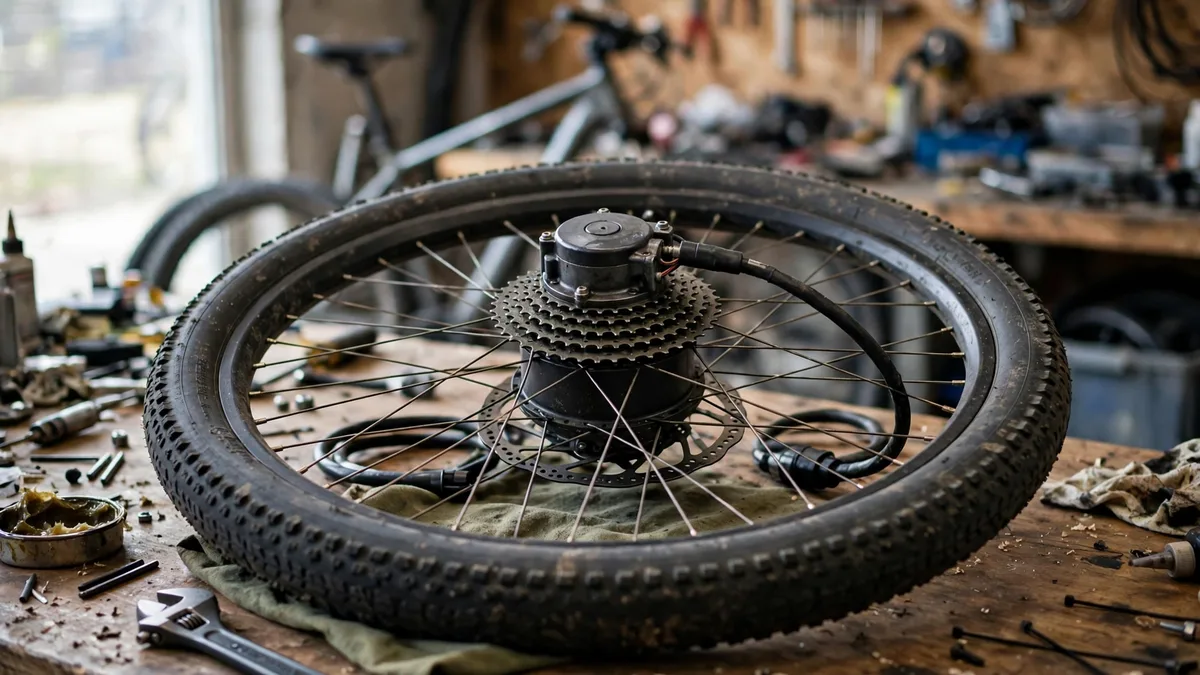
That drum is a hub motor, the most common kind of electric bike motor in the world. It lives inside the wheel itself, which is why so many e-bikes look almost exactly like ordinary bicycles.
A hub motor is a clever piece of packaging: a complete electric motor, squeezed into the space of a hub, that must be powerful, efficient, waterproof, and light enough to ride like a normal bike. This is how an e-bike hub motor works, from the twist of the throttle to the wheel turning beneath you.
How It Works
Step 1: The rider asks for help
Everything starts with a request. On most e-bikes, the rider asks for assistance by pedalling, and a sensor — usually a torque sensor in the crank or a simpler cadence sensor — tells the controller how hard and how fast they are pedalling. Either way, the signal travels to the controller, a small computer usually hidden in the frame or the battery mount. The controller’s job is to decide how much help to give: a gentle push on flat ground, a strong push on a hill, and nothing at all above the legal speed limit, which is 25 kilometres per hour in most of Europe.
Step 2: The controller turns battery power into a spinning field
The battery supplies direct current, but a hub motor needs something more subtle: three separate currents, rising and falling in a precise rhythm, that create a magnetic field spinning inside the motor. The controller makes those currents by switching the battery power on and off thousands of times a second, using transistors called MOSFETs. The controller also watches the motor’s position, using tiny Hall sensors inside the hub, so it always knows exactly where the magnetic field should be pointing next. The battery that makes all of this possible is a system of its own, as how an e-bike battery works explains.
Step 3: Magnets chase the field around the hub
Inside the hub motor, the spinning magnetic field has something to chase: a ring of permanent magnets, usually made from neodymium, fixed to the inside of the hub shell. The field pulls the magnets along, and because the magnets are attached to the hub, the whole wheel turns. There are no brushes, no commutator, and nothing rubbing — the only contact is through the bearings. This brushless design is why hub motors are so quiet and so reliable: there is almost nothing to wear out.

Step 4: The gears multiply the push
In a geared hub motor, the motor’s spinning shaft drives a small sun gear, which turns three planet gears, which in turn drive the hub shell itself. The gear reduction — typically about five to one — trades speed for torque, so the motor can spin fast and efficiently while the wheel turns slowly and strongly. That is exactly what a hill climb needs: lots of twisting force at low speed. There is also a freewheel clutch inside, which lets the wheel spin freely when the motor is off, so the bike still rides like a normal bicycle if the battery runs flat.
Step 5: The power reaches the road
From the hub shell, the power takes the shortest possible route to the road: through the spokes, to the rim, to the tyre, and onto the tarmac. Because the motor is in the wheel, there is no chain or belt involved in the electric drive at all — the rider’s pedalling still goes through the chain, but the motor’s power does not. That separation is part of the hub motor’s charm: the electric system and the bicycle’s gears work side by side without interfering with each other. The mid-drive alternative puts the motor at the pedals instead, as how an e-bike mid-drive motor works explains, and the choice between the two is one of the biggest decisions an e-bike buyer makes.
Step 6: The motor protects itself
A hub motor has to survive rain, mud, potholes, and the occasional kerb, so it is sealed against water and dust, with the cable entering through a waterproof gland. Inside, a temperature sensor watches the copper windings, and if they get too hot — on a long, steep climb in summer, for example — the controller quietly reduces the power until things cool down. Regenerative braking, which recovers energy when slowing down, is possible on direct-drive hubs but rare on geared ones, because the freewheel clutch prevents the wheel from driving the motor backwards. Building the motor itself is a precise manufacturing job, as the look inside e-bike hub motor production shows.
| Main material | Neodymium magnets, copper windings, and a steel or aluminium shell |
| Typical power | 250 watts nominal in Europe; 500 to 750 watts elsewhere |
| Motor type | Brushless direct current, usually with a planetary gear reduction |
| Gear reduction | About 5 to 1 in geared hubs; none in direct-drive hubs |
| Typical weight | About 2 to 4 kilograms for a geared hub; 4 to 7 for direct drive |
| Top assisted speed | 25 kilometres per hour in most of Europe; 32 in North America |
| Cooling | Passive, through the hub shell; temperature sensor protects the windings |
| Water protection | Sealed shell and waterproof cable entry; rated against rain and spray |
What Does an E-Bike Hub Motor Cost?
A hub motor is the affordable heart of the e-bike world. A complete geared hub motor kit, including the motor wheel, controller, and display, is estimated at roughly $200 to $600, while a factory-fitted hub motor on a complete e-bike adds an estimated $300 to $800 to the price of the bicycle, depending on power and brand. Those are estimates only, and they exclude the battery, which is usually the most expensive part of any e-bike. For riders, the ongoing costs are small: the motor itself needs almost no maintenance.
A Rare Fact
The hub motor is far older than the e-bike. The first electric hub motors were patented in the 1890s, when inventors fitted them to bicycles and even to early electric cars — the Lohner-Porsche of 1900, designed by a young Ferdinand Porsche, had a hub motor in each front wheel, making it one of the first four-wheel-drive vehicles ever built. Modern lithium batteries and brushless controllers finally made the nineteenth-century idea practical, and now the hub motor quietly powers millions of bicycles, scooters, and wheelchairs around the world.

The hub motor’s genius is that it disappears into the bicycle. It does not ask the rider to learn anything new, it does not change how the bike looks or handles very much, and it does its work in silence. You pedal, it helps, and the hill gets smaller. That is what a small drum of magnets and copper delivers every single day.


