The hill was the one he always dreaded. It rose out of the village in a long, lazy curve, steep enough that his legs would burn by the top and his shirt would stick to his back. That morning he rode it on a borrowed e-bike, and something strange happened: the harder he pushed, the more the bike helped, as if it could read his effort. When he eased off at the top, the help faded away, smoothly, without a lurch.
The part that read his effort was a torque sensor, a small device hidden in the crank that measures how hard the rider is pedalling, moment by moment. It is the difference between an e-bike that feels like a bicycle with a helping hand and one that feels like a moped with pedals attached. A good torque sensor makes the motor an extension of the rider’s legs; a bad one, or none at all, makes the motor feel like an on-off switch.
This guide explains the numbers behind the e-bike torque sensor in plain English: what each one means, and how to tell a genuinely natural-feeling e-bike from one that merely has a big battery.
How It Works
Step 1: Feeling the twist
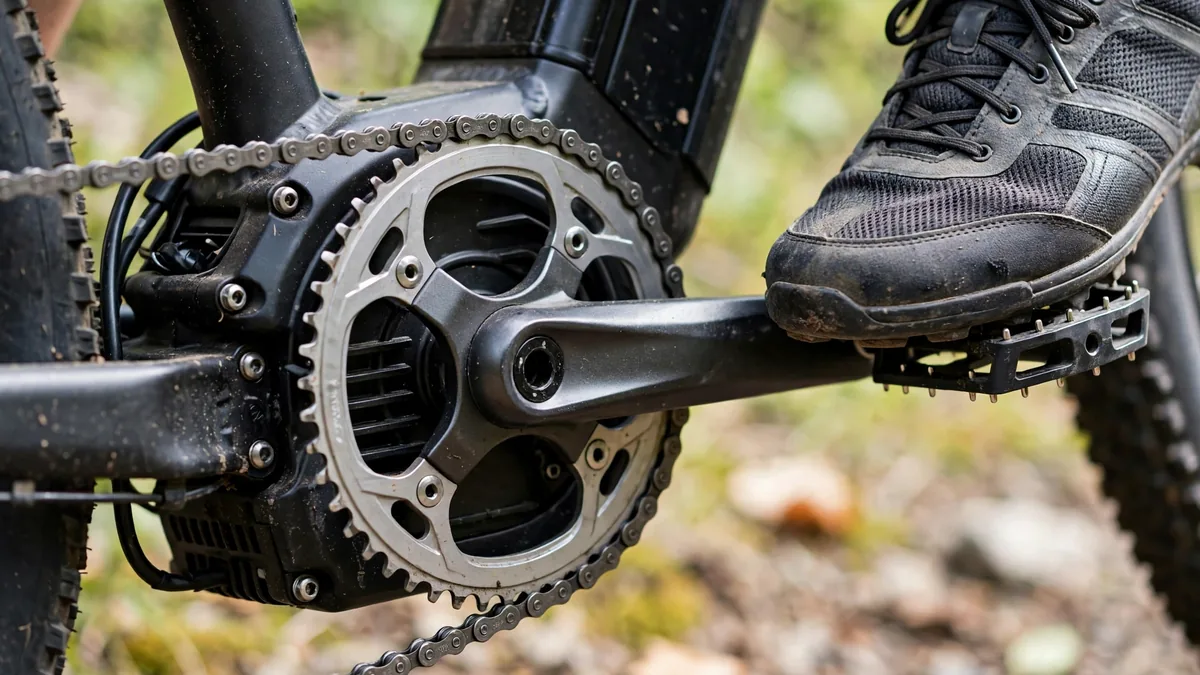
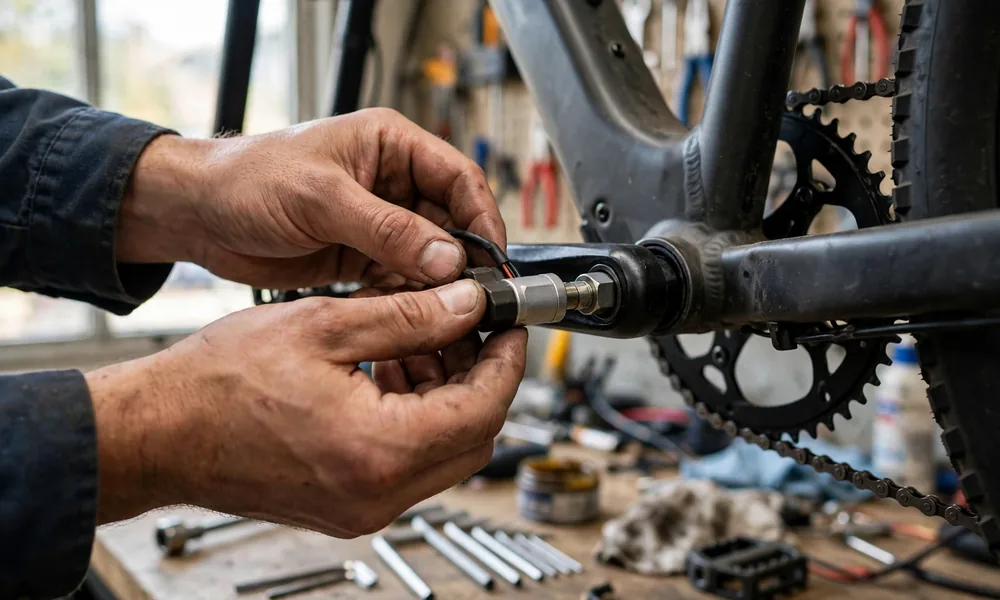
Everything starts with a twist. When you push on a pedal, the crank arm bends — only a fraction of a millimetre, far too little to see, but enough to measure. The torque sensor detects that tiny deflection, usually with strain gauges: small metal patterns glued to the crank or the bottom bracket spindle that change their electrical resistance when they are stretched. The harder you push, the more they stretch, and the bigger the signal.
Step 2: Measuring the spin
Twist alone is not enough, because the motor needs to know how fast you are pedalling as well. A cadence sensor counts the crank’s revolutions — typically with a ring of magnets passing a sensor, or a small disc with slots that interrupt a light beam — and the controller combines the two readings. Torque times cadence equals the power the rider is producing, and that is the number the motor uses to decide how much help to give. The motor that receives these orders has its own numbers to read, as the e-bike mid-drive motor explains.
Step 3: The controller decides
The torque signal flows to the bike’s controller, a small computer that decides how much motor power to add. In the lowest assist mode it might add half of what the rider produces; in the highest, three or four times as much. The controller updates its decision constantly — several hundred times a second on a good system — so the assistance rises and falls with the rider’s effort without any lag or surge. The battery that supplies all this power has its own limits, and they are spelled out in the e-bike battery guide.
Step 4: The motor answers
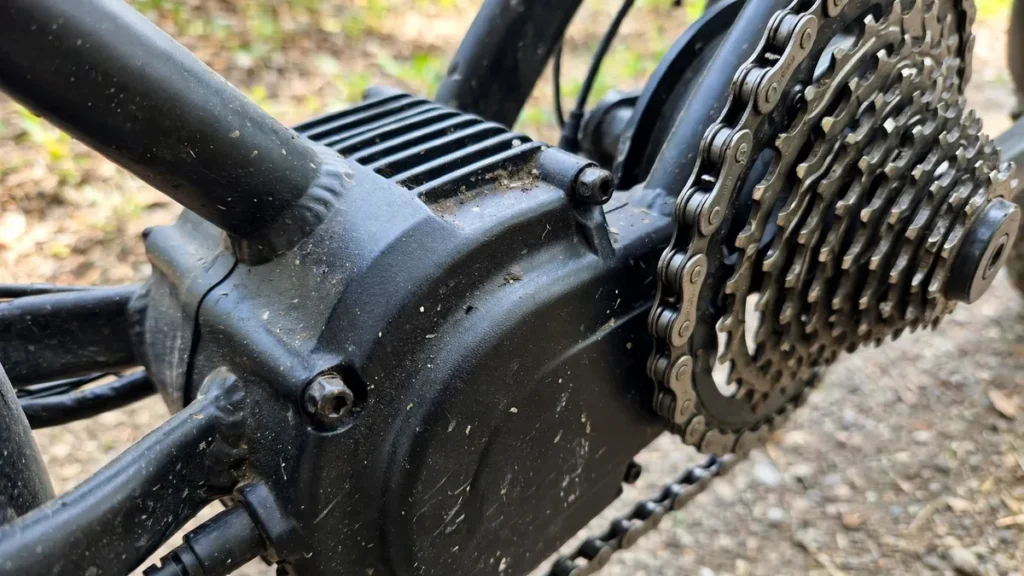
The controller’s command goes to the motor, usually mounted at the crank on a mid-drive bike, where it adds its torque directly to the rider’s through the same chain and gears. Because the motor works through the gears, it stays efficient on steep climbs, where the rider shifts down and the motor spins faster. Either way, the torque sensor is what makes the motor feel like a partner rather than a push: the harder the rider works, the harder the motor works, and the bike never runs away from its rider.
Step 5: Smoothing the ride
A raw torque signal is noisy — every pedal stroke has a dead spot at the top and bottom, and the force rises and falls twice per revolution. A good controller smooths this out, filtering the signal so the motor does not surge and fade with each stroke, and adding a little assistance even through the dead spots. It also handles the start, ramping the motor up gently instead of jerking the bike forward when you push off. That gentle start is one of the clearest signs of a quality system, and it is the first thing a test rider notices on a cheap bike that lacks it.
Step 6: Cutting out at the limit
Finally, the sensor helps enforce the law. In most countries, an e-bike’s motor must cut out at 25 kilometres an hour, and the torque sensor is part of how the bike knows when to stop helping. At the limit, the controller tapers the assistance down to nothing, so the bike feels like an ordinary bicycle above that speed. The sensor also cuts the motor the instant the rider stops pedalling — a safety feature as much as a legal one. The display that shows all of this — power, speed, and assist level — is the rider’s window into the system, and reading it is a skill of its own, as the e-bike display guide shows.
E-Bike Torque Sensor Specs
| Specification | Typical range |
|---|---|
| Measurement range | About 0 to 100 newton-metres of rider torque |
| Accuracy | About plus or minus 2 to 5 percent on good sensors |
| Response time | About 10 to 50 milliseconds from pedal input to motor response |
| Sampling rate | About 100 to 1,000 readings per second |
| Sensor type | Strain gauge on the crank spindle or bottom bracket; some use a magnetostrictive sensor |
| Assist ratio | About 50 to 400 percent of rider power, depending on assist mode |
| Cut-out speed | 25 kilometres per hour in the EU and UK; 32 kilometres per hour in the US (Class 1) |
| Operating temperature | About -10 to 50 degrees Celsius |
| Water resistance | Typically IP65 for the sensor unit (dust-tight and jet-proof) |
What Does an E-Bike Torque Sensor Cost?
You rarely buy a torque sensor on its own, because it is built into the bike — but its presence shows in the price. An e-bike with a torque sensor is estimated at roughly $1,500 to $4,000 for a mid-range model, while a basic e-bike with only a cadence sensor is estimated at roughly $800 to $1,500. A replacement torque sensor unit, if one fails, is estimated at roughly $50 to $150 plus fitting, though many are integrated into the bottom bracket and need a specialist to replace. The premium buys feel: a torque-sensing bike rides like a bicycle, while a cadence-only bike can feel like it has two speeds, on and off. All prices are estimates only and vary by brand, model, and retailer.
A Rare Fact
The torque sensor’s ancestor is the strain gauge, invented in 1938 by two engineers working independently on opposite sides of the Atlantic — one in California, one in Massachusetts — who both realised that a wire changes resistance when you stretch it. The first torque-sensing e-bikes appeared in the 1990s, and early riders described the feeling as uncanny: a bicycle that seemed to know what you wanted before you did. Thirty years later, the same trick is what separates a good e-bike from a merely electric one.

A bicycle that listens to your legs — that is the e-bike torque sensor, the small device that makes electric assistance feel human. Learn to read the specifications — range, accuracy, and response time — and the spec sheet stops being a list of big numbers and starts being a preview of how the bike will feel on the first hill.