The rider shifted down as the road tilted upwards, and the bike answered the way a good bicycle should: the pedals kept turning at the same comfortable rhythm, the motor hummed a little lower, and the hill flattened out beneath him. He had not thought about the gears at all. That, as any engineer will tell you, is the sign of a gearbox doing its job perfectly.
An e-bike gearbox is easy to overlook. It has no screen, no app, no glowing display — just a quiet mechanism that decides how hard your legs and the motor have to work at any given speed. Yet it shapes the ride more than almost any other part. The wrong gears make a powerful motor feel breathless on a hill and frantic on the flat; the right ones make a modest motor feel unstoppable.
This guide explains the numbers behind the e-bike gearbox in plain English: what each one means, how the gears work with the motor, and how to tell a genuinely well-matched setup from one that is only good on paper.
How It Works
Step 1: Gears match effort to speed
A gearbox does one fundamental thing: it trades speed for force. In a low gear, each turn of the pedals produces only a small turn of the wheel, so the rider and the motor can push hard against a hill without straining. In a high gear, each pedal turn spins the wheel many times, so the bike can cruise quickly on the flat. The range between the lowest and highest gear decides whether the bike can climb a steep hill and still cruise at speed. The motor that benefits from all this has its own numbers to read, as the e-bike mid-drive motor guide explains.
Step 2: The derailleur system
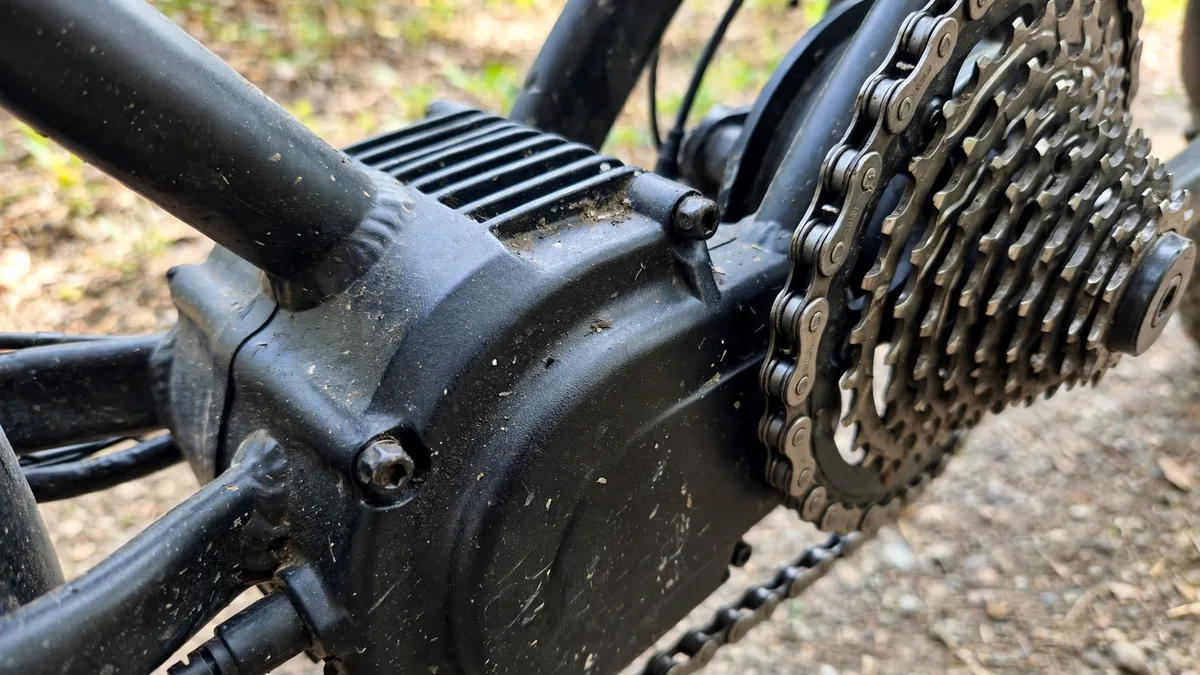
Most e-bikes use a derailleur: a mechanism that moves the chain sideways across a stack of sprockets at the rear wheel. It is light, efficient and familiar, and it offers the widest gear ranges available. Its weakness is that it cannot shift under full load — the rider has to ease off the pedals for a moment while the chain jumps — and it hangs exposed below the bike, where it can be damaged by a knock or clogged with mud.
Step 3: The internal hub alternative
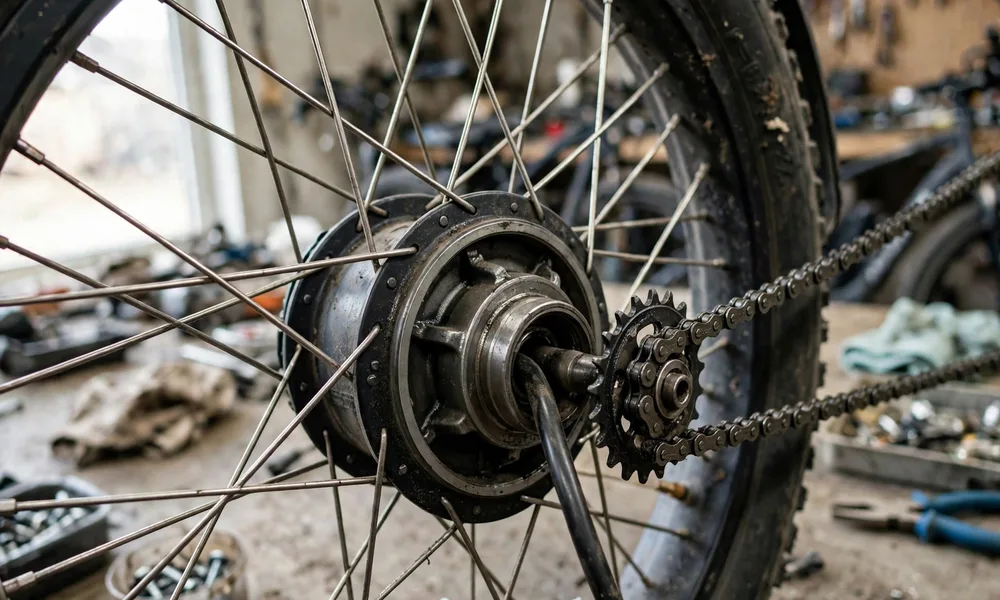
An increasing number of e-bikes use an internal gear hub, where the gears live sealed inside the rear wheel hub. The rider shifts with a twist grip or buttons, and the hub changes gear even when the bike is standing still — a blessing at traffic lights. The trade-off is weight and a narrower gear range on cheaper hubs, though premium hubs now rival derailleurs for range. The sensor that tells the motor how hard the rider is pushing works closely with the gears, and the e-bike torque sensor guide explains how it reads the rider’s effort.
Step 4: Automatic and electronic shifting
The newest e-bikes take the decision away from the rider altogether. Electronic shifting uses small motors to move the derailleur or change the hub gear, and automatic systems choose the gear based on speed, cadence and torque. The rider sets a preferred pedalling rhythm — say, 70 revolutions a minute — and the bike holds it, shifting up as speed rises and down as the road steepens. The system draws its power from the bike’s main battery, and a flat battery can leave an electronic shifter stuck in one gear.
Step 5: The motor multiplies the gears
On a mid-drive e-bike, the motor drives through the same gears as the rider, which is a crucial advantage. When the rider shifts down for a hill, the motor also gets a lower gear, so it spins faster and works more efficiently, producing more torque at the wheel. A hub motor, by contrast, drives the wheel directly and cannot benefit from the gears at all, which is why the e-bike hub motor guide reads quite differently from the mid-drive one.
Step 6: Wear, chains and belts
Gears wear out, and on an e-bike they wear faster than on an ordinary bicycle because the motor adds torque the chain was never designed for. A chain on a powerful e-bike wears about twice as fast as on a normal bike. Many e-bikes now use a belt drive instead — a carbon-reinforced rubber belt that runs silently and never needs oil. Belts only work with internal gear hubs, not derailleurs, so choosing a belt means choosing a hub, and the two decisions belong together.
E-Bike Gearbox Specs
| Specification | Typical range |
|---|---|
| Number of gears | About 7 to 12 on a derailleur; 3 to 14 in an internal hub |
| Gear range | About 250 to 550 percent from lowest to highest gear |
| Lowest gear ratio | About 0.5 to 0.8, for steep climbs with a loaded bike |
| Highest gear ratio | About 3.5 to 5.0, for cruising above 40 kilometres per hour |
| Shifting type | Manual derailleur, manual hub, electronic, or fully automatic |
| Shift time | About 0.2 to 0.5 seconds for electronic shifting; longer for manual |
| Weight | About 300 to 600 grams for a derailleur system; 1.5 to 2 kilograms for an internal hub |
| Drive type | Chain or carbon belt, with belts only on hub-gear bikes |
| Chain life on an e-bike | About 2,000 to 4,000 kilometres, shorter than on a normal bike |
| Maintenance interval | Chain cleaning every 200 to 500 kilometres; hub service about once a year |
What Does an E-Bike Gearbox Cost?
Gearbox prices span a wide range. A good derailleur drivetrain for an e-bike is estimated at roughly $200 to $600 for the shifters, derailleur, cassette and chain. An internal gear hub is estimated at roughly $300 to $1,500 depending on the number of gears. Electronic shifting adds an estimated $500 to $1,000, and a carbon belt drive is estimated at roughly $100 to $250 for the belt and sprockets. A full drivetrain replacement on an e-bike, including labour, is estimated at roughly $300 to $1,200. All prices are estimates only and vary by brand, model, and retailer.
A Rare Fact
The internal gear hub is older than the derailleur by decades. The first three-speed hub was patented in 1902 by the English company Sturmey-Archer, and it was so successful that it became the standard gearbox for British bicycles for most of the twentieth century — millions of commuters rode to work on three quiet, enclosed gears. A century later, the electric bike has brought the hub roaring back, because a sealed gearbox that shifts at a standstill turns out to be exactly what a motor-assisted city bike needs.
An e-bike gearbox is the quiet partner in every ride: it decides whether the motor’s power reaches the road gracefully or wastefully, whether a hill feels like a challenge or a chore. Learn to read the numbers — gear range, shift type, and the weight of the system — and the spec sheet stops being a list of sprocket counts and starts being a preview of how the bike will feel on the first steep hill.