The dashboard says the charger is delivering 250 kilowatts, and the battery is drinking it in. For ten minutes, everything is perfect — the range climbs by the second. Then, almost without warning, the charging speed falls off a cliff. Two hundred and fifty becomes one hundred, then fifty. The car is not broken. It is protecting itself, because inside the battery pack, the temperature is rising, and heat is the one thing a lithium battery fears more than anything else.
Every electric car carries a cooling system, and it is one of the hardest-working parts of the vehicle. A battery pack holds thousands of cells packed tightly together, and every charge and discharge generates heat. Too cold, and the battery becomes sluggish and refuses to charge quickly. Too hot, and the cells age rapidly. The cooling system is the quiet guardian that keeps the pack in a narrow band of comfort.
This guide explains the numbers in plain English — temperature ranges, coolant flow, cooling power and charging speeds — and what they mean for how fast your car charges and how long its battery lasts. The way EV battery cooling works is the difference between a battery that lasts fifteen years and one that fades in five.
How EV Battery Cooling Works
Step 1: Sensing the heat
Dozens of temperature sensors are scattered through the battery pack, watching individual modules and cells. The car’s computer reads them constantly, and it knows the middle of the pack runs hotter than the edges, and that fast charging heats the cells far faster than normal driving. When the temperature starts to climb, the cooling system wakes up before the driver notices anything at all.
Step 2: Moving the heat away
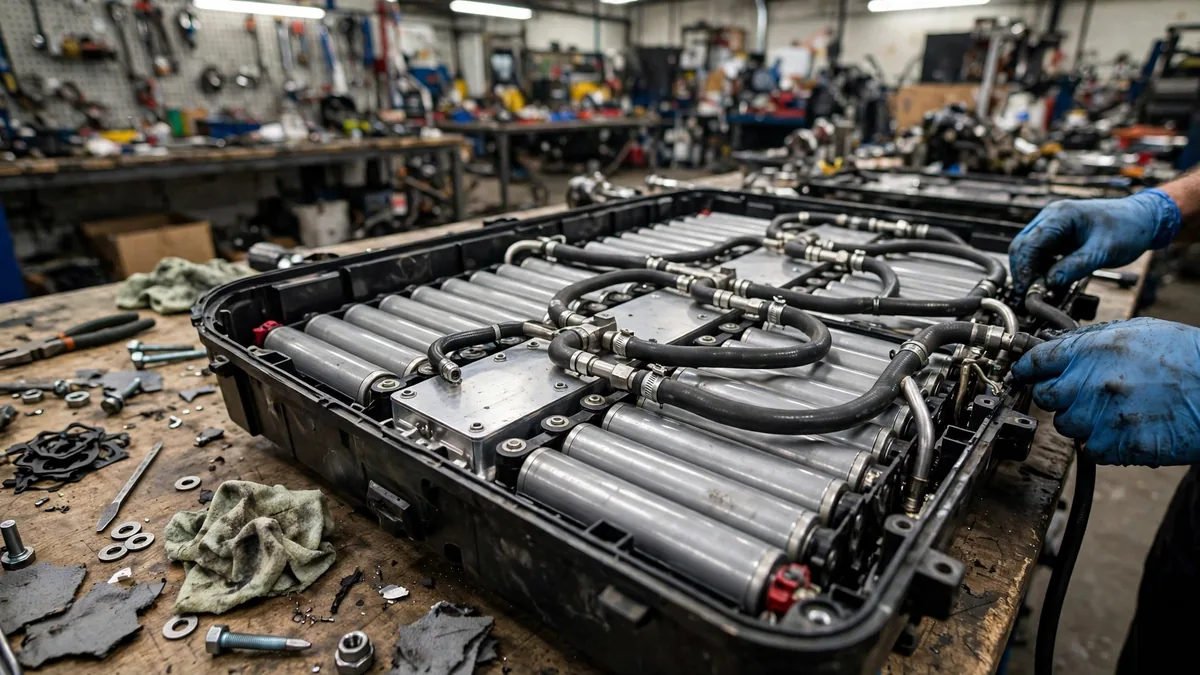
In most modern electric cars, a liquid coolant — usually a mix of water and glycol, like antifreeze — is pumped through thin metal cold plates that sit beneath or between the battery modules. The coolant absorbs heat from the cells and carries it to a radiator at the front of the car. The specs of an EV battery cell explain why this matters: each cell is a chemical reaction in a sealed metal can, and heat speeds that reaction up in ways that shorten its life.
Step 3: Warming up when it is cold
Cooling is only half the job. On a freezing morning, the same system can warm the battery, using a heater or waste heat from the motor to bring the cells up to their happy temperature before charging. A cold battery that is fast-charged can be permanently damaged, so many cars now pre-heat the pack automatically when you navigate to a fast charger.

EV Battery Cooling Specs
The cooling system’s spec sheet is a short list of numbers, and each one answers a different question: how hot is too hot, how much heat can be removed, and how fast can the car charge without cooking its own battery.
| Spec | Typical number | What it means | How it compares |
|---|---|---|---|
| Ideal cell temperature | 15 to 35 °C | The temperature range where cells are happiest | Below 0 °C charging slows sharply; above 45 °C ageing accelerates fast |
| Cooling method | Liquid cold plate | Coolant flowing through metal plates under the cells | Air cooling is cheaper but far weaker; liquid cooling is standard on fast-charging cars |
| Coolant type | 50/50 water-glycol | The fluid carrying heat away from the pack | Some cars use dedicated dielectric fluid; most use a glycol mix like engine coolant |
| Cooling power | 5 to 10 kW | How much heat the system can remove | Early electric cars managed 2 to 3 kW; the fastest-charging cars now exceed 10 kW |
| Peak charging power | 150 to 350 kW | The fastest rate the car can accept from a charger | A home charger delivers 7 kW; a fast charger can deliver fifty times more |
| Temperature spread | Under 5 °C | The difference between the hottest and coldest cells | A spread above 10 °C means some cells age far faster than others |
Ideal cell temperature is the number everything else serves. Lithium-ion cells are chemical devices, and like most chemistry, they have a comfort zone: roughly 15 to 35 °C. Inside that band, they charge quickly, deliver full power and age slowly. Below freezing, fast charging can deposit metallic lithium inside the cell, permanently damaging it — which is why cars limit charging speed in winter until the pack warms up. Above 45 °C, the ageing reactions accelerate sharply.
Cooling power, measured in kilowatts, is the most revealing figure on the sheet, and it is the one makers rarely advertise. A car that can charge at 350 kW generates enormous heat inside its pack, and unless the cooling system can remove 10 kW or more of that heat, the charging speed will fall within minutes. Modern cars with 10 kW or more hold their peak charging speed far longer, which is why two cars with the same headline charging figure can take very different times to fill up.
The temperature spread across the pack is a quiet measure of engineering quality. In a pack of thousands of cells, the ones in the middle get hotter than the ones at the edges, because they are insulated by their neighbours. A good cooling system keeps the difference between the hottest and coldest cells under 5 °C, so every cell ages at roughly the same rate.
Coolant choice sounds like a detail, but it shapes the whole system. Most cars use a 50/50 mix of water and glycol, the same kind of fluid as engine coolant, because it carries heat well, does not freeze in winter and is cheap to replace. A few performance cars use dielectric fluid — a liquid that does not conduct electricity — so it can flow directly over the cells themselves, cooling them far more effectively. The trade-off is cost: dielectric systems are heavier and more expensive, so they remain rare outside flagship models.
The heat pump deserves a special mention, because it is the cooling system’s twin. Instead of generating heat with an electric heater, which drains the battery, a heat pump moves heat from one place to another — scavenging warmth from the motor and the outside air. Cars with heat pumps can lose as little as 10 percent of their range in winter, while cars without one can lose 30 percent or more. The specs of an EV battery pack show how all these systems fit together into a single sealed unit.

What Does EV Battery Cooling Cost?
For the driver, the cooling system is mostly invisible in the running costs — it is sealed for life on many cars, and the coolant is typically changed only every few years at a service costing around $100 to $200 (estimate). When things go wrong, the numbers grow quickly: a replacement coolant pump costs roughly $300 to $800 (estimate), and a full battery pack replacement $5,000 to $15,000 or more (estimate).
A Rare Fact
The first mass-market electric cars were cooled by air alone — essentially, by blowing cabin air over the battery — and it was not enough. In hot climates, early air-cooled packs lost a fifth of their capacity in just a few years. The lesson reshaped the whole industry: today, every serious fast-charging electric car uses liquid cooling.


