An electric car’s battery is a paradox: it must be powerful enough to launch a two-tonne car to motorway speed in seconds, and delicate enough that a few degrees of heat can shorten its life. The cells love a narrow band of temperature — roughly the range a human finds comfortable — and outside it they age fast, charge slowly, or fail dangerously. Keeping hundreds of cells inside that band, in a car that can sit in desert sun or Arctic cold, is the job of the battery cooling system.
The system is a small world of its own: aluminium plates pressed against the cells, channels of coolant snaking between them, a pump, a chiller that borrows the car’s air conditioning, and sensors that watch the temperature of every module. It is built on a line that treats cleanliness like a hospital and sealing like a submarine. Here is how the factory builds one.

How It’s Made
Step 1: Making the cells and the modules they live in
The battery starts as individual cells — usually cylindrical or pouch cells — each one made in a dry room where the humidity is kept near zero, because moisture inside a lithium cell is poison. The cells are sorted by capacity and resistance, then grouped into modules, their terminals welded by laser in a fraction of a second. A module with one weak cell drags the whole pack down, so every cell is tested before welding, and the factory records each cell’s history.
Step 2: Building the cooling plates
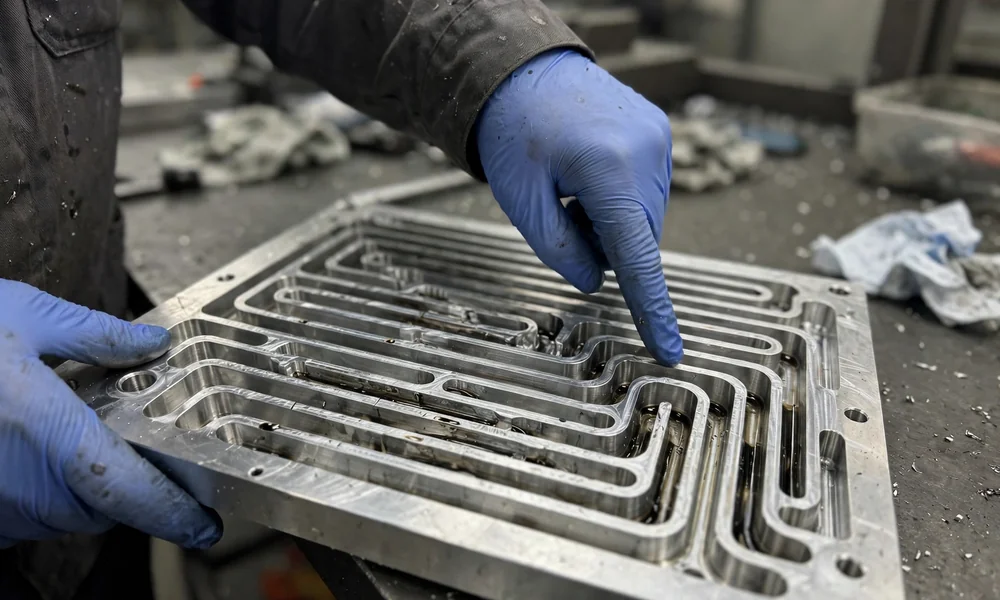
The heart of the system is the cold plate: a flat aluminium plate with channels inside it, pressed against the cells to carry heat away. The plates are made by brazing two formed sheets of aluminium together in a furnace, the channels between them shaped to spread the coolant evenly — a plate that cools one end more than the other will age the cells unevenly, and the pack will die early. Each plate is pressure-tested with air, then with coolant, and checked for leaks down to a few cubic centimetres per minute. The plates are machined flat to within a fraction of a millimetre, since a gap between plate and cell is an insulating air gap.
Step 3: Fitting the coolant loop, pump and chiller
Coolant — usually a water-glycol mix — circulates through the plates in a closed loop, driven by an electric pump and cooled by a chiller that shares refrigerant with the car’s air conditioning. The hoses and fittings are assembled on a bench, then pressure-tested as a complete loop before fitting, because a leak on the bench is a five-minute fix. The pump itself is tested for flow rate and noise, and the chiller is checked against its design capacity. The cooling capacity the car advertises — how fast it can charge on a hot day without overheating — is decided by this loop, and by nothing else.
Step 4: Sealing the pack and fitting the sensors
The modules and cooling plates go into a steel or aluminium pack housing, which is sealed against water and dust to a standard that would keep out a pressure washer. The lid is bolted down with a gasket and a precise torque pattern, and the finished pack is dunked or spray-tested to prove the seal. Inside, dozens of temperature sensors sit on the modules, watching for hot spots, and the battery management system reads them many times a second. A pack with a dead sensor is still a failure, because the car would be driving blind. The factory tests the whole sensor network before the lid goes on, since afterwards the sensors are unreachable.
Step 5: Filling, bleeding and the thermal test
With the pack sealed, the cooling loop is filled with coolant and bled of air — air bubbles in a cooling plate are hot spots waiting to happen, and the factory uses a vacuum fill to pull the coolant in without trapping any. Then comes the thermal test: the pack is charged and discharged at full power on a rig while engineers watch every module’s temperature. The target is a spread of only a few degrees between the hottest and coldest cell, even at full fast-charging power. The aluminium plates and coolant either hold that spread or they do not, and a pack that fails is opened, fixed and tested again — it is never shipped on a promise.
Step 6: Fitting the pack to the car and the road test
The finished pack is lifted into the car’s floor — it is the heaviest single part of an electric car, and it bolts into the body structure, becoming part of the car’s strength in a crash. The coolant lines and high-voltage cables are connected and checked, and the car is started for the first time. On the road test, the car is fast-charged and driven hard while battery temperatures are logged. The battery pack itself is designed around its cooling, and on the test drive the two prove each other — or the car goes back to the line.
EV Battery Cooling Specifications
| Specification | Typical Value |
|---|---|
| Coolant type | Water-glycol mix (50/50) |
| Cooling plate material | Brazed aluminium |
| Target cell temperature | 20–35 °C |
| Maximum cell spread | 3–5 °C across the pack |
| Cooling capacity | 5–10 kW at full fast charging |
| Pump type | Electric centrifugal pump |
| Chiller | Shared with cabin air conditioning |
| Pack sealing | IP67 water and dust protection |
| Temperature sensors | 20–60 per pack |
| Service life | 8–10 years, coolant change every 4–5 years |
What an EV Battery Cooling System Costs
Prices are estimates and vary with pack size and the car it serves. The cooling system itself costs an estimated $800–$2,000 as part of a new car, while the complete battery pack it protects costs an estimated $8,000–$18,000. Replacing a failed cooling pump out of warranty runs an estimated $400–$900, a chiller replacement an estimated $600–$1,200, and a coolant change an estimated $150–$300. A leaking cooling plate inside the pack can cost an estimated $2,000–$5,000 to repair. The cooling system is a small fraction of the car’s price — and the cheapest insurance a battery ever gets.
A Rare Fact
An EV battery can be damaged by being too cold just as surely as by being too hot. Below freezing, charging a lithium cell can plate metallic lithium onto its anode, permanently reducing capacity — so on a cold morning, the system runs in reverse, warming the battery first. The same loop that cools the pack in summer heats it in winter. A battery that is cold is not a battery that is safe; it is a battery waiting for permission to charge.
The battery cooling system is the quiet guardian of the most expensive part of an electric car. It is a set of aluminium plates, a pump and a chiller, tested until every cell sits within a few degrees of its neighbours. You will never see it working — but every fast charge you ever do depends on it.