Lift the floor of a modern electric car and you will find a flat slab the size of a double bed, weighing half a tonne, holding enough energy to drive hundreds of kilometres. An EV battery pack is a carefully arranged city of thousands of cells, each one a small chemical factory, packed together with cooling channels, sensors, fuses and armour — and every material in it is chosen to balance three things that fight each other: energy, safety and weight.
This is the story of the materials inside that slab, and of the trade-offs behind every kilometre of range.

The Materials Behind the EV Battery Pack
The headline materials are lithium, nickel, cobalt and graphite, the chemistry of the cells themselves, held in aluminium or steel housings. Around them sit the copper busbars that carry current, the cooling plates that keep the cells at the right temperature, the flame-retardant plastics that separate the modules, and the adhesives that glue the whole pack into a structural unit. Even the separators inside each cell — a plastic film thinner than cling film — are an engineering story.
Step 1: The cathode and its metals
The cathode is where most of the pack’s value sits. In most long-range electric cars it is a nickel-manganese-cobalt oxide — NMC — a layered crystal in which lithium ions shuttle in and out as the battery charges and discharges. More nickel means more energy, so makers have pushed from equal parts of each metal toward nickel-rich recipes with 80 percent nickel or more.
Step 2: The anode and its graphite
On the other side of each cell sits the anode, usually graphite — layers of carbon atoms arranged like the pages of a book, with lithium ions slipping between the pages when the battery charges. Natural and synthetic graphite are both used, and the choice is a balance of cost, purity and speed: synthetic graphite charges faster but costs more to make, because it is baked at nearly 3,000 degrees Celsius. The EV battery pack assembly process starts with these electrodes, coated, dried and wound or stacked into cells.
Step 3: The electrolyte and the separator
Between the electrodes sits the electrolyte, the liquid that lets lithium ions travel while blocking electrons — a mix of organic carbonates and a lithium salt, usually lithium hexafluorophosphate. It is flammable, which is the pack’s central safety problem, and much of battery research is about replacing it with something that is not. The separator is a film of polyethylene or polypropylene, thinner than cling film, full of microscopic pores that let ions through but keep the electrodes from touching. If the cell overheats, the separator is designed to melt shut — closing its pores and stopping the current, like a fuse.

Step 4: The cell casing and the current collectors
Each cell is sealed in its own case: a steel can for cylindrical cells, an aluminium pouch for pouch cells, or a rigid aluminium box for prismatic cells. The steel can is drawn from a single sheet, nickel-plated to resist corrosion, and its vent — a scored disc in the top — is designed to burst at a precise pressure, letting gas escape before the cell bursts. The current collectors are copper on the anode side and aluminium on the cathode side, foils so thin they tear like tissue, coated with the electrode slurries and welded to tabs with ultrasonic welders. The EV battery cell specifications spell out which shape a car uses, and why.
Step 5: Busbars, cooling and the thermal system
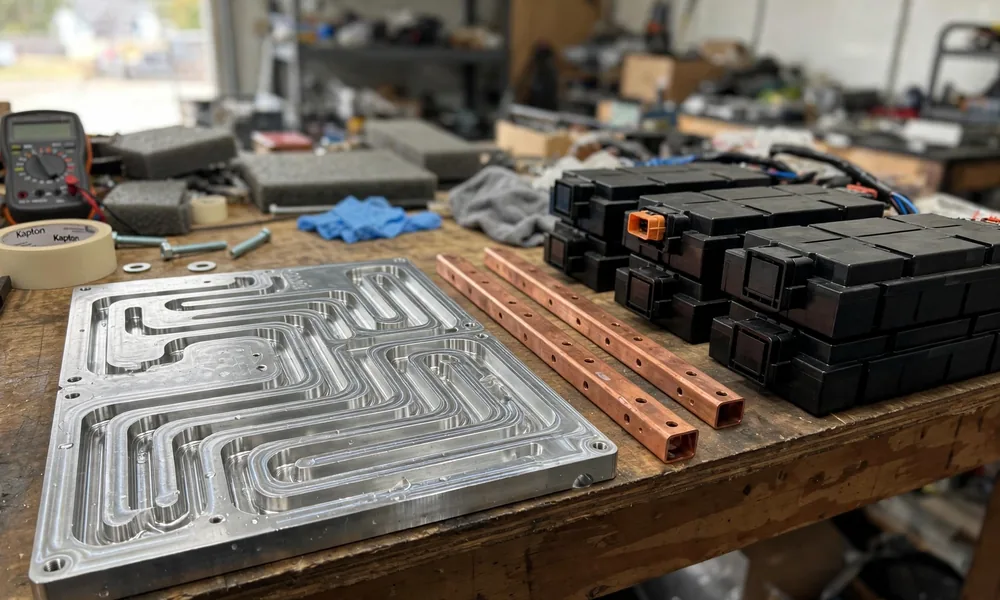
Cells are wired together by busbars — flat bars of copper or aluminium that carry hundreds of amps between modules. Copper carries more current for its size, aluminium is lighter and cheaper, and many packs use both, joined by laser welding or friction stir welding, because joining copper to aluminium is notoriously hard. Under the modules sits the cooling plate, usually aluminium, with channels for a water-glycol coolant that keeps the cells near 25 degrees Celsius — the temperature where they are happiest. The cooling plate is bonded to the modules with a thermally conductive adhesive, a paste loaded with ceramic particles, and the whole thermal system is the reason an EV can fast-charge in twenty minutes instead of melting. Cooling is the same problem solved by EV battery cooling, where the plate and the coolant do the quiet work.
Step 6: The housing, the armour and the glue
The pack’s housing is its armour. The tray is usually aluminium — extruded and welded, or cast as a single piece — because it must be stiff enough to be part of the car’s structure and strong enough to protect the cells in a crash. The lid is steel or aluminium, sealed with a gasket, and the underside carries a shield against stones and speed bumps. Inside, the modules are glued in place with structural adhesive, which does three jobs: it holds the cells, conducts heat to the cooling plate, and stiffens the pack. The housing is what turns a pile of cells into a car part.
Step 7: Sensors, fuses and the safety net
Woven through the pack is a nervous system: temperature sensors on the modules, voltage taps on every group of cells, and a battery management system that watches them all, hundreds of times a second. Between the modules sit flame-retardant barriers — mica sheets, ceramic felts and intumescent coatings that swell when hot — designed to stop a single failing cell from setting off its neighbours. A pack that passes its tests can contain a thermal runaway in one cell without the car catching fire. That containment, more than any single material, is what makes a half-tonne slab of stored energy safe to sit on.
EV Battery Pack at a Glance
| Specification | Detail |
|---|---|
| Cathode | Nickel-manganese-cobalt oxide, or lithium iron phosphate |
| Anode | Graphite, sometimes with silicon added |
| Electrolyte | Organic carbonates with lithium salt |
| Separator | Polyethylene or polypropylene film, shutdown design |
| Cell casing | Steel can, aluminium pouch or prismatic box |
| Cooling | Aluminium plate, water-glycol coolant |
| Housing | Aluminium tray, structural adhesive, mica barriers |
What Does It Cost?
An EV battery pack typically costs around $100 to $140 per kilowatt-hour at pack level (estimate), so a 75kWh pack — the size in a typical long-range electric car — costs roughly $7,500 to $10,500 (estimate) to make. The cells are most of that, and their price has fallen by nearly 90 percent in a decade. A replacement pack for an older car can cost $10,000 to $20,000 (estimate) including labour.
A Rare Fact
The lithium in an EV battery pack is so light that a whole car’s worth — around 10 kilograms — would fit in a shoebox, yet it takes roughly 500,000 litres of brine, evaporated in desert ponds over two years, to produce it from a salt flat. A battery pack’s most important material begins its life as salty water in one of the driest places on Earth — and the same lithium can be recycled from an old pack, closing a loop that mining alone cannot.


