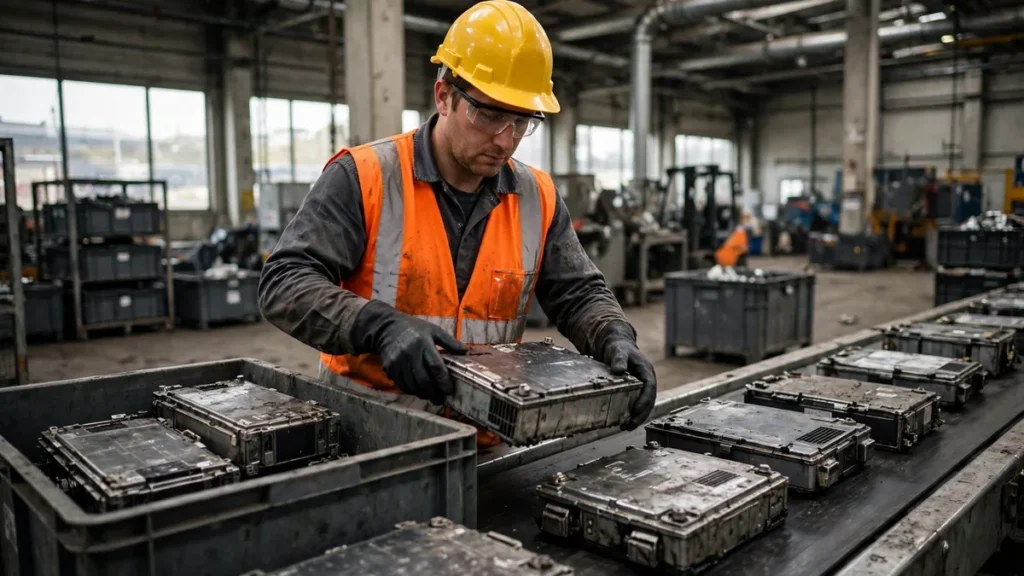
Every electric car battery that comes off the road has a second life waiting inside it. A pack that can no longer hold a charge still holds kilograms of nickel, cobalt, lithium and copper — metals that were dug out of the ground at great cost, refined at great heat, and sealed into cells that were never meant to be opened. Inside are metals worth more than the car they came from, and chemicals that can burn a hole through a workbench.
This is the story of the materials inside an EV battery recycling plant, and of what happens when each one is pushed too far.

The Materials Behind EV Battery Recycling
A used battery pack arrives as a sealed slab of aluminium and steel, and everything that follows is a contest between chemistry and containment. The cathode metals are the prize, the graphite and plastics are the bulk, the electrolyte is the danger, and the steel, copper and aluminium around them are the structure that must be cut, shredded and separated. The EV battery recycling process starts with discharge and dismantling, and every material in the plant is chosen for one of those jobs.
Step 1: The cathode metals — nickel, cobalt and lithium
In a nickel-manganese-cobalt cell it is a layered oxide powder, coated onto aluminium foil, holding the lithium ions that carry the charge. When a pack is recycled, these metals are the reason the whole plant exists: a tonne of spent cathodes can hold more nickel and cobalt than a tonne of ore from a mine. If the cathode is damaged by heat during shredding, the metals oxidise and mix with impurities, and the recovered powder loses value — a burnt cathode is worth far less than a clean one, which is why the first steps of recycling are gentle, not violent.
Step 2: The anode graphite and the copper foil
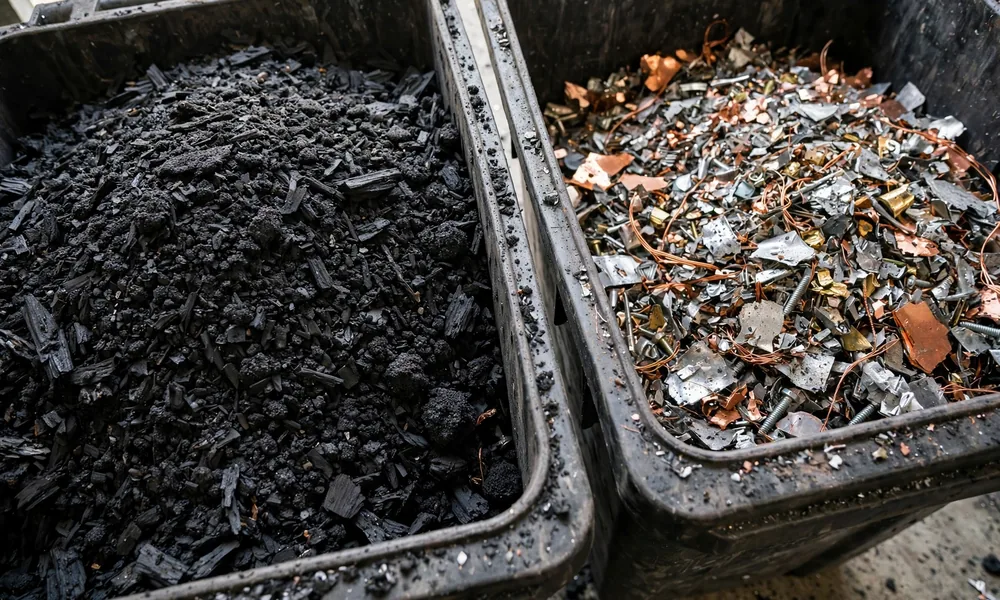
On the other side of each cell sits the anode: graphite, layers of carbon atoms with lithium slipped between them, coated onto copper foil. If graphite dust escapes into the air, though, it is a breathing hazard and a fire risk — fine carbon dust can ignite — so the shredding halls are kept under extraction, and the dust is captured in filters rather than left to settle.
Step 3: The electrolyte — the dangerous liquid
Between the electrodes sits the electrolyte, a mix of organic carbonate solvents and a lithium salt, and it is the most dangerous material in the plant. It is flammable, it gives off toxic fumes when it burns, and when it meets water it can release hydrogen fluoride, a gas that etches glass and burns lungs. Before any cell is cut open, the pack is discharged in a salt-water bath or by a controlled resistor, draining the stored energy so a short circuit cannot start a fire. If a charged cell is shredded, the electrolyte ignites, the fire spreads from cell to cell, and the hall fills with smoke — which is why discharge is the one step no recycler ever skips. Recyclers test every pack for voltage before it is touched, because a pack that looks dead can still hold enough charge to arc.
Step 4: The separator and the plastics
The separator is a film of polyethylene or polypropylene, thinner than cling film, full of microscopic pores — and in a recycling plant it is mostly a nuisance. The plastic module housings and cable insulation are separated by density: they float while the metals sink, in a bath of water or a dense liquid.
Step 5: The steel casing and the aluminium tray
Each cell is sealed in its own case — a nickel-plated steel can, an aluminium pouch, or a rigid aluminium box — and the whole pack sits in an aluminium tray that is also part of the car’s structure. Steel and aluminium are the workhorses of the recycling line: they are magnetic or light enough to separate easily, they melt cleanly, and they can be sold straight to a smelter. The EV battery pack materials show why the tray is so tough — it was built to protect the cells in a crash — and that toughness is the recycler’s first problem, solved with saws, shears and patience.
Step 6: The acids and solvents that do the dissolving
Once the black mass is collected, chemistry takes over. The powder is leached in sulphuric acid, sometimes with hydrogen peroxide added to speed the reaction, dissolving the nickel, cobalt, manganese and lithium into a dark liquid. The acids are chosen because they dissolve the oxides without dissolving everything else, and the solvents because they are selective.
Step 7: The protective gear and the plant itself
The last material in the story is the one that protects the people: the gloves, respirators, aprons and face shields worn on the dismantling line, and the fire-resistant coatings on the walls. Battery dust contains nickel and cobalt, both skin sensitisers, and the fumes contain hydrogen fluoride, so the protective gear is not optional decoration — it is part of the process design. The EV battery cell specifications explain what is inside each cell, and the protective gear exists because every one of those materials is hazardous once the cell is opened.

Materials at a Glance
| Material | Why it is chosen | How it is shaped | When it fails |
|---|---|---|---|
| Nickel-cobalt cathode | Stores the energy; the most valuable metals in the pack | Layered oxide powder coated on aluminium foil | Heat damage oxidises it and destroys its value |
| Graphite anode | Holds lithium between carbon layers; cheap and reusable | Powder coated on copper foil, baked at high heat | Fine dust ignites and harms lungs if it escapes |
| Electrolyte | Carries lithium ions between the electrodes | Liquid carbonate solvents with a lithium salt | Flammable; releases toxic hydrogen fluoride |
| Steel and aluminium | Protect the cells; easy to separate and melt | Drawn cans, pouches, extruded trays | Mixed metals lose value; steel rusts if stored wet |
| Sulphuric acid | Dissolves cathode metals for recovery | Used in lined leaching tanks | Eats through unlined steel; leaks are dangerous |
| Protective gear | Keeps workers safe from dust and fumes | Gloves, respirators, aprons, face shields | A torn glove or failed respirator exposes the worker |
EV Battery Recycling at a Glance
| Specification | Detail |
|---|---|
| Main recovered metals | Nickel, cobalt, lithium, copper, aluminium |
| Key intermediate | Black mass — shredded cathode and anode powder |
| Leaching acid | Sulphuric acid, often with hydrogen peroxide |
| Recovery rate (estimate) | Over 90 percent of cobalt and nickel in modern plants |
| Biggest hazard | Fire from charged cells; hydrogen fluoride fumes |
| First step | Full discharge before any cutting or shredding |
| End product | Battery-grade metal sulphates and lithium carbonate |
A Rare Fact
It is the graphite: making a kilogram of battery-grade synthetic graphite takes roughly fifty kilowatt-hours of electricity, baked at temperatures hotter than lava, so recovering it saves more energy than recovering any metal in the pack. The dirtiest-looking powder in the plant is, quietly, the biggest energy saving of all. And the loop is closing: the metals in a recycled pack can be back in a new car within months, not years.