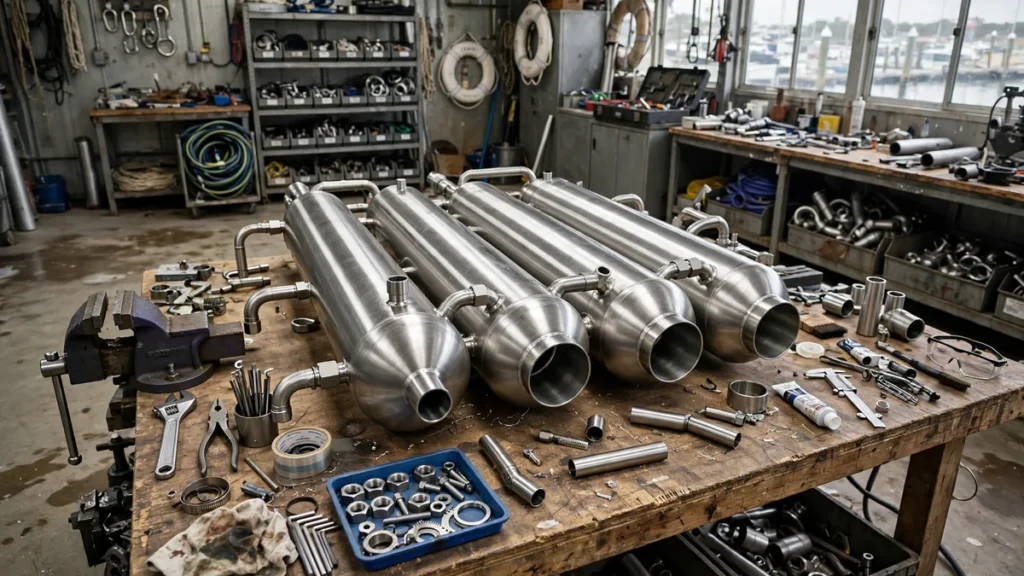
An electric car battery does not end its life in a landfill. When a pack is too worn to power a car, it still holds valuable metals — lithium, cobalt, nickel, copper, and aluminium — and a whole industry has grown up to take it apart and win those metals back. The recycling plant is where a dead battery begins its second life, as the raw material for a new one.
Inside the factory that does this work, the job looks nothing like a car plant. There are no shiny new parts and no assembly lines building something up. Instead, the work runs in reverse: packs are taken apart, cells are emptied of their charge, and the pieces are sorted, shredded, and refined until what is left is a dark powder rich in metals worth recovering.

Inside the Production
Step 1: Receiving and checking the packs
Production begins when used packs arrive, usually from scrapyards, car makers, or fleets retiring old vehicles. Each pack is logged, weighed, and checked for damage: a swollen, leaking, or fire-damaged pack is handled separately, with extra care. Workers record the pack’s make and chemistry, because different batteries hold different metals and need different treatment. Packs that still hold a useful charge may be sent for a second life in stationary storage instead, but the rest are queued for recycling, stored in fire-safe areas until their turn on the line.
Step 2: Discharging and dismantling
Before anything is taken apart, the pack must be made safe. It is discharged — its remaining energy drained away in a controlled way — so that no live voltage is left to spark or shock. Workers in insulated gloves and face shields then open the case, unbolt the modules, and disconnect the busbars and wiring. The cooling pipes are drained, the electronics are removed, and the steel or aluminium case is set aside for ordinary metal recycling. What is left is a set of modules: blocks of cells, still holding their metals, ready for the next stage.
Step 3: Shredding and sorting
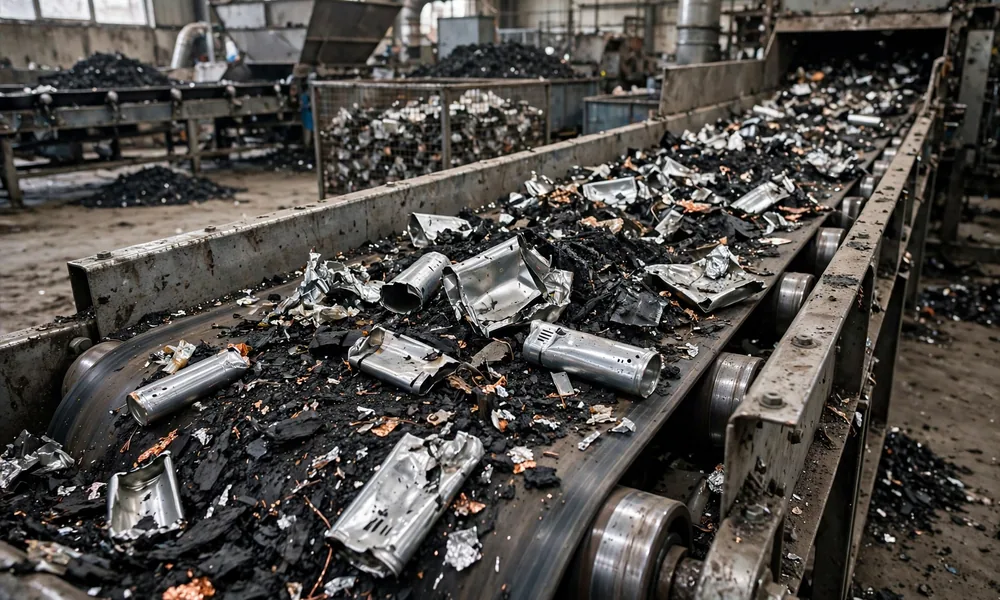
The modules are fed into a shredder, a heavy machine that tears them into small pieces. The shredding usually happens in a sealed chamber, often under an inert gas, so that the flammable electrolyte inside the cells cannot catch fire. What comes out is a mixed stream of fragments: steel, aluminium, copper foil, plastic, and a fine dark powder called black mass, which holds the lithium, cobalt, nickel, and graphite. Magnets pull out the steel, air jets and screens separate the light plastics from the heavy metals, and the black mass is collected on its own — it is the most valuable thing in the whole plant.
Step 4: Separating the metals
The black mass is where the chemistry begins. It is treated with acids in large tanks, dissolving the metals into a liquid while the graphite and other leftovers are filtered out. The liquid is then processed step by step: one metal is drawn out, then the next, each one separated by adjusting the chemistry of the bath. Cobalt and nickel are recovered as salts, lithium as a white powder, and copper is plated out onto sheets. The way the metals are won back is part of what how EV battery recycling works describes, and this separation stage is where a shredded battery stops being waste and starts being raw material again.
Step 5: Refining to battery grade
Recovered metals are not yet good enough for a new battery. They must be refined to a high purity, because even small amounts of contamination would shorten the life of a new cell. The metal salts are washed, crystallised, and dried, then tested in a laboratory against strict standards for purity and particle size. Lithium is turned into lithium carbonate or lithium hydroxide, the forms battery makers buy, and the nickel and cobalt salts are prepared the same way. Only material that passes the laboratory tests is bagged and sold on; anything below grade is sent back through the process for another pass.
Step 6: Testing and shipping
Nothing leaves the plant without proof of what it is. Each batch of recovered material is sampled and analysed, and a certificate records its purity and composition. The material is packed in sealed drums or bags, labelled, and shipped to battery makers, where it is mixed with newly mined material and made into fresh cells. The plant also tracks its own recovery rates — how much of each metal it won back from every tonne of packs — because that number is the measure of whether the process is working. A plant that recovers most of the lithium, cobalt, and nickel from its packs is doing the job the whole industry depends on.

Specs
| Specification | Typical figure |
|---|---|
| Pack weight | 400 to 600 kg per EV pack |
| Metals recovered | Lithium, cobalt, nickel, copper, aluminium |
| Key output | Black mass, rich in battery metals |
| Process type | Mechanical shredding plus chemical separation |
| Recovery rate | Often above 90 percent for cobalt and nickel |
| Output form | Metal salts and lithium carbonate or hydroxide |
| Safety | Discharge before dismantling, inert shredding |
| Second life | Healthy packs reused for stationary storage |
| Testing | Laboratory purity test on every batch |
Price
Recycling an EV battery is a business built on the value of what comes out. As an estimate, a recycler pays roughly $100 to $300 for a worn-out pack, depending on its size and chemistry, and spends roughly $500 to $1,000 per tonne processing it. The recovered metals are worth roughly $1,000 to $3,000 per tonne of packs, with cobalt and nickel worth the most. These are estimates, and the real figures swing with metal prices — when cobalt is expensive, recycling pays well; when it falls, the margins get thin. But the direction is clear: as more EVs retire, the flow of old packs only grows.
A Rare Fact
The most valuable thing in a recycling plant is a powder that looks like dirt. Black mass, the fine dark powder left after shredding, holds almost all of the lithium, cobalt, and nickel from a battery, yet to the eye it is just a dull black dust. A single tonne of black mass can hold more cobalt than a tonne of ore dug from a mine, because a battery is already a concentrated store of the metal. That is why the powder is handled like treasure — weighed, sampled, and locked away — even though it looks like something swept off a workshop floor. It is also why the shredding stage is guarded so carefully: lose the black mass to the air or the drains, and the most valuable part of the battery is gone.
The recycling plant closes the loop on the electric car, but it only makes sense alongside the battery it takes apart. The materials behind the recovered metals are covered in the EV battery recycling materials engineering guide, and the pack those metals came from is described in how an EV battery pack is made. The next time an old electric car is taken off the road, remember the discharged packs, the shredded modules, and the dark powder that will one day power a new car.