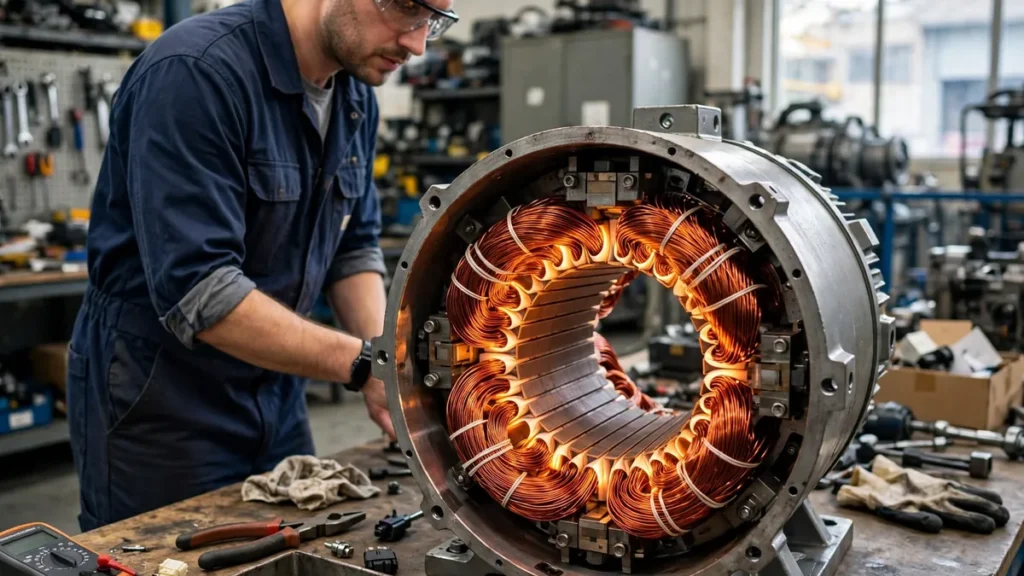
Open up an electric car motor and the first thing you see is copper — great loops of it, wound into neat coils around a ring of steel, gleaming like jewellery in a workshop. The winding is the motor’s muscle: electricity flows through those copper coils, makes a magnetic field, and that field drags the rotor round, thousands of times a minute. There is no fuel, no explosion, no exhaust — just copper, steel, magnets and insulation, arranged with extraordinary precision. A winding that is a fraction of a millimetre out of place wastes energy as heat, and heat is range lost.
This is the story of the materials inside that winding, and of the trade-offs behind every turn of copper.
The Materials Behind the EV Motor Winding
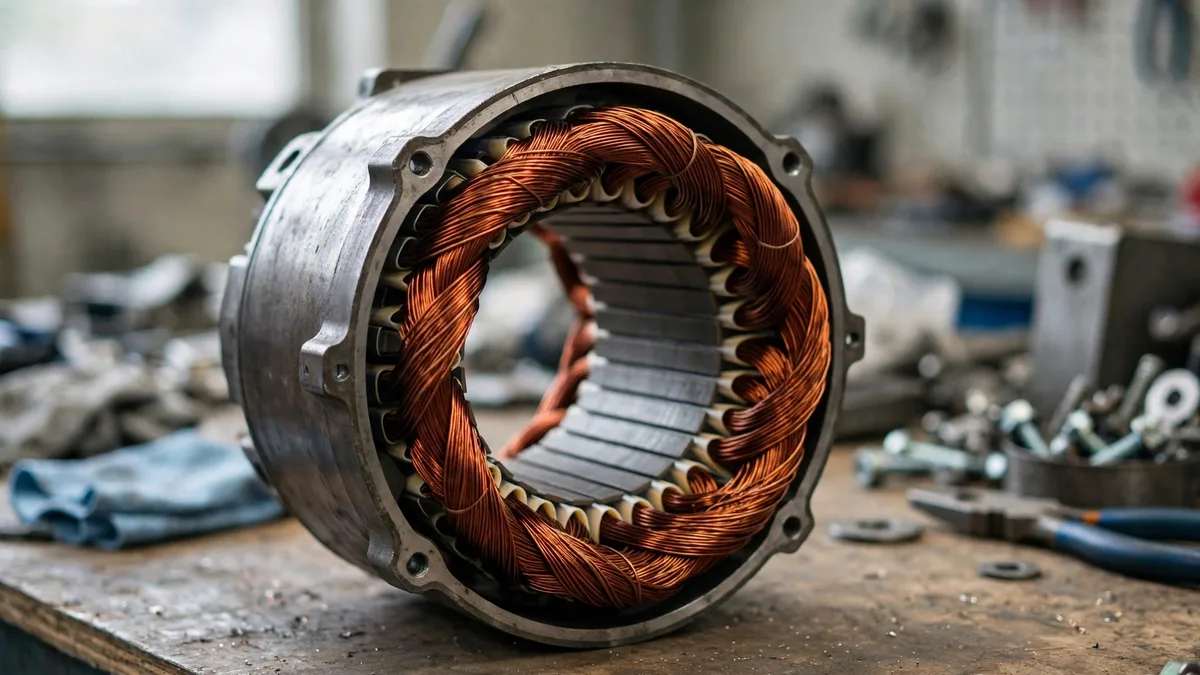
The headline materials are copper for the wire, electrical steel for the core, and insulation — enamel, paper and resin — that keeps the copper from shorting to the steel or to itself. Around them sit the slot liners, the wedges that hold the coils in place, and the resin that fills the finished stator and locks everything solid. Even the shape of the wire matters: round wire, flat wire and hairpins all behave differently.
Step 1: The copper wire and its enamel
The winding starts as copper wire, drawn from high-purity copper that is 99.99 percent pure, because even tiny impurities raise the wire’s resistance and waste energy as heat. The wire is coated with enamel — a thin layer of polyamide-imide or polyester-imide resin — that insulates each turn from its neighbours. The enamel must survive being bent around tight corners, heated to well over 150 degrees Celsius, and soaked in oil or coolant for years without cracking. A single pinhole in the enamel can short two turns together, creating a hot spot that slowly kills the motor, so the wire is tested for insulation faults as it is wound.
Step 2: The steel core and its laminations
The copper coils sit in a core of electrical steel — thin sheets of iron alloyed with silicon, stacked into a ring called the stator. The silicon raises the steel’s electrical resistance, which cuts the eddy currents that would otherwise waste energy as heat, and the sheets are coated with a thin insulating varnish so current cannot flow between them. Each sheet is less than half a millimetre thick, and a stator can contain hundreds of them, stamped out like coins and stacked with extraordinary precision. The EV motor winding specifications spell out the slot count, the wire size and the fill factor — the share of each slot that is actually copper.
Step 3: Hairpins and the winding machines
Many modern EV motors use hairpin windings: the copper is bent into U-shaped pins, dropped into the stator slots, and welded together at the ends to form the coils. Hairpins pack far more copper into a slot than round wire, because there is no wasted space between round strands, and they are easier for robots to place. The welds are done by laser, and each one is inspected, because a bad weld is a hot spot. Other motors use traditional round-wire winding, where a needle winds the wire into the slots turn by turn, which is slower but more flexible for complex designs.

Step 4: Insulation, slot liners and wedges
Between the copper and the steel sit the insulators. Each slot is lined with a paper or film of aramid or polyester, which stops the enamelled wire touching the bare steel of the slot. The coils are separated from each other by phase insulation, and the whole winding is held in place by wedges — small strips of glass-filled plastic or magnetic material pushed into the top of each slot. The EV inverter materials matter here too, because the inverter feeds the winding with fast-switching pulses, and those pulses stress the insulation far more than a smooth supply would.
Step 5: Impregnation and the resin bath
Once wound, the stator is impregnated with resin — usually an epoxy or polyester varnish — that fills every gap between the wires, the insulation and the steel. The resin is drawn in under vacuum, so it reaches into the smallest spaces, then cured with heat until it sets hard. Impregnation does three jobs: it locks the coils in place so they cannot vibrate, it improves heat transfer from the copper to the steel and the cooling jacket, and it protects the insulation from moisture and chemicals. The electric axle the motor bolts into carries the cooling for this assembly, because the winding’s heat must go somewhere.
Step 6: The rotor, the magnets and the other half
The winding is only half the motor. Inside it spins the rotor, which in most EV motors carries permanent magnets — usually neodymium-iron-boron, the strongest magnets known — set into a laminated steel core. The magnets are coated against corrosion, often with nickel or epoxy, because a corroded magnet loses strength. The air gap between the rotor and the stator is less than a millimetre, and it must stay that tight while the rotor spins at 20,000 revolutions per minute. The winding’s magnetic field pulls on the rotor’s magnets, and the rotor turns — that is the whole trick, and it depends on the gap staying exact.
Step 7: Cooling, testing and the life of a winding
A winding’s enemy is heat. Copper’s resistance rises as it gets hotter, so a hot winding wastes more energy, which makes it hotter still — a vicious circle that ends in melted insulation. EV motors cool their windings with water jackets around the stator, oil sprayed directly onto the coil ends, or both. A good EV motor is over 90 percent efficient at turning electricity into motion, and the winding is the reason: copper, steel and insulation, placed with sub-millimetre precision, and kept cool enough to last the life of the car.

EV Motor Winding at a Glance
| Specification | Detail |
|---|---|
| Wire | High-purity copper, enamelled, round or flat |
| Winding type | Hairpin or round-wire, laser-welded ends |
| Core | Silicon electrical steel laminations, varnish-coated |
| Insulation | Aramid or polyester slot liners, glass-filled wedges |
| Impregnation | Epoxy or polyester resin, vacuum-filled and cured |
| Rotor | Neodymium magnets in laminated steel, or copper bars |
| Cooling | Water jacket, oil spray, or both |
What Does It Cost?
An EV motor winding typically costs $150 to $400 (estimate) in materials and winding labour, with hairpin windings at the top of that range because of the laser welding and precision tooling. A complete EV motor costs roughly $1,000 to $3,000 (estimate) to make, and the winding is one of its most expensive parts after the magnets. A replacement motor for an older EV can cost $3,000 to $8,000 (estimate) including labour.
A Rare Fact
The copper in a single EV motor winding weighs around 10 to 15 kilograms — about as much as a large dog’s worth of copper wire — yet it is wound so tightly that if it were unwound, it would stretch for more than a kilometre. And the air gap between the spinning rotor and the stationary winding is thinner than a credit card, maintained while the rotor turns at up to 20,000 revolutions per minute.