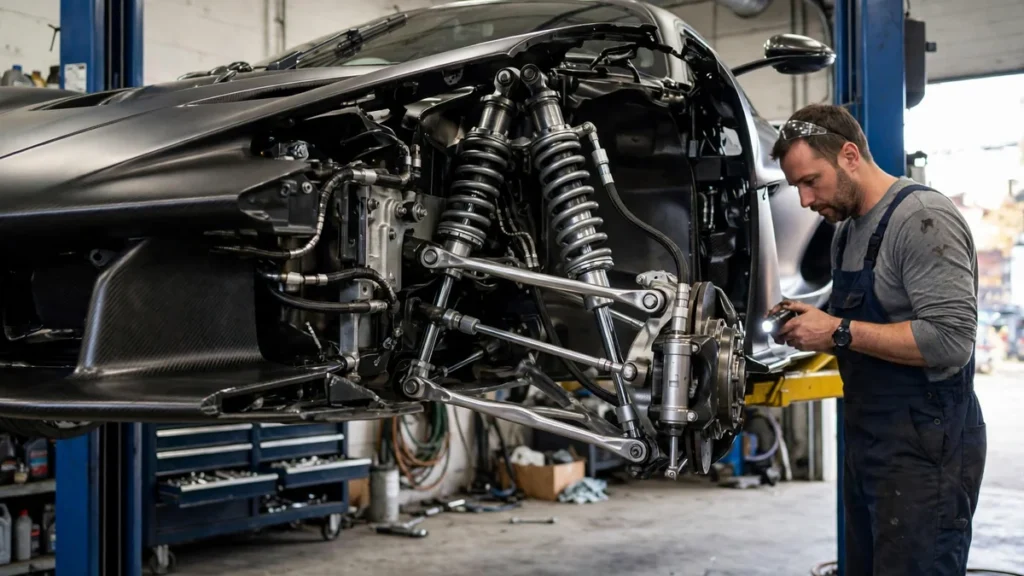
There is a moment on every electric car production line when the car stops looking like a collection of parts and starts looking like a machine: the moment the electric axle drops into place — motor, gearbox and power electronics fused into a single compact unit that bolts straight to the chassis. No driveshaft down the middle, no exhaust, no gearbox tunnel. Just one dense block that turns battery power into motion. The electric axle, or e-axle, is why modern EVs are so spacious inside.
An e-axle lives a hard life. Its motor spins at speeds a petrol engine could never survive — twenty thousand revolutions per minute is routine — while its gears transmit instant torque from a standstill and its electronics switch hundreds of amps in microseconds, all inside a housing sealed against water, dust and salt for the life of the car. Every material inside survives one specific kind of abuse: heat, magnetism, friction, vibration or corrosion.
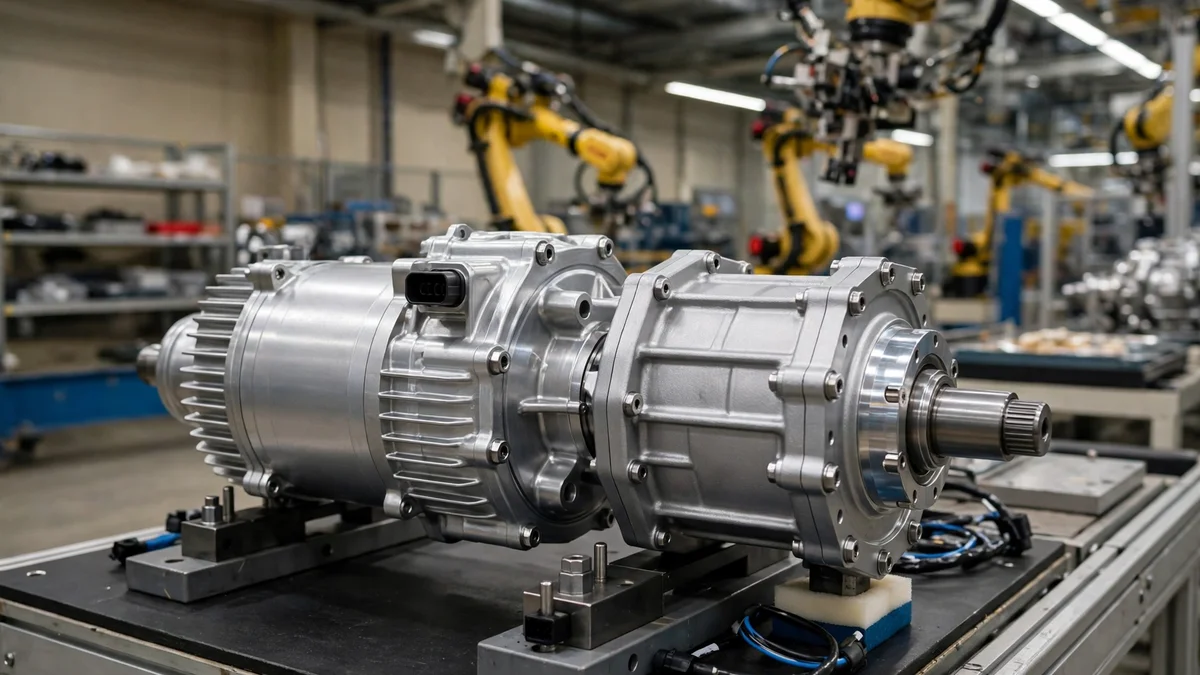
The Materials Behind the EV Electric Axle
The heart of the e-axle is its motor, and the heart of the motor is its magnets. Most EV traction motors use neodymium-iron-boron permanent magnets — the strongest known — often with small additions of dysprosium or terbium to stop them losing magnetism when hot. Around them are laminations of electrical steel, stamped into paper-thin sheets and stacked into stator and rotor. The windings are copper, the best practical conductor; the gears are case-hardened alloy steel; the housing is usually cast aluminium, light and good at shedding heat; and the power electronics sit on silicon carbide chips, which handle high voltage and temperature far better than ordinary silicon.
Step 1: Stamping the electrical steel
Everything starts with the laminations. Coils of silicon steel, less than half a millimetre thick, are stamped into the intricate shapes of stator and rotor teeth at high speed — hundreds of parts a minute. The steel is coated with a thin insulating layer first, because if the laminations touched electrically, eddy currents would waste energy as heat. The stampings are stacked, pressed and welded into a solid core. It looks simple and is anything but: a burr on one lamination, a stack a fraction of a millimetre out of true, and the motor will hum, vibrate and waste energy for its whole life.
Step 2: Winding the copper
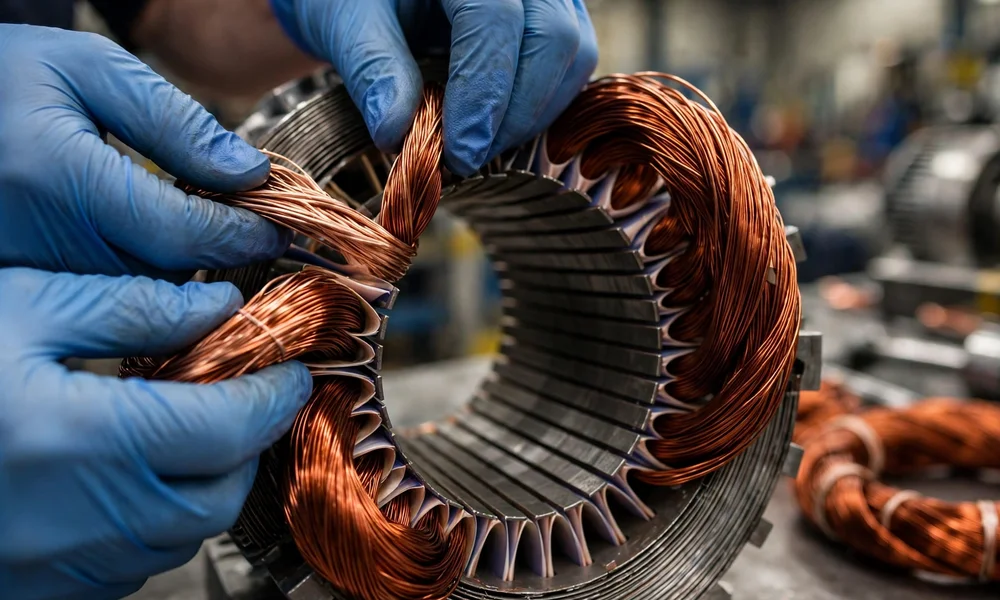
Copper wire — sometimes round, increasingly flat rectangular “hairpin” conductors — is wound into the stator slots. Hairpin winding, now common in premium e-axles, packs far more copper into the same space than round wire, which means more power from the same size motor. The copper is coated with enamel insulation that must survive high temperatures and constant vibration without cracking, because a single short between two turns can kill a motor. Once wound, the stator is impregnated with resin and baked, locking every wire in place — the same discipline behind the simpler motors that explain how an electric motor works.
Step 3: Making the magnets
The magnets start as a powder of neodymium, iron and boron, pressed into shape in a magnetic field, sintered at high temperature, then magnetised in a pulse so powerful it would erase every credit card in the room. Each is coated — usually with nickel or epoxy — because neodymium corrodes eagerly, and a corroded magnet is a dead magnet. They are glued and mechanically locked into the rotor, arranged so their fields combine into a smooth turning force. A palm-sized neodymium magnet can pinch hard enough to break a finger.
Step 4: Cutting the gears
While the motor is built, the gearbox is machined from alloy steel blanks. The gears are cut, then case-hardened — heated in a carbon-rich atmosphere so the surface resists wear while the core stays tough enough to absorb shocks. Then they are ground to tolerances measured in microns, because at e-axle speeds and torques, a gear even slightly out of true will whine, and a whine in an otherwise silent EV is the loudest thing in the car. The e-axle gearbox is usually a single reduction stage, far simpler than a dual-clutch gearbox, but it carries more torque than many sports-car gearboxes ever see.
Step 5: Casting and machining the housing
The housing is cast in aluminium, often by high-pressure die casting, which produces a thin-walled, intricate shape that would be impossibly expensive to machine from solid. Inside are channels for coolant — the same liquid cooling that keeps an EV battery pack at its best temperature — because the motor and power electronics generate serious heat under load. After casting, the sealing faces and bearing seats are machined to tolerances tighter than a human hair. A housing that is not perfectly flat will leak, and a leak will kill the electronics inside.
Step 6: Fitting the power electronics
The inverter — which turns the battery’s direct current into the alternating current the motor needs — is built onto the axle, its silicon carbide chips soldered onto copper base plates and cooled by the same coolant loop as the motor. Silicon carbide switches faster, wastes less energy and tolerates far more heat than the silicon it replaces, which is why e-axles keep getting smaller and more powerful. The chips are bonded with silver sintering rather than ordinary solder, which would crack under the constant heating and cooling of daily driving.
Step 7: Assembly, sealing and testing
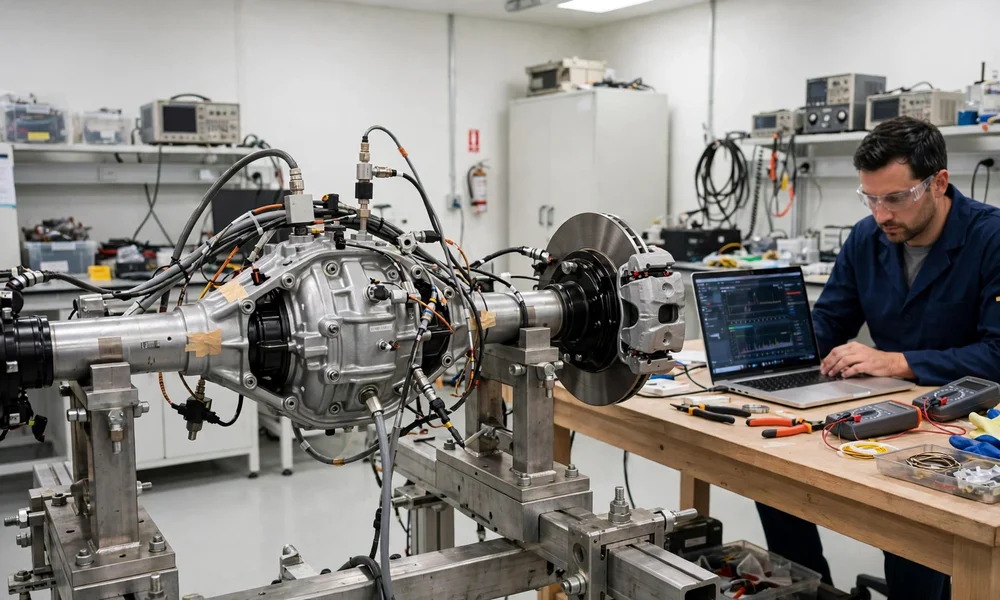
Finally the motor, gears and electronics are assembled into the housing, the bearings pressed in, the unit sealed against water and dust and filled with low-viscosity oil. Then comes the test rig: the e-axle is spun to full speed, loaded to full torque, and run through heat and cold cycles while sensors listen for vibration, check for leaks and measure efficiency. Only an axle that passes every test — silent, sealed, efficient — is cleared to meet a car, where it will spend its life buried under the floor, turning electricity into motion for hundreds of thousands of kilometres.
EV Electric Axle at a Glance
| Specification | Detail |
|---|---|
| Main materials | Neodymium magnets, silicon steel, copper, alloy steel gears, aluminium housing |
| Power electronics | Silicon carbide (SiC) inverter chips |
| Typical motor speed | Up to ~20,000 rpm |
| Typical power | 150–300 kW per axle |
| Gearbox | Single-stage reduction, case-hardened steel gears |
| Cooling | Liquid coolant loop shared with motor and inverter |
| Sealing | Water and dust sealed for the life of the vehicle |
What Does It Cost?
An e-axle is one of the most expensive single components in an electric car. A complete unit for a mainstream EV costs the manufacturer on the order of several thousand dollars (estimate), with the permanent magnets and silicon carbide electronics accounting for a large share — both have volatile prices tied to rare-earth and semiconductor supply chains. Premium e-axles cost considerably more. The cost is falling as volumes rise, but for now the e-axle is where an EV’s materials bill is most concentrated: a kilogram of magnets and a handful of chips doing the work that once took an engine, a gearbox and a driveshaft.
A Rare Fact
The magnets in a single EV motor contain only a kilogram or two of rare-earth metals, yet carmakers sign decade-long supply contracts for them and fund recycling plants to recover magnets from old motors. The strongest magnets are so powerful that factory workers handle them with brass tools — steel tools would be yanked from their hands. The most advanced part of the electric car age is held together by magnets you could lose in a coat pocket.