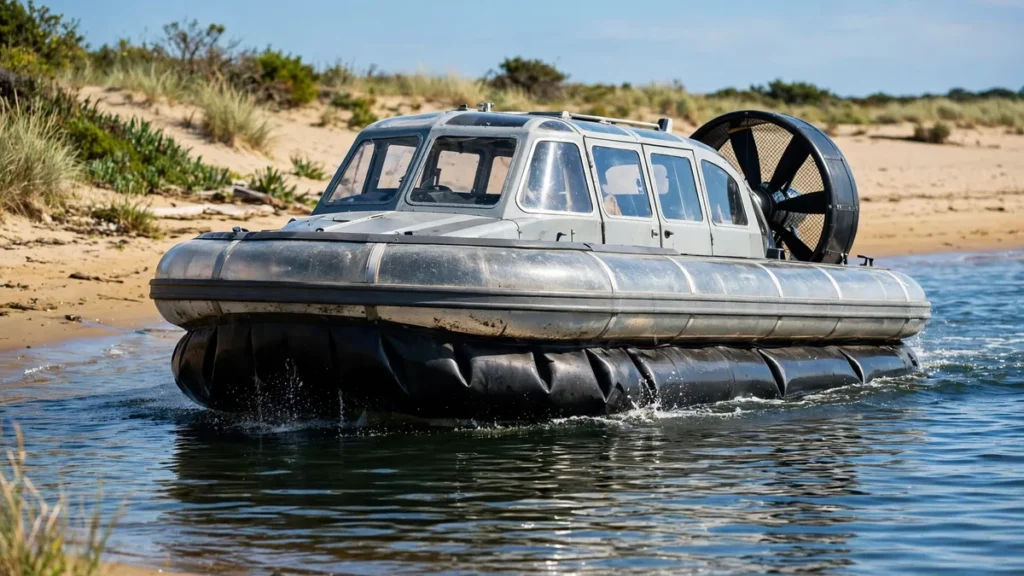
Stand on the car deck of a ferry as it leaves port, and you can feel the whole ship working. The engines thrum through the steel under your feet, the bow lifts over the first wave, and the hull — a box of steel the size of a city block — flexes almost imperceptibly as it takes the sea.
Ferries are the workhorses of the sea, and their hulls are built for a life no other ship endures: constant loading, constant speed, shallow water, tight turns into harbour walls, and a schedule that leaves no time for pampering. The materials behind a ferry hull are chosen for toughness, repairability and weight, in that order, and the result is a structure that is far more clever than its boxy shape suggests.

The Materials Behind the Ferry Hull
The hull of a modern ferry is built mostly from marine-grade steel, with aluminium used for the superstructure and for the hulls of fast ferries, and composites appearing in smaller craft. The steel is welded into a double-skinned box, coated inside and out, and protected by anodes that sacrifice themselves to save it. Around the steel sit the propellers, the rudders, the bow thruster tunnels and the vehicle decks, each with its own material demands. It is a practical machine, and its materials are practical too.
Step 1: Choosing the steel for a working hull
A ferry hull is built from high-strength marine steel, usually grades such as AH36, which is roughly a third stronger than ordinary mild steel. That strength lets designers use thinner plates and save weight, which matters on a ship that must accelerate and stop all day. The bottom plating is the thickest, because it takes the grounding risk and the slamming of waves, while the side shell is thinner and the decks lighter still. The container ship hull uses the same grades and the same logic, because both ships are steel boxes that earn their living by carrying weight across rough water.
Step 2: Cutting, rolling and assembling the hull
The hull begins as flat steel plate, cut to shape by plasma or laser and rolled into curves by enormous machines. The plates are fitted onto the frames and bulkheads that form the ship’s skeleton, then welded into a continuous shell. A ferry hull is unusually boxy, with flat sides and a flat bottom that let it carry the maximum number of cars, and the flat panels are stiffened with frames spaced closely together so they do not drum and flex under the engines.
Step 3: Welding the shell and inspecting every joint
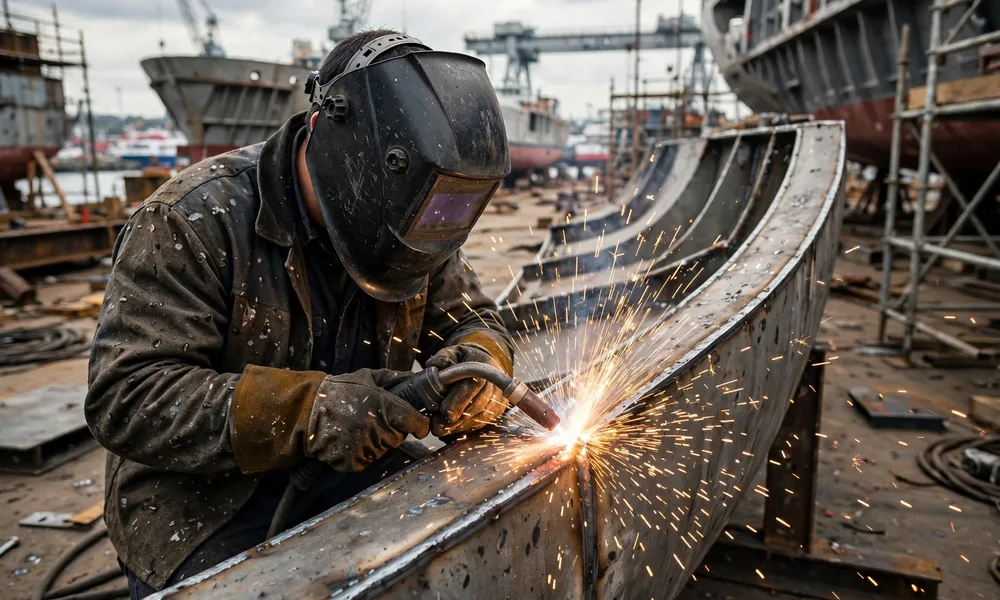
The welds matter more than the plates, because a hull fails at its joints before its steel ever yields. Ferry yards weld kilometres of joints, using processes that shield the molten metal from the air, and every critical weld is inspected — visually, then with ultrasound or dye penetrant — to find cracks or voids invisible to the eye. The steel welding on a ferry is a production-line discipline, repeated identically on ship after ship, and the yards keep records of every weld so that a problem found years later can be traced back to the day it was made.
Step 4: Aluminium superstructures and fast ferry hulls
Above the main deck, most ferries switch to aluminium for the superstructure, because weight high up hurts stability. Aluminium is welded to the steel hull through a bimetallic transition joint, a strip of explosively bonded steel and aluminium, because the two metals cannot be welded directly. Fast ferries go further and build the whole hull from aluminium: the lighter hull lets them reach speeds a steel ferry cannot, and the fuel saved over thirty years pays for the more expensive metal many times over.
Step 5: Propellers, rudders and the parts that move
The parts of a ferry that move through the water are made from different metals again. Propellers are usually cast from nickel-aluminium bronze, an alloy that resists corrosion and cavitation, the tiny collapsing bubbles that eat away at a spinning blade. Rudders are steel, skinned and faired smooth, and the shafts that drive them run through seals that keep the sea out of the engine room. The ship propeller on a ferry takes a harder life than most, because ferries manoeuvre in harbours all day, reversing and turning in shallow water where sand and debris are stirred up into the blades.
Step 6: Coatings, antifouling and cathodic protection
Bare steel in salt water can lose a millimetre a year to corrosion, so a ferry hull is never left bare. The underwater plating gets epoxy primers and antifouling paint several hundred microns thick, built up coat after coat, while the topsides get a hard gloss finish in the operator’s colours. The antifouling stops barnacles and weed from growing on the hull, which would slow the ship and burn more fuel. Sacrificial anodes of zinc or aluminium, bolted to the hull below the waterline, corrode in place of the steel, and they are replaced at every dry docking, a humble ritual that saves the ship.
Step 7: The vehicle decks and the daily punishment
The last material story is the one passengers never think about: the vehicle decks. Cars, lorries and their loads drive on and off all day, and the deck steel is coated with a tough, non-slip epoxy that resists oil, salt and the scraping of tyres and chains. The decks are designed to drain, so rain and sea spray run overboard instead of pooling, and the ramps and hinges that load the cars are built from heavy steel and serviced constantly.

Ferry Hull at a Glance
| Specification | Detail |
|---|---|
| Main hull steel | Marine-grade high-strength steel, typically AH36 |
| Superstructure | Aluminium, joined via bimetallic transition strips |
| Fast ferries | All-aluminium hulls for higher speed and lower weight |
| Propellers | Nickel-aluminium bronze, resistant to cavitation |
| Underwater coating | Epoxy primers plus antifouling, several hundred microns |
| Corrosion protection | Sacrificial zinc or aluminium anodes, replaced at docking |
| Hull lifespan | Typically 25–35 years of daily service |
What Does It Cost?
A ferry hull is a large share of the price of the whole ship. Marine-grade steel plate runs to several thousand dollars per tonne (estimate) before cutting, rolling and welding, and a large ferry carries thousands of tonnes of it. The aluminium superstructure costs more per tonne than the steel, and the propeller castings, coatings and anodes add more still. All told, the hull structure of a large car ferry can represent tens of millions of dollars (estimate) of the finished price. It is money spent on material that passengers never see, yet it decides whether the ferry sails for thirty years or ten.
A Rare Fact
Ferries have a hidden enemy that has nothing to do with the sea: the vehicles they carry. Road salt, dripping from cars in winter, is far more corrosive than seawater, and it pools on the vehicle decks and seeps into the steel below. Yards have opened up ferries a few years after delivery to find the deck steel corroding from the inside, not because the sea got in, but because the cars brought the salt with them.