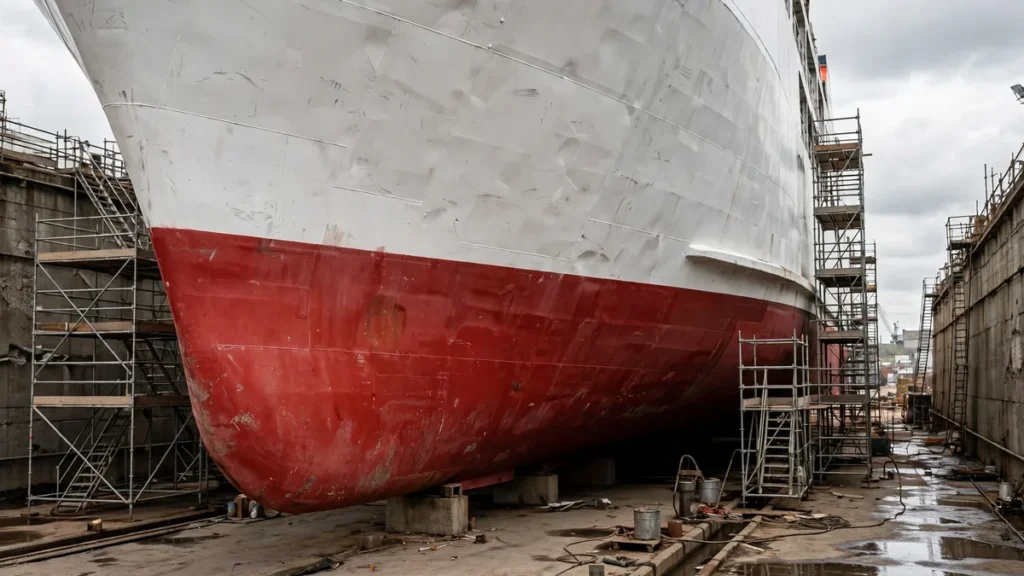
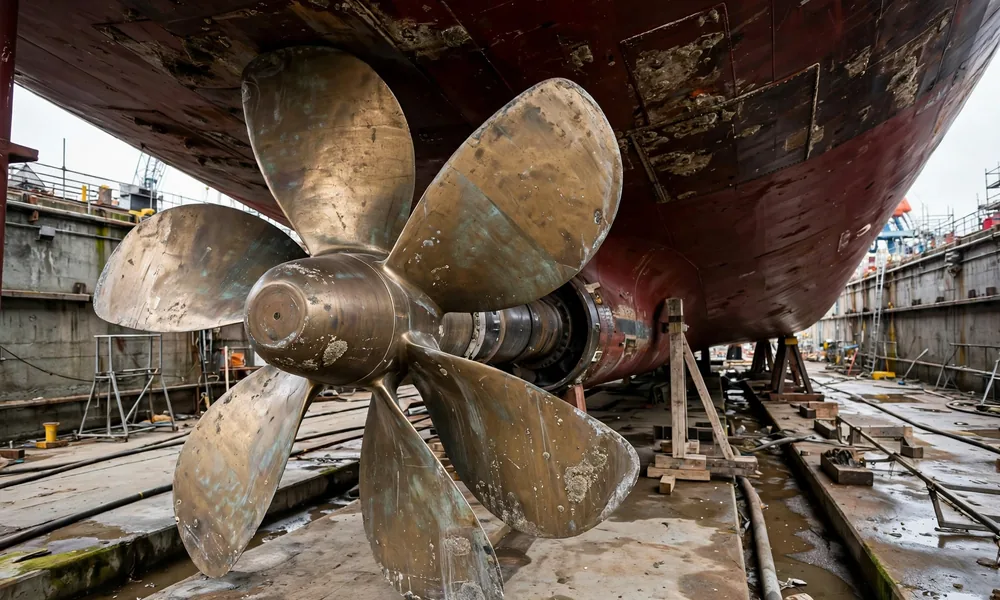
Stand on the dock beside a container ship in dry dock and look underneath. The propeller is bigger than you expect, much bigger. A single bronze blade is taller than a person, the whole wheel is wider than a house, and it weighs as much as a dozen cars. It is hard to believe that this one spinning wheel pushes a ship the length of three football fields through the sea, fully loaded, at twenty knots, day after day.
Yet the propeller is also the most efficient machine on the ship. A modern propeller turns more than two-thirds of the engine’s power into forward push, and it does it with no gears touching the water, no exhaust, and nothing but shaped metal moving through the sea. Its shape looks simple, a few twisted blades on a hub, but every curve is calculated, and a small change in the twist can save a shipping line millions of dollars in fuel. Here is how a ship propeller works, from the engine room to the wake.

How a Ship Propeller Works
Step 1: The engine turns the shaft
Everything starts in the engine room. A ship’s main engine, a diesel the size of a small house on the biggest vessels, turns a long steel shaft that runs the length of the ship, through the hull, and out the stern to the propeller. The shaft is supported by bearings and passes through a seal, the stern tube, which keeps the sea out while the shaft spins. The shaft turns slowly by engine standards, often just 60 to 120 revolutions per minute on a big ship, because a propeller works best when it turns slowly and bites a large volume of water.
Step 2: The blades bite the water
The propeller itself is a hub with three to seven blades, each one twisted like a fan blade. As the hub turns, each blade slices through the water at an angle, and the water is thrown backwards. The reaction pushes the blade, and the ship, forwards. It is the same principle as a screw turning through wood, which is why sailors still call the propeller a screw.
The blades are shaped by computer and finished by hand, and the difference between a good propeller and a great one is measured in millimetres of curve. The making of these blades is a story in itself, covered in how a ship propeller is made, which follows the casting, machining, and polishing of a bronze wheel.
Step 3: Thrust is born from pressure difference
As a blade moves through the water, pressure builds on its back face and drops on its front face. The difference between the two is thrust, the push that moves the ship. The faster the blade turns, the bigger the difference, but there is a limit. If the pressure on the front face falls too low, the water boils at ordinary temperature, forming bubbles that collapse violently against the blade. This is cavitation, and it eats metal, makes noise, and wastes power.
On a warship, where silence matters, avoiding cavitation is critical, because the collapsing bubbles are loud enough for a submarine to hear from miles away. The same physics in a quieter setting appears in how a submarine propeller works, which explains the skew and the pump-jet designs that keep a submarine silent.
Step 4: The rudder steers the slipstream
Behind the propeller sits the rudder, a flat steel plate that steers the ship by deflecting the fast-moving water the propeller throws backwards. When the rudder turns, the slipstream pushes sideways on it, and the stern swings. Because the propeller’s wash is much faster than the water flowing past the hull, the rudder works even when the ship is barely moving, which is why a ship can turn in a harbour with only a little way on.
Step 5: Controllable pitch changes the bite
Not every propeller is fixed. Many ships use a controllable pitch propeller, where each blade can rotate in its hub to change its angle while the ship is under way. The captain can go from full ahead to full astern without stopping or reversing the engine, just by turning the blades through flat pitch and past it. It is the marine equivalent of changing gear.
The factory side of these wheels is shown in inside ship propeller production, which tours the foundry and machine shop where a propeller is born.
Step 6: The hull and propeller work as a pair
A propeller does not work in open water. It sits in the wake of the hull, where the water is already moving forward with the ship, and the stern is shaped to feed it smooth, even flow. If the water arrives unevenly, one blade loads up while another goes slack, and the propeller vibrates, cavitates, and wears its bearings. Naval architects shape the stern and fit fins and ducts to smooth the flow before it reaches the blades.

Step 7: Maintenance keeps the edge
A propeller lives in the harshest place on the ship, in salt water, spinning at full power, and it needs regular care. Every dry docking, the blades are inspected for cavitation damage, cracks, and bent edges, and divers check them between dockings. Small damage is ground out and polished smooth, because a rough blade wastes fuel and a cracked one can break. Even a thin layer of barnacles and weed on a blade can cost a ship a knot of speed.
Ship Propeller Specifications
| Feature | Typical figure |
|---|---|
| Diameter | 3–10 metres on large ships |
| Blades | 3–7, most commonly 4 or 5 |
| Material | Nickel-aluminium bronze |
| Weight | 10–100 tonnes, depending on size |
| Speed | 60–120 rpm on large ships |
| Efficiency | About 60–70% of engine power to thrust |
| Pitch type | Fixed pitch or controllable pitch |
| Service interval | Inspection every dry docking, about 5 years |
What a Ship Propeller Costs
A ship propeller is a major purchase, priced by weight, size, and complexity. As an estimate, a propeller for a mid-size cargo ship costs roughly $200,000 to $500,000, while a ten-metre propeller for a very large container ship can cost $1 million or more, before the shaft, bearings, and seals.
A Rare Fact
The largest ship propellers ever built are over 11 metres across, wider than a three-storey house, and a single blade weighs more than an elephant. They are cast in one piece in a mould the size of a swimming pool, and they are so heavy that the foundry moves them on rails and polishes them with a robot arm, because no person could lift or reach across a blade that big.
The ship propeller is a reminder that the best engineering is often the simplest. A twisted wheel of bronze, spinning slowly in the sea, pushes the largest moving objects ever built by humankind. Nearly two centuries after it replaced the paddle wheel, nothing has beaten it.