A container ship leaving port carries twenty thousand steel boxes, stacked ten high on deck, and below them all is a single steel shell that has to hold the weight, keep the sea out, and survive thirty years of storms. The hull is one of the largest welded structures ever built, longer than three football pitches and assembled from thousands of steel plates, and it starts life not in the water but in a yard full of cranes, cutting machines, and welders.
Building it is a job of cutting, bending, welding, and painting on an enormous scale, and every step has to be right, because a hull cannot be taken back to the workshop once it is afloat. This is how a container ship hull is made, plate by plate.

How a Container Ship Hull Is Made
Step 1: The steel is ordered, cut, and marked
Everything starts with steel, and a lot of it. A large container ship hull uses tens of thousands of tonnes of high-strength shipbuilding steel, delivered to the yard as flat plates and rolled sections. Each plate is checked, blasted clean of mill scale, and primed, then cut to shape by computer-guided plasma or laser cutters that follow the hull’s digital design. The cut pieces are marked with their position in the ship, because a plate made for the bow curve will not fit anywhere else, and in a yard building several ships at once, keeping thousands of pieces in the right order is half the job.
Step 2: Curved plates are bent and formed
Most of a hull is not flat. The bow sweeps up and in, the stern rounds away, and the bilge curves under the ship, so flat plates have to be bent to shape. Heavy plates go through a press that pushes them slowly into a curve, while thinner ones are rolled between giant rollers or shaped by line heating, where a flame is run along the plate and the steel shrinks as it cools, pulling itself into a bend. Each curved panel is checked against a template, and a panel that is out by a few millimetres is reheated and bent again, because gaps between panels mean weak welds later.

Step 3: Panels are welded into blocks
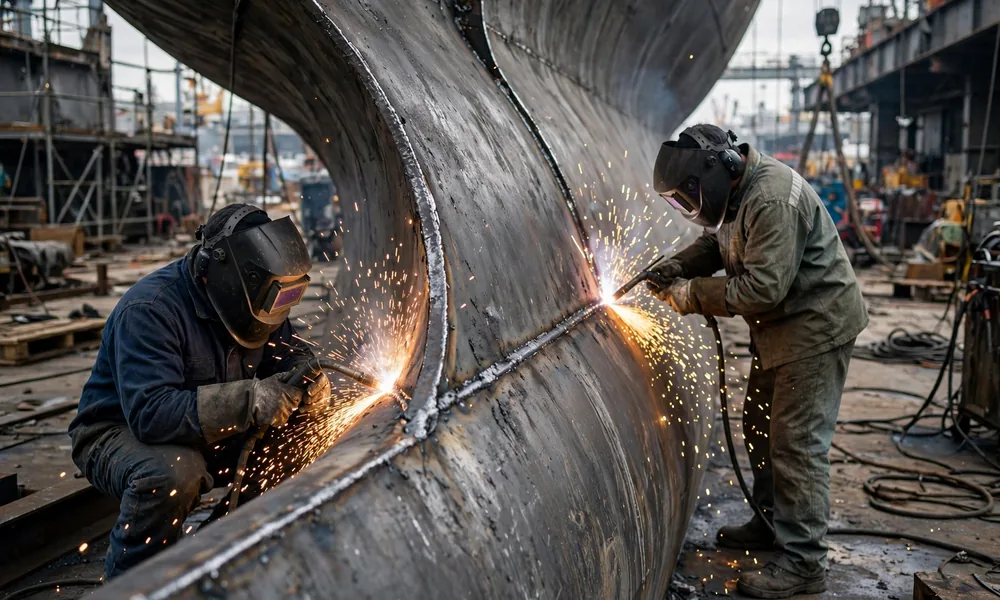
Curved and flat panels are welded together into blocks, sections of hull weighing hundreds of tonnes each. Welders work with the block turned so the seam is always flat and easy to reach, laying down welds that are then checked with ultrasound and X-rays, because a flaw hidden inside a weld can grow into a crack at sea. The materials and grades of steel behind these welds are covered in container ship hull materials engineering, and the blocks are built upside down and right way up in turn, so that outfitting — pipes, cables, and brackets — can be fitted while the steel is still easy to reach.
Step 4: Blocks are lifted into place in the dry dock
When the blocks are ready, giant gantry cranes lift them into the dry dock one at a time, and the hull grows block by block from the keel upwards. The keel is laid first, a heavy spine of steel along the centreline, and each block is lowered onto it, aligned to within millimetres, and welded to its neighbours. Scaffolding climbs around the growing hull, and inside, workers fit the double bottom, the ballast tanks, and the engine seating while the steel is still open to the sky. At this stage the ship already looks like a ship, even though it has no engine, no propeller, and no paint.
Step 5: The hull is welded, tested, and coated
Once the last block is in place, the seams between blocks are welded, and the whole hull is tested. Tanks are filled with water to check for leaks, welds are inspected again, and the hull is blasted clean before painting. The coating is a system in itself: a primer to grip the steel, several coats of epoxy to keep the seawater out, and an antifouling topcoat that stops barnacles and weed from growing on the hull and slowing the ship down. A hull that fouls badly can burn noticeably more fuel, so the paint is not decoration, it is part of the ship’s economy. How the finished hull behaves at sea is explained in how a container ship hull works.
Step 6: The hull is launched and finished afloat
With the hull complete, the dry dock is flooded and the ship floats for the first time, a moment the yard plans for months. Tugs move it to a fitting-out quay, where the engine, propeller, rudder, and container guides are installed, and the accommodation block is lifted on. The hull is tested again at sea, its speed and handling measured on trials, before it is handed over to its owners. The same block-building method is used for the toughest hulls of all, including how an icebreaker hull is made, where the steel is thicker and the bow is shaped to ride up onto the ice and break it with the ship’s weight.
Container Ship Hull Specifications
| Specification | Typical figure |
|---|---|
| Length | Up to about 400 metres |
| Steel used | Tens of thousands of tonnes |
| Plate thickness | Roughly 10 to 40 millimetres |
| Hull form | Single skin with double bottom |
| Coating | Epoxy primer plus antifouling topcoat |
| Build time | Roughly 12 to 18 months in the yard |
How Much Does a Container Ship Hull Cost?
A hull is never sold on its own, so there is no list price, but a large container ship costs roughly $150 million to $200 million to build (estimate), and the hull steelwork and coating account for a large share of that. The price moves with the cost of steel, the size of the ship, and the yard’s order book, and a bigger ship is cheaper per container carried, which is why container ships keep growing. Against that, the hull has to last thirty years of salt water and storms, so the yard’s real product is not just steel, it is thirty years of keeping the sea out.
A Rare Fact About the Container Ship Hull
Here is something few people realise: a container ship hull is designed to flex. A 400-metre ship bends and twists in heavy seas, and the hull can hog and sag by more than a metre between wave crests, so the steel has to be tough enough to bend without cracking, thousands of times over its life. That is why ship steel is tested for toughness at low temperatures, and why a hull is never built as stiff as possible. A ship that could not flex would break, and the most impressive thing about a container ship hull is not that it is strong, it is that it is strong and flexible at the same time.
So the next time you watch a container ship slide out of port, remember what is underneath the boxes: thousands of steel plates cut by computer, bent by presses and flame, welded into blocks, lifted into a dry dock, tested, painted, and floated for the first time, all to make a shell that can carry a small town’s worth of cargo across an ocean and flex with the waves while it does it.


