The ferry pulls away from the pier at seven in the morning, and by the time it reaches the far shore it will have carried four hundred passengers, eighty cars, and a dozen lorries across twenty miles of open water. Nobody on board thinks about the specification sheet. They think about the coffee, the view, and whether they will make their connection, and that is exactly how it should be.
But the sheet is what makes the crossing possible. It lists the length, the beam, the draft, the engine power, the speed, the passenger capacity, and the number of vehicle lanes, and every one of those numbers is a promise the ferry has to keep, four times a day, in weather that ranges from glassy calm to a full gale. A ferry is not a yacht and it is not a cruise ship. It is a working machine, and its specifications are written for work.
Reading the sheet tells you why one ferry crosses in forty minutes and another takes an hour, why some ferries carry lorries and others carry only foot passengers, and why the ferry that looks biggest is not always the one that carries the most. The numbers are practical, and so is the story they tell.

Ferry Specs Explained
1. Length, beam and draft
The first numbers are the dimensions. A typical coastal ferry is between 60 and 150 metres long, with a beam of 15 to 25 metres, and the beam is what gives the ferry its wide, flat vehicle deck. The draft is usually between 3 and 6 metres, shallow enough to enter small harbours, and that shallow draft is a deliberate choice: a ferry that cannot get into the harbour cannot do its job at all. The length sets the number of vehicle lanes, and a 100-metre ferry can carry roughly twice as many cars as a 60-metre one.
2. Gross tonnage and deadweight
Gross tonnage is not a weight at all but a measure of the ferry’s internal volume, usually between 5,000 and 30,000 for a coastal ferry, and it is the number that decides the size of the crew, the safety equipment, and the port fees. Deadweight is the weight the ferry can carry, passengers, cars, lorries, fuel and stores together, and it is usually between 1,000 and 5,000 tonnes. A ferry’s deadweight is what the operator watches most closely on a busy sailing, because a full load of lorries weighs far more than a full load of cars.
3. Passenger and vehicle capacity
Capacity is the number every passenger feels. A large coastal ferry carries between 500 and 2,000 passengers and between 100 and 400 cars, and the balance between the two is a design decision. A ferry on a commuter route carries more foot passengers and fewer cars, while a ferry on a holiday route needs more vehicle lanes. The hull that carries all of this weight is built to take constant punishment at the waterline, and the ferry hull specifications explain how it is shaped and strengthened.
4. Engine power and propulsion
A ferry’s engines are sized for one thing above all: keeping to the timetable. A coastal ferry usually has between 5,000 and 20,000 kilowatts of installed power, driving two or four propellers, and that power has to push a wide, flat hull through the water at 15 to 22 knots. Many modern ferries use diesel-electric propulsion, where diesel generators make electricity and electric motors turn the propellers, because it lets the ferry run on fewer engines at quiet times and all of them at peak times. Battery-electric ferries are now crossing short routes with no diesel at all, and the best electric ferries ranked shows which designs are leading the change.
5. Speed and crossing time
Service speed is the speed the ferry actually sails at, usually 15 to 22 knots for a conventional ferry, and it is lower than the top speed because running flat out burns far more fuel for very little time saved. The crossing time is the number passengers care about, and it is set by the speed, the distance, and the time spent loading and unloading. A ferry that loads in fifteen minutes and crosses in forty is a better machine than one that loads in forty minutes and crosses in thirty, which is why the ramps, the doors and the vehicle deck layout matter as much as the engines.
6. Loading, ramps and turnaround
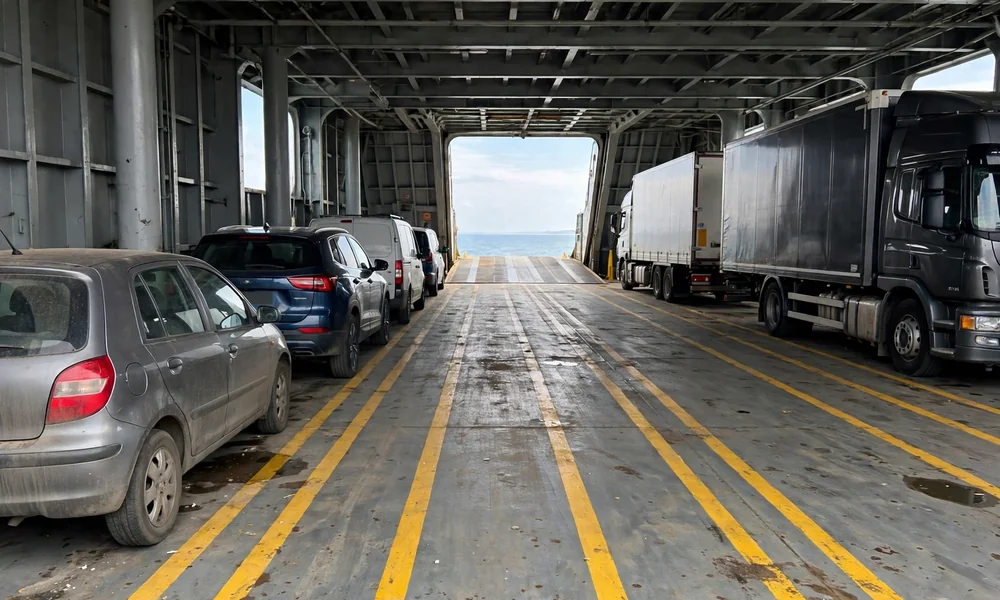
The turnaround is the time between one sailing and the next, often as little as twenty minutes, and the specification sheet lists the ramps, the bow and stern doors, and the number of vehicle decks that make it possible. A double-ended ferry, with a bridge at each end, never has to turn around at all, and that saves ten minutes on every crossing. The ramps have to take the weight of a fully loaded lorry, the doors have to seal against the sea in a storm, and the whole system has to work in the dark, in the rain, and with a queue of tired drivers waiting.
7. Safety, stability and crew
The last numbers on the sheet are the safety ones. A ferry carries lifeboats and liferafts for every person on board plus a margin, and its stability is calculated for the worst case: a full load of lorries on one side and a storm on the other. The crew is usually between 20 and 60 people, and the bridge, the engine room and the vehicle deck are all manned during every crossing.
Ferry Specs
| Specification | Typical range |
|---|---|
| Length overall | About 60 to 150 metres |
| Beam | About 15 to 25 metres |
| Draft | About 3 to 6 metres |
| Gross tonnage | About 5,000 to 30,000 |
| Deadweight | About 1,000 to 5,000 tonnes |
| Passengers | About 500 to 2,000 |
| Cars | About 100 to 400 |
| Lane metres | About 1,000 to 2,000 |
| Installed power | About 5,000 to 20,000 kilowatts |
| Service speed | About 15 to 22 knots |
| Crew | About 20 to 60 people |
What Does a Ferry Cost?
A new coastal ferry is estimated to cost roughly $30 million to $150 million, depending on size, speed and propulsion, with a small commuter ferry estimated near the lower end and a large dual-fuel vessel estimated at the top end or beyond. Running a ferry is estimated to cost millions of dollars a year in fuel, crew and maintenance, and the fuel bill alone can decide whether a route survives. The difference between a plain working ferry and a luxurious one is larger than most passengers guess, and why a luxury ferry is so expensive explains where that extra money goes.
A Rare Fact
Here is a detail that surprises most people who first read a ferry specification sheet: gross tonnage is not a weight. It is a measure of volume, and it is calculated from the size of the enclosed spaces inside the ship, which is why two ferries of the same weight can have very different gross tonnage figures.

A ferry is not glamorous, and its specification sheet is not exciting, but the sheet is a promise, and every crossing is the ferry keeping it.


