The electric ferry has gone from a Norwegian experiment to the fastest-growing corner of shipping in barely a decade. The first battery ferry, Ampere, crossed a fjord on a battery smaller than the one in a long-range electric car. Today the largest electric ferry carries more than two thousand passengers on a battery of over forty megawatt-hours, and charging arms at the dock deliver megawatts in minutes. Ferries are the perfect electric vehicle: they run short, fixed routes, they return to the same dock every time, and they sit still long enough to charge.
This ranking judges electric ferries on scale, maturity, battery size and how much they changed the industry. The ten below run from the pioneer that started it all to the giant that now leads it.
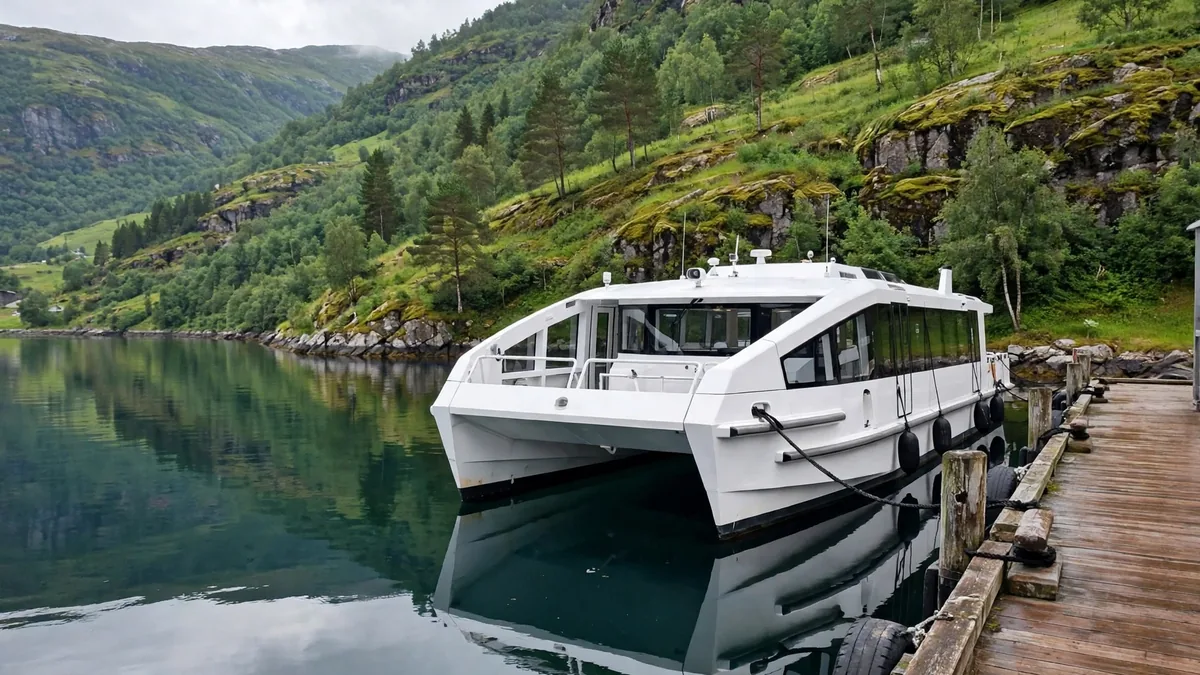
The 10 Best Electric Ferries, Ranked
1. China Zorrilla, Buquebus
China Zorrilla is the largest battery-electric ship in service, and it is not close. Built by Incat in Tasmania for Buquebus, the 130-metre aluminium catamaran carries up to 2,100 passengers and 225 vehicles across the Rio de la Plata between Buenos Aires and Colonia, on a battery of more than 41 megawatt-hours. Eight electric motors of 2.4 megawatts each drive waterjets, and the terminals charge the ship through two 8-megawatt connections between crossings. China Zorrilla matters because it proves that battery power works at real ferry scale, on a busy international route, with thousands of people aboard. Nothing else here comes near it.
2. Bastø Electric, Bastø Fosen
Bastø Electric runs the Moss to Horten crossing in Norway, one of the busiest ferry routes in the country, carrying 600 passengers and 200 cars on a 4.3 megawatt-hour battery. It entered service in 2021 and charges at up to 7.2 megawatts at the dock, topping up in the minutes between crossings. It turned the electric ferry from a demonstration into a workhorse, and every large battery ferry since owes it something.
3. Ellen, Ærø Municipality
Ellen, known formally as the E-ferry, carries 200 passengers and 30 cars on a 22-nautical-mile route between Søby and Fynshav in Denmark, on a 4.3 megawatt-hour battery. She entered service in 2019 and was built to prove that a battery ferry could handle a long route, not just a short hop across a fjord. Ellen ranks third because she extended the range of what an electric ferry could attempt, and because she did it for a small island community that depended on her working every day.
4. Tycho Brahe and Aurora, ForSea
Tycho Brahe and Aurora are a pair of converted ferries running between Helsingborg in Sweden and Helsingør in Denmark, each carrying a 4.16 megawatt-hour battery after their conversion to battery power in 2018. Converting an existing ferry, fitting batteries and charging gear into a hull that already worked, is faster and cheaper than building from scratch. The pair run constantly, and their conversion became the template for operators with older fleets and no appetite for new builds.
5. P&O Pioneer, P&O Ferries
P&O Pioneer is a hybrid, not a pure battery ferry, and she earns her place by bringing batteries to the hardest route of all: Dover to Calais, the busiest ferry crossing in Europe. She carries up to 8.8 megawatt-hours of batteries alongside four diesel engines, using the batteries to cut fuel use and emissions on a route where a full battery crossing is not yet practical. Hybrids are the bridge, and Pioneer is the biggest bridge yet built.
6. Ampere, Norled
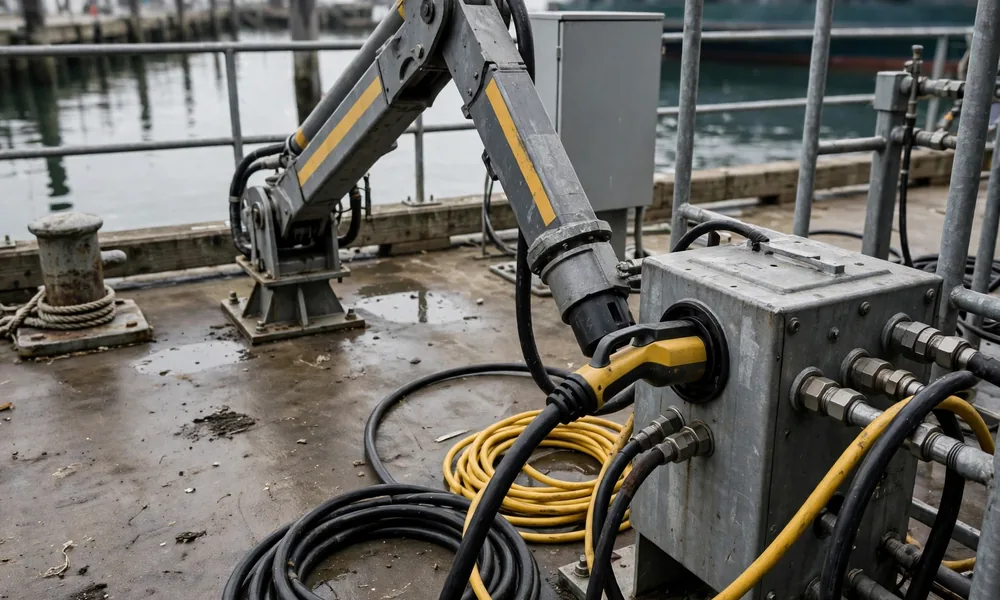
Ampere is the ferry that started everything. She entered service in February 2015 on the Lavik to Oppedal crossing of the Sognefjord in Norway, with a battery of just 1,090 kilowatt-hours, two 450-kilowatt motors, room for 360 passengers and 120 cars, and a crossing that uses only 150 to 200 kilowatt-hours. Norled reports she saves about a million litres of diesel and more than 570 tonnes of carbon dioxide a year. She proved the idea, the economics and the reliability all at once, and she is still the most important electric ferry ever built, even if she is no longer the biggest.
7. Candela P-12, Candela
The Candela P-12 is the smallest ferry on this list and the most radical. She carries 30 passengers on computer-controlled hydrofoils that lift the hull out of the water, cutting drag by around 80 percent and letting a 180-kilowatt-hour battery deliver about 50 nautical miles of range at 20 knots. In Stockholm she runs as a public ferry, and the Business version measures just 63 to 64 decibels in the cabin at cruise, quieter than a train carriage. The P-12 ranks seventh because she points at the future: small, fast, silent electric ferries that use a fraction of the energy of a conventional boat, on routes where a big ship would be wasteful.
8. Medstraum, Norled
Medstraum is a fast passenger ferry running around Stavanger in Norway, carrying 150 passengers at 23 knots on a 1.5 megawatt-hour battery with two electric motors. Speed is the hard part for electric boats, because pushing water aside at high speed takes far more power than cruising slowly, and Medstraum proves that a battery ferry can be a fast ferry, not just a slow one. For city water transport, she is the model that other harbours are now copying.
9. Ika Rere, East by West Ferries
Ika Rere runs across Wellington Harbour in New Zealand, carrying 132 passengers at 20 knots on a battery of just 525 kilowatt-hours, recharged in short bursts at the dock between her eight return trips a day. She charges at up to a megawatt while passengers board, and her operators plan to raise that further. Ika Rere ranks ninth because she proves the economics work at small scale too, in a harbour on the far side of the world from Norway, with no fjords and no subsidies to hide behind.
10. Aditya, Kerala State Water Transport
Aditya is a solar-powered electric ferry running in Kerala, India, carrying 75 passengers on two 20-kilowatt motors with a 20-kilowatt solar array on the roof and no fossil fuel aboard at all. She cruises at about 7.5 knots and runs for six hours on her batteries, recharged by the sun she sails under. Aditya shows that electric ferries are not just a rich-country technology. They are a cheap, clean way to move people on water anywhere the sun shines.

What the Best Electric Ferries Have in Common
The ferries at the top of this list share three things. First, the route fits the battery: short crossings, fixed timetables and a dock that can charge. The battery is only half the system, and the electric ferry battery is sized to the route, not to a brochure. Third, the operators committed fully: these are not trials, they are services, and the boats run every day whether the press is watching or not.
That commitment is also why the technology is spreading so fast. The way these ships are built is changing too, as our look at how an electric ferry is made shows, with batteries and charging designed in from the first drawing rather than bolted on later. And the same electric propulsion ideas are moving down in scale, as the ranking of electric boat propulsion systems makes clear. The ferry was the first ship to go electric at scale. It will not be the last.


