The ferry leaves the pier at dawn, and nobody on board gives the hull a second thought. Cars roll on below deck, passengers climb to the lounge with their coffee, and the ship settles into the water like a building deciding to float. But the hull under their feet is a careful compromise, built to carry a thousand tonnes of vehicles across open water in weather that would keep a smaller boat in harbour — and to do it twice a day, every day, for thirty years.
Stand on the car deck and you can feel the hull working. It flexes as the ferry crosses a wave, a slow breathing of steel that engineers design for rather than against. The flat bottom that lets the ferry load cars in a straight line is the same flat bottom that slams in a head sea, and the wide beam that keeps her stable is the same wide beam that makes her push a wall of water ahead of her bow. Every dimension of a ferry hull is an argument settled in steel.
Ferry hulls are among the most specialised hulls afloat. Unlike a cargo ship, a ferry must load and unload in minutes, turn around in a crowded harbour, and keep a strict timetable in all weathers. Her hull is shaped by those demands, and the specifications — length, beam, draught, steel thickness, and the rest — are the numbers that decide whether she makes the crossing on time or waits for the weather. The same steel-shaping discipline that builds a container ship hull is at work here, scaled to a ship that must behave like a bus. Here is what the numbers mean.
How It Works
Step 1: Shaping the hull for speed and stability
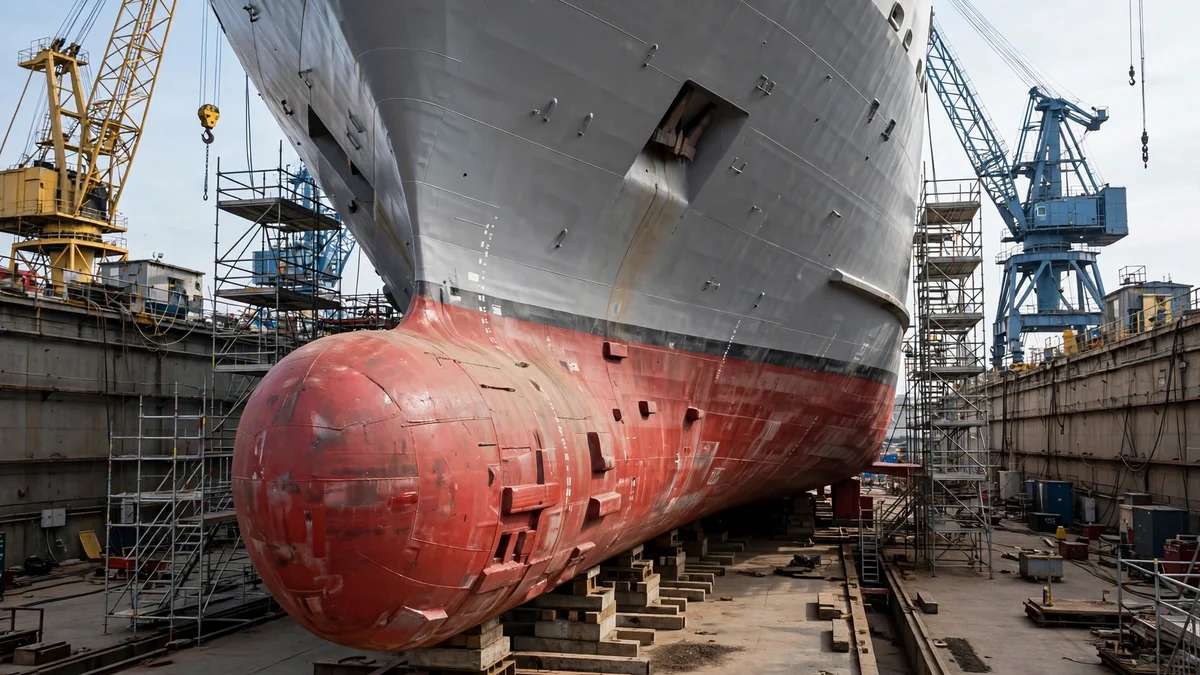
A ferry hull is wide and shallow compared with a cargo ship of the same length. The wide beam gives her stability — she resists rolling when cars shift or passengers crowd to one side — and the shallow draught lets her use small harbours. The penalty is resistance: a wide, shallow hull pushes more water aside, so ferries need more power for their size than a slim cargo ship. The bow is usually a rounded, flared shape with a bulbous bulb below the waterline, a torpedo-like swelling that cancels out the bow wave and saves fuel.
Step 2: Plating the steel shell
The hull is built from steel plates welded together over a skeleton of frames and bulkheads. Plate thickness varies with position: thickest at the bottom, where grounding and cargo loads bear down, and around the bow, where waves slam hardest. A typical ferry uses plates from about 8 to 25 millimetres thick. Each plate is cut by computer-controlled machines, curved in presses, and welded in place — and every weld is inspected, because a hull is only as strong as its weakest joint. The same thick-plate thinking shapes icebreaker hulls, built to push through sea ice.
Step 3: Framing and bulkheads inside
Inside the steel shell, transverse frames run around the hull like ribs, and longitudinal stiffeners run fore and aft. Watertight bulkheads divide the hull into compartments, so that flooding in one section cannot sink the ship. On a ferry, the car deck is a vast open space with almost no bulkheads — it has to be, for the cars — which makes the hull girder itself do the structural work. That is why ferry hulls are so heavily stiffened above the waterline, where other ships would be comparatively light — a lesson shared with superyacht steel hulls, which face the same open-span problem.
Step 4: The bow and stern doors
Most modern ferries load through the bow or the stern, or both. A bow visor lifts like a helmet to reveal a ramp, and a stern door drops down as a loading bridge. These doors are part of the hull structure when closed, and they must seal watertight against the sea. Their locking mechanisms are among the most inspected items on any ferry: a door that opens at sea is a catastrophe, and the industry learned that lesson the hard way in the 1980s.
Step 5: Coatings and cathodic protection
Steel in seawater rusts fast, so a ferry hull is protected by layers of paint and by sacrificial anodes — blocks of zinc or aluminium bolted to the hull that corrode in place of the steel. The paint system alone can be several millimetres thick, and a ferry is repainted in dry dock every few years. Between dockings, divers inspect the hull underwater, and the anodes are replaced when they are eaten away.
Step 6: Sea trials and the life of the hull
When a ferry is finished, she goes to sea trials, where her speed, turning, stopping, and stability are measured against the contract. Only then does she enter service, where the hull is surveyed every year and dry-docked every two to five years. A well-built ferry hull lasts thirty years or more, carrying millions of passengers — and at the end of her life, the same steel that carried them is cut up and recycled, often into the hull of her replacement.

Ferry Hull Specs
| Specification | Typical range |
|---|---|
| Length overall | About 100 to 220 metres for a large passenger ferry |
| Beam (width) | About 20 to 32 metres |
| Draught | About 5 to 7 metres |
| Displacement | About 10,000 to 50,000 tonnes |
| Hull steel thickness | About 8 to 25 mm, thickest at the bottom and bow |
| Hull material | High-tensile marine steel; aluminium on fast ferries |
| Design speed | About 18 to 25 knots; fast ferries 35 to 45 knots |
| Vehicle capacity | About 100 to 300 cars, or 1,000+ lane-metres |
| Passenger capacity | About 500 to 2,500 passengers |
| Service life | About 25 to 35 years |
What Does a Ferry Hull Cost?
A new large passenger ferry is estimated to cost roughly $50 million to $200 million to build, with the hull structure accounting for a large share of the steelwork and labour — roughly a third of the total. A hull refit or major steel renewal in dry dock is estimated to cost $2 million to $10 million, depending on how much plate must be replaced. Prices are estimates only and vary widely by size, yard, and specification.
A Rare Fact
Some ferries are double-ended — they have a bow at both ends, with a bridge and propellers at each end, so they never need to turn around. They simply sail one way, dock, and sail back the other way. Double-ended ferries are common on short river and harbour crossings, and they save minutes on every trip — minutes that add up to thousands of hours over a ship’s life. The idea is old: the first double-ended steam ferries crossed the Mersey and the Hudson in the nineteenth century, and the shape has barely changed since.

Next time you drive onto a ferry and park below deck, look at the steel around you. It is not just a floating car park — it is a hull shaped by a century of timetables, tides, and hard lessons, and it is doing far more work than it ever shows.


