You open your phone, and the screen unfolds like a page. What was a pocket-sized rectangle becomes a small tablet, and the video you were watching grows to twice its size. Then you fold it shut, slip it into your pocket, and do it again tomorrow — and the day after, hundreds of times a year.
The part that makes that possible is the foldable display, a screen that bends. Every other screen in your life is rigid: glass on a flat back, never asked to move. A foldable display must bend thousands of times, stay bright and sharp, and survive dust, drops, and a thumb pressed into the crease. The spec sheet is where those demands are measured.
This guide explains the numbers on a foldable display spec sheet: what the fold rating guarantees, why the crease is still there, how brightness and refresh rate work on a screen that bends, and which figures decide whether a folding phone lasts two years or five.

The Numbers That Matter on a Foldable Display
1. Fold rating: how many bends it survives
Fold rating is the open-and-close cycles the display is tested to survive, typically 200,000 to 500,000 folds on a modern foldable phone. At 100 folds a day, 200,000 folds is more than five years of use, measured by machines that fold it until the screen fails. The rating covers the panel itself, not the hinge, and it is tested at room temperature — cold weather stiffens the materials. The mechanism that does the folding is covered in the foldable phone hinge specs guide.
2. Bend radius: how tight the fold is
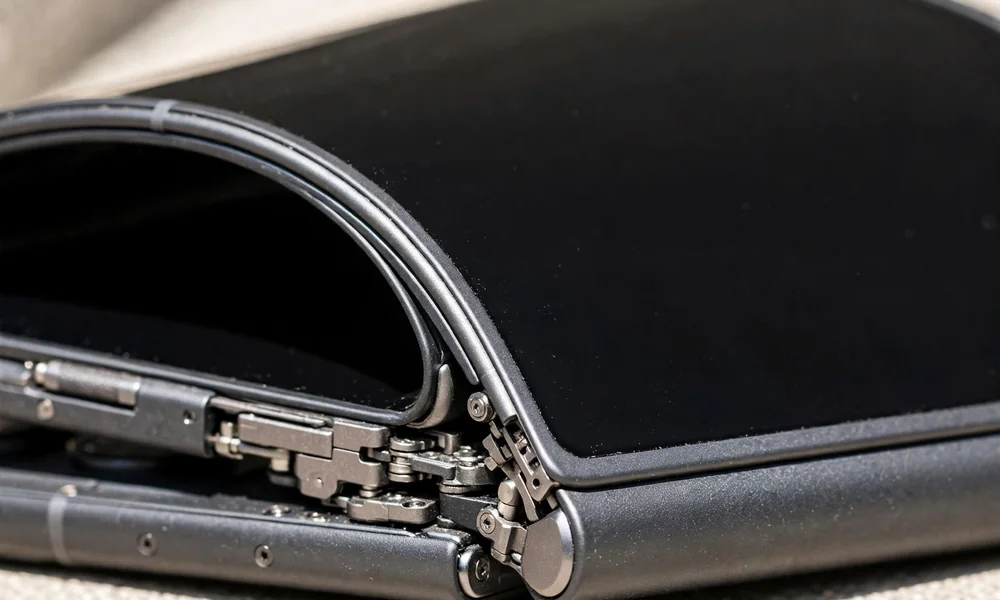
Bend radius is measured in millimetres: how tightly the display curves when the phone is closed, typically 1.5 to 3 mm on modern foldables. A smaller radius means the phone folds flatter and thinner, but the layers inside are stretched and squeezed harder with every fold, which shortens their life. The radius is decided by the hinge, and it is why folding phones are thicker than flat ones: the screen needs room to curve. A display that folded like paper would last days; one that folds around a gentle curve lasts years.
3. Display size: folded and unfolded
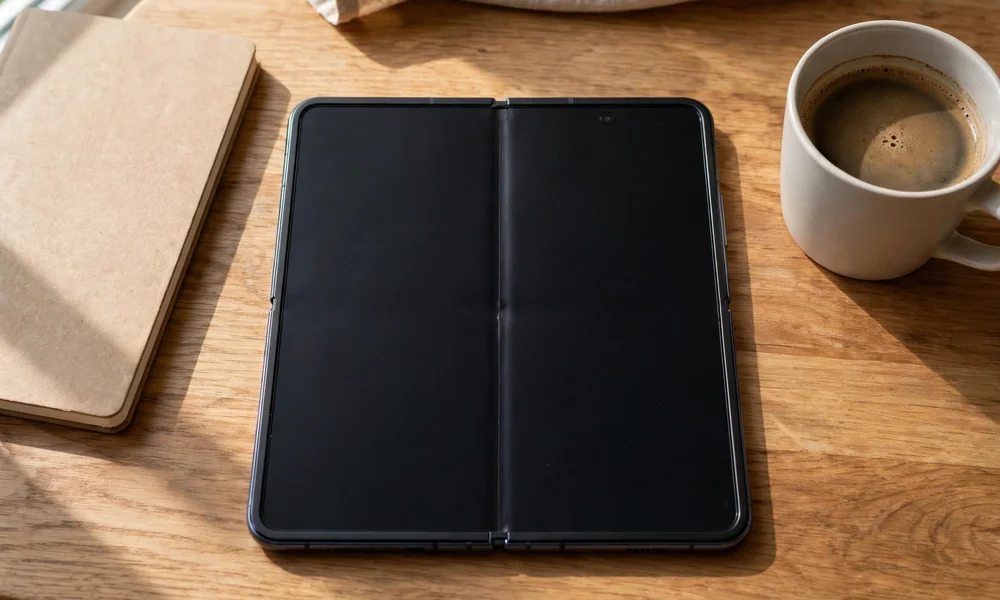
Display size is quoted twice — folded and unfolded — because the phone is two devices in one. A book-style foldable has a cover screen of around 6.2 inches and an inner screen of 7.6 inches open, while a flip-style has a small outer screen of 3 to 4 inches and an inner screen of about 6.7 inches. The unfolded size is measured diagonally, but the aspect ratio is nearly square, suiting reading and multitasking more than video. The cover screen is rigid; only the inner screen folds.
4. Brightness: readable in sunlight
Brightness is measured in nits, and a modern foldable inner display reaches 1,000 to 1,750 nits at peak, with some reaching 2,600 nits or more. The inner screen is dimmer than the cover screen, because the ultra-thin glass lets through slightly less light and the display is protected by a soft plastic layer. Peak brightness matters most outdoors, where sunlight washes out a dim screen. The colours are covered in the quantum dot display specs guide, and the rigid-screen cousin in the OLED display panel specs guide.
5. Cover material: ultra-thin glass, not glass
Cover material is what sits on top of the display, and on a foldable it is not ordinary glass but ultra-thin glass, typically 30 to 100 microns thick — thinner than a human hair — with a soft plastic protective layer on top. Ordinary phone glass is 500 microns or more and would snap the first time it was folded. Ultra-thin glass can bend because it is so thin, but it is also softer, which is why a fingernail can mark a foldable screen that would do nothing to a rigid phone. The sheet names the glass thickness and the film, and both decide how carefully the phone must be treated.
Foldable Display Specs
| Specification | Typical range |
|---|---|
| Fold rating | 200,000 to 500,000 folds |
| Bend radius | 1.5 to 3 mm |
| Inner display size | 7.6 in (book), 6.7 in (flip) |
| Cover display size | 6.2 in (book), 3 to 4 in (flip) |
| Peak brightness | 1,000 to 2,600 nits |
| Cover glass thickness | 30 to 100 microns |
| Panel type | Foldable OLED |
How a Foldable Display Is Made
A foldable display starts as an ordinary flexible OLED panel, made foldable through steps that trade hardness for flexibility.
Step 1: The OLED layers are built on plastic. Instead of glass, the light-emitting layers are deposited on a thin polyimide plastic substrate, which bends without breaking. The transistors that switch each pixel are made from a flexible semiconductor.
Step 2: The layers are sealed against air and water. Thin-film encapsulation — alternating organic and inorganic layers, each thinner than a wavelength of light — is laid over the OLED to keep out oxygen and moisture, which would kill the pixels.
Step 3: The ultra-thin glass and film are added. A sheet of glass 30 to 100 microns thick is chemically strengthened and laminated onto the panel. Thin enough to bend, it protects the pixels better than plastic alone. A soft plastic film goes on top, taking the scratches and fingerprints — and users are warned never to peel it off.
Step 4: The panel is bonded to the hinge. The finished display is glued to the hinge with a flexible adhesive that lets the layers slide microscopically as the phone folds, so nothing stretches or buckles.
Step 5: The display is folded and tested. Before shipping, each panel is folded by machine hundreds of times and checked for dead pixels, lines, and brightness changes across the crease. A flawed panel is rejected.
What Does a Foldable Display Cost?
A foldable display is estimated at roughly $150 to $400 as a replacement part, and $300 to $600 or more with the hinge assembly and labour included. Inside a new phone it is estimated at $100 to $250, several times the cost of a rigid OLED panel of the same size. The ultra-thin glass, the encapsulation, and the low yield — many panels fail testing — keep the price high. It is the phone’s most expensive part, and a cracked one is the priciest common repair in the phone world. All prices are estimates only.
A Rare Fact
The idea of a folding screen is older than the smartphone. In the 1990s, researchers at Xerox PARC built a prototype display on flexible plastic and bent it around a pencil to show it still worked, and in 2008 Polymer Vision showed a rollable e-reader that pulled out of a tube like a scroll. The first commercial foldable arrived in 2019, and its screen failed so quickly in reviewers’ hands that the launch was delayed by months — dust got under the display, and the film peeled off because people thought it was a shipping protector. The crease every foldable still has is not a flaw; it is the physical price of bending a screen at all.
The spec sheet is the honest version of the unfolding trick. Fold rating tells you how long it lasts, bend radius tells you how flat it folds, and the glass thickness tells you how carefully to treat it. A foldable display is the most ambitious screen ever put in a pocket, and its numbers decide whether the magic survives the second year.


