Picture a rocket fuel tank, a cylinder of aluminium taller than a house, holding tonnes of liquid oxygen at minus 183 degrees. It cannot leak, and the seam that runs around it was never melted. A spinning steel tool stirred the two plates together until they became one piece.
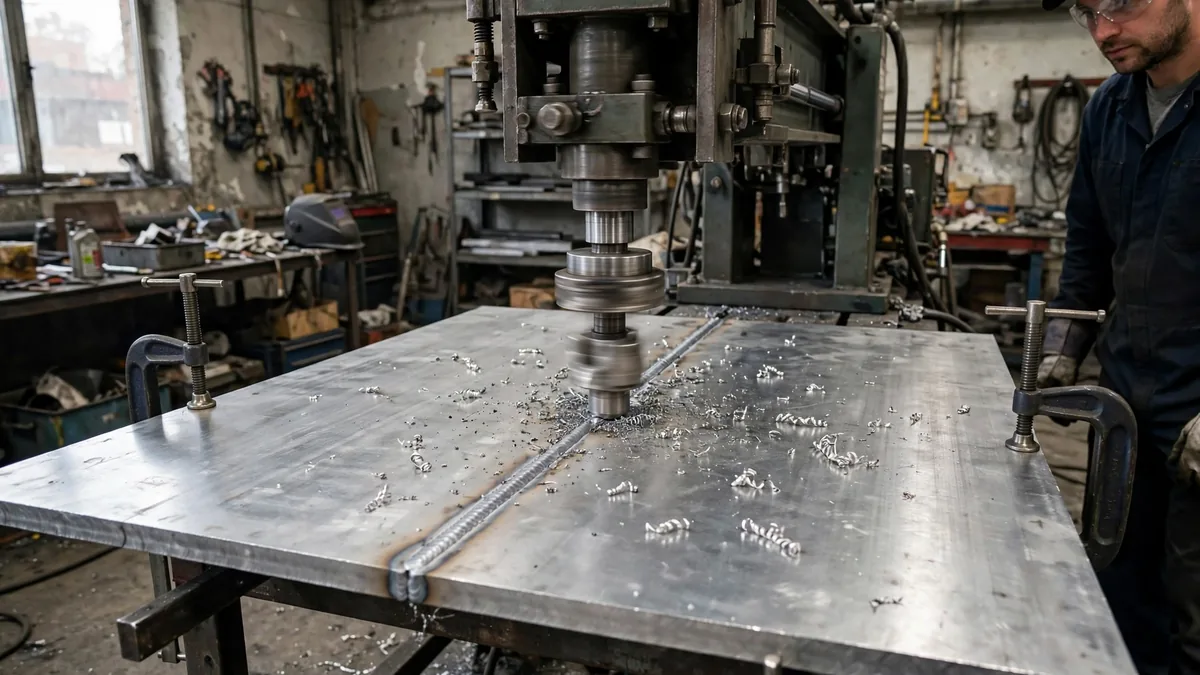
That is friction stir welding. Two pieces of metal are clamped tight, a rotating tool with a short pin plunges into the seam, and friction heats the metal until it softens — but never melts. The tool travels along the joint, and behind it a smooth, solid weld appears.
The process was invented in 1991, and in three decades it has gone from a laboratory curiosity to the way spacecraft fuel tanks, ship panels, train carriages and aeroplane wings are joined. Its numbers look modest beside those of other welding processes, and that is the point: the weld is made below the melting point. Its closest relatives are the friction stir welding production line that turns the idea into finished parts, and the electron beam welding process used where a deep, narrow weld in a vacuum is needed instead. Here is what the specifications mean.
Rotation Speed: How Fast the Tool Spins
The heart of friction stir welding is the tool, and its first specification is how fast it spins. For aluminium, the tool typically turns at 400 to 1,200 revolutions per minute, within a full range of about 200 to 2,000 rpm. That spin makes the heat: the shoulder of the tool rubs against the surface of the plates, and friction warms the metal to roughly 400 to 500 degrees Celsius, well below aluminium’s melting point of about 660 degrees. Spin too slowly and the metal stays too stiff to stir; spin too fast and the metal overheats.
Travel Speed: How Fast the Weld Moves
Once the tool is spinning and plunged into the seam, it moves forward along the joint, and that travel speed is the second key number. For aluminium plate, typical travel speeds run from about 100 to 500 millimetres per minute, with the full range from roughly 50 to 1,500 millimetres per minute depending on the job. Thin panels weld quickly; thick plate moves slowly, giving the tool time to stir the full depth. Travel speed and rotation speed work together: a fast travel with a slow spin leaves a cold, weak weld, while a slow travel with a fast spin overheats the metal.
Downforce and the Tool: Pressure That Holds It Together
While the tool spins and travels, it is also pressed down hard into the plates. That downforce is typically 5 to 50 kilonewtons — roughly the weight of half a tonne to five tonnes pressing down on a tool no wider than a coin. It keeps the tool shoulder in firm contact so friction can generate heat, and forges the softened metal together behind the pin, squeezing out voids. The tool itself is a specification too. Its shoulder is usually 10 to 30 millimetres across, and its pin is slightly shorter than the thickness of the plates, so it stirs almost the full depth without punching through the back.
Plate Thickness: From Thin Panels to Ship Plate
Friction stir welding covers an extraordinary range of thicknesses. At the thin end, sheets of 1 to 3 millimetres are joined for aircraft skins and electronic enclosures. In the middle, plates of 6 to 25 millimetres cover most ship panels, train bodies and fuel tanks. At the far end, single-pass welds in aluminium up to about 75 millimetres thick have been demonstrated, and thicker joints can be made by welding from both sides. That range is one reason the process spread so fast: the same idea, with a bigger tool and a stronger machine, scales from a laptop-sized panel to a rocket tank.
Joint Strength: How Strong Is the Weld?
The number buyers care about most is joint efficiency: how strong the weld is compared with the metal around it. A good friction stir weld in aluminium reaches 70 to 95 per cent of the parent metal’s tensile strength. For the common alloy 6061, that means a weld of around 240 megapascals against a parent metal strength of about 310 megapascals. That beats most fusion welds in the same alloy, which often manage only 50 to 70 per cent. There is one weakness to know about: when the tool is pulled out at the end of a weld it leaves a small keyhole, a round hole the diameter of the pin. Production welds deal with it by running the tool off the end of the joint onto a scrap tab.

Friction Stir Welding Specs
| Specification | Typical range |
|---|---|
| Tool rotation speed | 200 to 2,000 rpm; 400 to 1,200 rpm for aluminium |
| Travel speed | 50 to 1,500 mm per minute; 100 to 500 mm typical |
| Peak weld temperature | 400 to 500 °C for aluminium, below its 660 °C melting point |
| Downforce | About 5 to 50 kN, depending on plate thickness |
| Tool shoulder diameter | About 10 to 30 mm |
| Plate thickness, single pass | About 1 to 75 mm in aluminium |
| Joint efficiency | About 70 to 95 per cent of parent metal tensile strength |
| Weld strength, 6061 aluminium | About 240 MPa, against about 310 MPa for the parent metal |
| Filler metal | None required |
| Shielding gas | None required in most cases |
What Does Friction Stir Welding Cost?
Friction stir welding is not cheap to set up, but it is cheap to run. A small friction stir welding machine is estimated to cost roughly $50,000 to $150,000, a production gantry system is estimated at $500,000 to $2 million, and the giant machines that weld rocket tanks cost several million dollars — all estimates, and every installation is bespoke. Running costs are low: no filler wire, no shielding gas, and no grinding or rework. That is why the process wins on long, straight production welds. The comparison that matters is with steel welding, where the arc, the filler and the gas are all consumables and every weld needs cleaning afterwards. For a one-off repair it rarely makes sense; for a thousand identical panels, it is hard to beat.
A Rare Fact
Friction stir welding was invented in 1991 by Wayne Thomas at The Welding Institute in Cambridge, England — and its first great success was in space. NASA adopted the process for the Space Shuttle’s external fuel tank, the huge orange tank that was the largest single part of the Shuttle stack, because friction stir welds were stronger and more reliable than the fusion welds they replaced. It now holds together the tanks that carry rockets into orbit — without ever melting the metal.
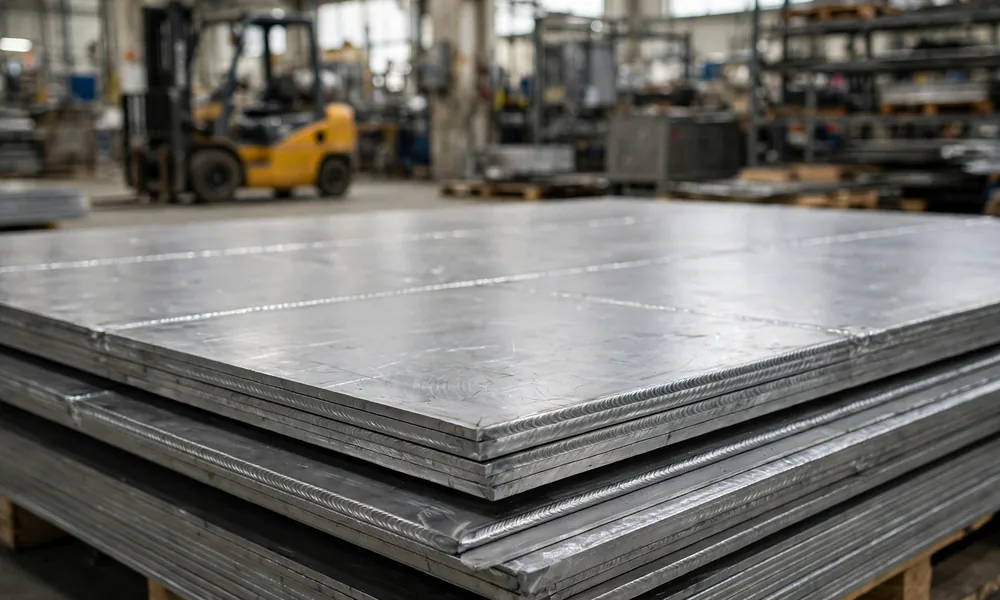
Friction stir welding looks like a small idea — a spinning tool, a seam, no flame — but it changed what engineers expect from a weld. No melting means no porosity, no solidification cracking and far less distortion, and the numbers show it: joint strengths of up to 95 per cent of the parent metal, on plates from a millimetre to 75 millimetres thick. The next time you see a train carriage or a rocket on a launch pad, the metal may well have been stirred, not melted, into place.