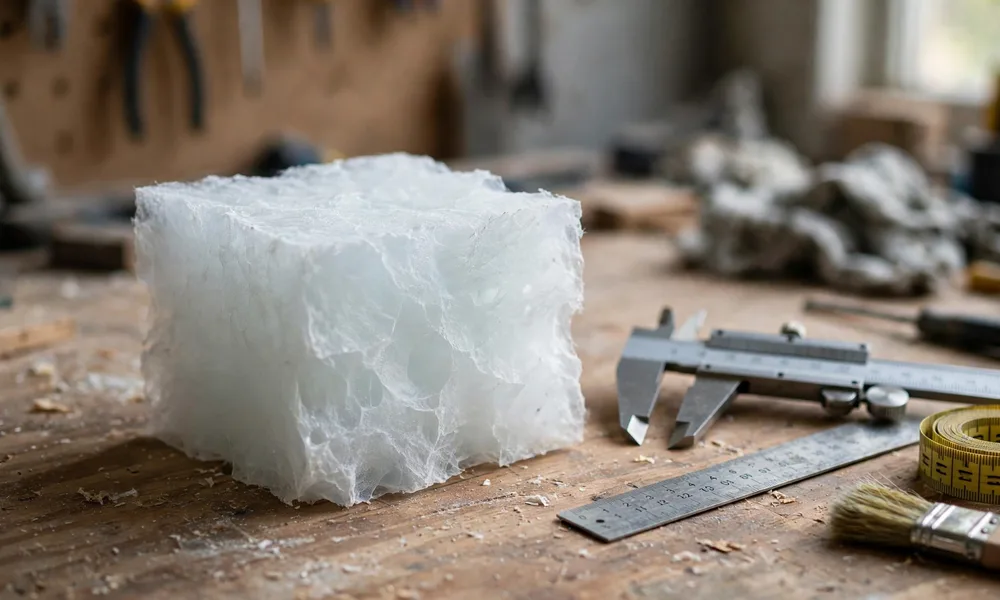
Hold a panel of aerogel in your hand and your brain refuses to believe what your fingers are telling you. It looks like a piece of frozen smoke, pale blue and almost weightless, yet it feels solid. Put a blowtorch on one side and you can press your palm against the other side without flinching. It is the lightest solid material ever made, and it stops heat more effectively than almost anything else on Earth.
That impossible combination is why aerogel insulation turns up in places where failure is not an option. It wraps the pipes of oil refineries and chemical plants, lines spacecraft and Mars rovers, and keeps the cold out of demanding buildings. A layer just a centimetre thick can do the work of several centimetres of ordinary insulation, which matters enormously when every millimetre and every gram counts.
Yet for all its space-age reputation, aerogel works through a beautifully simple idea: it traps air so thoroughly that heat has almost nowhere to go. There is no pump, no power supply, and no moving part. This is how aerogel insulation works, from the heat trying to escape to the quiet structure that stops it.

How It Works
Step 1: Heat tries to escape in three ways
Heat is always looking for a way out, and it travels by three routes. Conduction carries it through solid material, molecule bumping into molecule. Convection carries it in moving air or liquid, as warm currents rise and cold ones sink. Radiation sends it as invisible infrared waves, straight through empty space. Aerogel is unusual because its structure attacks all three routes simultaneously, which is the first reason it performs so far beyond its weight.
Step 2: The maze of nanopores traps the air
An aerogel is a silica skeleton that is up to 99.8 percent air by volume. Its solid part is a tangled network of tiny glass-like strands, and the gaps between them are only tens of nanometres wide, far smaller than the distance an air molecule normally travels before bumping into another one. Inside such a tiny pore, air molecules collide with the pore walls far more often than with each other, so they cannot pass heat along in the usual way. The detailed numbers behind that structure are laid out in the aerogel insulation specifications, which show just how little solid material is doing all the work.
Step 3: Conduction hits a dead end
The solid skeleton is the only path left for conduction, and it is a terrible one. The silica strands are thin, they twist and branch, and they touch each other only at tiny points, so heat must travel a long, winding route through very little material. Imagine trying to walk across a city where every street is a narrow footpath that doubles back on itself; that is what heat faces inside an aerogel. The strands themselves are made of silica, which is already a poor conductor, and there is so little of it that the total heat flow is minuscule.

Step 4: Infrared radiation is scattered and absorbed
At high temperatures, radiation becomes the biggest route for heat loss, and aerogel deals with that too. The nanoporous network scatters infrared waves, bouncing them in random directions instead of letting them pass straight through, and the silica itself absorbs some of the energy. For the hottest applications, makers add opacifiers — fine powders such as carbon black or titanium dioxide — that soak up infrared radiation even more effectively. Getting the blanket onto hot pipes in the first place is its own craft, as how aerogel insulation is made explains.
Step 5: The blanket is cut, wrapped, and sealed
In practice, most aerogel insulation arrives as a flexible blanket: aerogel particles held inside a fibrous mat, like dust trapped in a quilt. Installers cut it with a knife, wrap it around pipes, vessels, and ducts, and hold it in place with bands or wire. Because it is so thin for its performance, it fits into tight spaces where thick conventional insulation would never go — between a pipe and a wall, inside a cramped engine bay, or around a valve that still needs to be reached for maintenance. The edges are sealed with tape or a metal jacket to keep water out, because a soaked blanket loses performance.
Step 6: It keeps working for decades
Once installed, aerogel insulation has almost nothing to wear out. There are no moving parts, no chemicals to top up, and no power draw. It does not settle or slump the way fibrous insulation can, it does not rot, and it is not eaten by pests. Its main enemies are physical damage and prolonged soaking, both of which a proper metal jacket prevents. In industry, it means pipes that stay at temperature and processes that use less fuel. The material simply sits there, its nanopores holding the air still, doing the same quiet job on day ten thousand as it did on day one.
| Main material | Silica aerogel, up to 99.8 percent air by volume |
| Thermal conductivity | About 0.013 to 0.018 watts per metre-kelvin |
| Density | About 100 to 200 kilograms per cubic metre for blanket form |
| Maximum service temperature | About 650 degrees Celsius for standard blankets |
| Typical thickness | 5 to 20 millimetres, replacing far thicker conventional insulation |
| Form | Flexible blanket, rigid panel, or loose granules |
| Water behaviour | Hydrophobic; repels liquid water but must be sealed against soaking |
| Service life | Decades when protected by a jacket, with no settling or slumping |
What Does Aerogel Insulation Cost?
Aerogel insulation is expensive, and there is no hiding from that fact. A standard aerogel blanket is estimated at roughly $40 to $90 per square metre for a 10-millimetre thickness, depending on grade and quantity, while rigid panels and specialist high-temperature grades cost considerably more. Those are estimates only, and they explain why aerogel is still a specialist material rather than the default in every home. The argument for it is not the price of the blanket but the price of everything around it: thinner walls, less space lost, and energy saved every day for decades. That is also why it carries a premium reputation, as why aerogel insulation is so expensive explores in detail.
A Rare Fact
Aerogel has flown further than any other insulation material ever made. NASA used it on the Mars rovers to keep their electronics warm through freezing Martian nights, and the Stardust spacecraft used a block of aerogel as a catcher’s mitt to trap dust from a comet — particles travelling at six kilometres a second were slowed gently enough to survive, because the aerogel was almost entirely empty space. A material so light that it barely exists has now touched another planet and caught pieces of a comet.
Aerogel insulation will probably never be the cheapest option on the shelf, and it does not need to be. Its job is to go where nothing else can: into the tightest gap, onto the hottest pipe, and aboard the spacecraft where a single extra kilogram costs a fortune. It works by holding air still in a maze too small to see.


