An e-bike weighs twice as much as a normal bicycle and can hit 45 kilometres an hour with a motor pushing it along. Stopping that weight, again and again, in rain and mud, falls to two discs of steel no bigger than a saucer. E-bike disc brakes look simple — a rotor, a caliper and two pads — but they are machined to fine tolerances, because a brake that judders, squeals or fades on a steep descent is the difference between stopping and not stopping.
The factory that makes them is a world away from a bike shop. Steel arrives in coils, is stamped and machined by robots, and every rotor is tested before it is packed. A single production line can turn out thousands of rotors a day. This is what happens inside the factory that builds the disc brakes on an e-bike.
How E-Bike Disc Brakes Are Made
Step 1: Choosing the steel
It starts with the metal. Brake rotors are made from stainless steel, chosen because it resists rust, holds its shape when hot and can be machined to a smooth, flat surface. The steel arrives as coils or sheets, and each batch is tested for hardness and composition before it is used — a rotor made from the wrong steel would wear out in months. The thickness matters too: most e-bike rotors are between 1.8 and 2.3 millimetres thick, thin enough to stay light but thick enough to absorb heat without warping. The exact figures for thickness, weight and size are set out in the e-bike disc brake specifications.
Step 2: Stamping and cutting the rotor
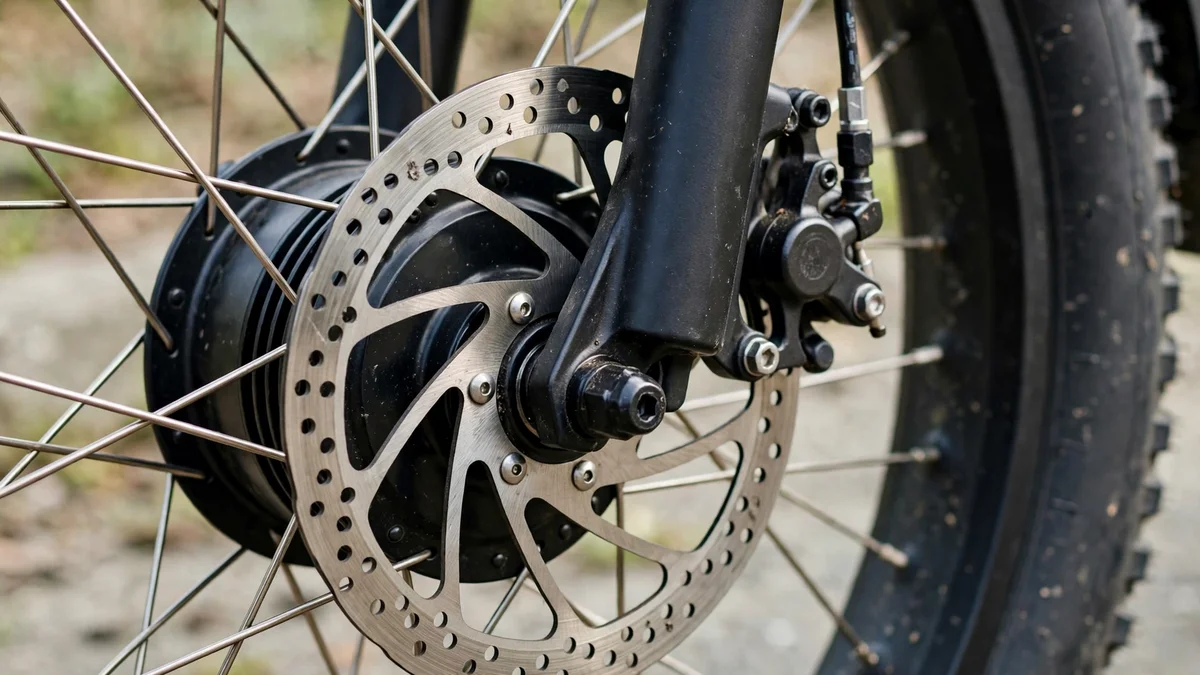
The flat steel is stamped into a disc, then the centre is cut away to leave the familiar spider shape, with arms reaching out to the braking ring. The holes and slots in the ring are punched or laser-cut in the same pass — they save weight, clear water and mud, and help the rotor cool. The edge of the disc is deburred so there are no sharp lips to catch the pads. At this stage the rotor looks almost finished, but it is still a rough blank: the braking surface is not yet flat enough, and the mounting holes are not yet precise enough, to stop a bike safely.
Step 3: Machining the braking surface
The blank goes onto a CNC lathe or mill, where the braking faces are machined flat. This is the most precise step in the whole factory: the two faces must be parallel to within a few hundredths of a millimetre, or the pads will grip unevenly and the brake will pulse under the rider’s fingers. The machine cuts both faces in one setup, then drills the mounting holes to the exact pattern for the hub. Each rotor is measured with a dial gauge as it comes off the machine, and any rotor that runs out of true by more than the limit goes straight into the scrap bin.
Step 4: Heat treatment
After machining, the rotors are heat-treated to harden the steel and relieve the stresses left by cutting. They are heated in a furnace to several hundred degrees, held there, then cooled in a controlled way so the metal hardens evenly without warping. A rotor that skips this step would wear quickly and could crack under repeated hard braking. Heat treatment is invisible on the finished part — there is nothing to see — but it is what lets a thin steel disc survive thousands of stops from high speed without losing its shape or its bite.
Step 5: Making the caliper
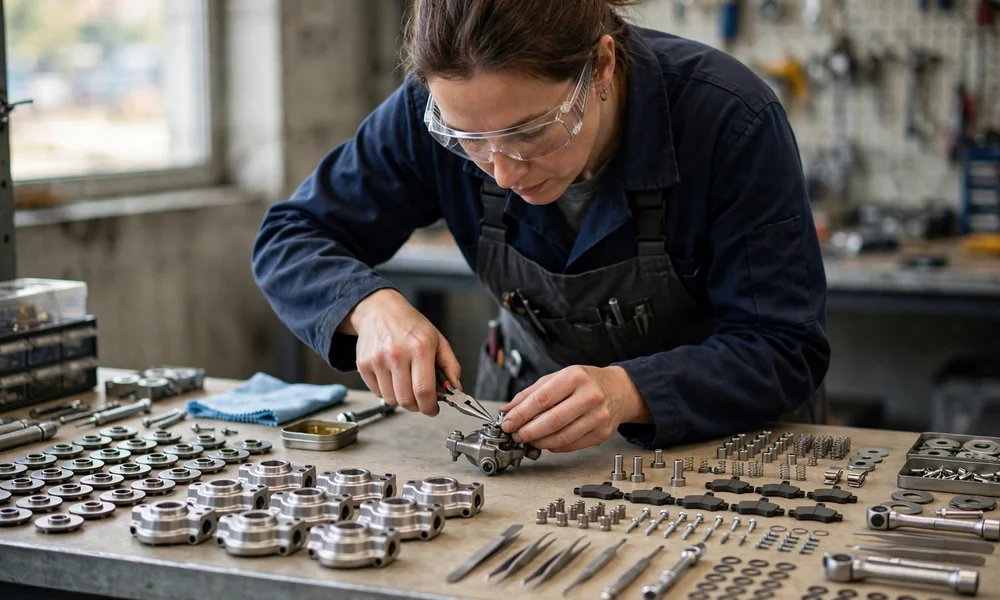
While the rotors are being finished, another line makes the calipers. The caliper body is cast or forged from aluminium, then machined on a CNC mill to take the pistons, the seals and the brake pads. The bores for the pistons are honed to a mirror finish, because a rough bore would let brake fluid leak past the seals. The caliper is anodised to protect it from corrosion and to give it its colour, then the pistons, seals and pads are fitted by hand. Each caliper is pressure-tested with fluid before it leaves the line — a caliper that leaks is a brake that fails.
Step 6: Making the pads
The brake pads are small, but they do the actual stopping. A pad is a steel backing plate with a block of friction material bonded to it — a mix of metal fibres, resins and fillers, pressed and baked in a mould. There are two main types: resin pads, which are quiet and gentle on rotors, and metallic pads, which last longer and cope better with heat and wet weather. The compound is mixed to a precise recipe, pressed under tonnes of force and cured in an oven. Each batch is tested for friction and wear, because a pad that is too hard squeals and one that is too soft vanishes in a single wet ride.
Step 7: Assembly, bedding and testing
Finally, rotor, caliper and pads come together. The rotor is bolted to a test hub and spun on a rig while the caliper squeezes it, checking for runout, drag and noise. The brake is then bedded in — the pads are pressed against the spinning rotor until a thin layer of pad material transfers onto the steel, which gives the brake its full power. The finished set is inspected, packed and shipped to bike factories. The price of all this precision is higher than most riders expect, as explained in why e-bike disc brakes are so expensive — and the frame they bolt to is made with the same care, as shown in how an e-bike carbon frame is made.
E-Bike Disc Brakes at a Glance
| Specification | Typical Value |
|---|---|
| Rotor material | Stainless steel |
| Rotor thickness | About 1.8–2.3 mm |
| Rotor diameter | 160–203 mm, depending on the bike |
| Caliper material | Forged or cast aluminium, anodised |
| Pad types | Resin or metallic compound |
| Flatness tolerance | Within a few hundredths of a millimetre |
| Key advantage | Strong, consistent stopping in wet and dry conditions |
What Does It Cost?
A set of e-bike disc brakes — two rotors, two calipers, pads and hoses — typically costs $100–$400 (estimate) at retail, depending on the brand and the level. Entry-level hydraulic sets sit at the bottom of that range, while high-end four-piston sets with larger rotors cost far more. The factory cost is a fraction of the retail price, but the machining, heat treatment and testing are not cheap: a rotor that must be flat to hundredths of a millimetre needs expensive machines and constant measurement. For the rider, the cost is small next to the bike itself, and the brakes should never be bought on price alone.

A Rare Fact
The holes in a brake rotor are not just for lightness. When a rotor gets hot during a long descent, the holes let the pad gases escape and help the rotor cool, but they also act as a cleaning system: each hole scrapes the pad surface as it passes, keeping the friction material fresh. Early disc brakes had solid rotors, and riders found they faded badly in the wet. The drilled pattern that solved it was borrowed from motorcycle racing — and it is why a modern e-bike rotor looks like a piece of lace made of steel.


