Pick up a blanket of aerogel insulation and your hand barely knows it is there. It is 99 percent air, lighter than a feather, yet it can keep a pipe at 500 degrees cool enough to touch, and it once flew to Mars to insulate a rover. Aerogel is the lightest solid material ever made, a ghost of a solid that looks like frozen smoke. Making it is one of the strangest manufacturing processes on Earth: a jelly is turned into a solid without ever being allowed to dry out in the normal way.
The factory that does it looks more like a chemical plant than a textile mill. Silica is mixed into a gel, the liquid inside it is swapped for gas under high pressure, and the result is a blanket so light it floats on air. The process is slow, expensive and fussy — and it is the only way to make a material that insulates better than anything else known. This is how aerogel insulation is grown.

How Aerogel Insulation Is Made
Step 1: Mixing the silica gel
It starts with chemistry. Silica, the same material as sand and glass, is dissolved and mixed with a solvent to form a liquid called a sol. A catalyst is added, and the liquid begins to set into a gel — a jelly-like solid threaded through with a network of tiny silica strands. The gel is mostly liquid at this point, and it is as fragile as a soap bubble: touch it wrongly and it collapses. The gel is cast into sheets or poured into moulds, often around a fibre blanket that will give the finished material its strength. Getting the gel right is the foundation of everything that follows.
Step 2: Ageing the gel
Once cast, the gel is left to age. Over hours or days, the silica network inside it grows stronger as more silica links form between the strands, like a spider’s web thickening. The gel is kept wet in its solvent the whole time, because if it dries out now, the surface tension of the evaporating liquid will crush the delicate network flat. Ageing is a waiting game, and the factory runs it in batches: racks of gel sheets sit in tanks, quietly getting stronger while the next batch is mixed. The timing matters — too little ageing and the gel breaks later; too much and the process wastes days.
Step 3: Swapping the liquid
Next, the liquid inside the gel has to be replaced. The original solvent is washed out and swapped for liquid carbon dioxide, in a series of baths that gradually exchange one fluid for the other. This step is slow and careful: the exchange must be complete, or the drying step that follows will fail. The gel still looks the same — a wet, transparent sheet — but inside, every pore is now filled with liquid carbon dioxide instead of solvent. The making of aerogel insulation is mostly this kind of invisible chemistry, not cutting and welding.
Step 4: Supercritical drying
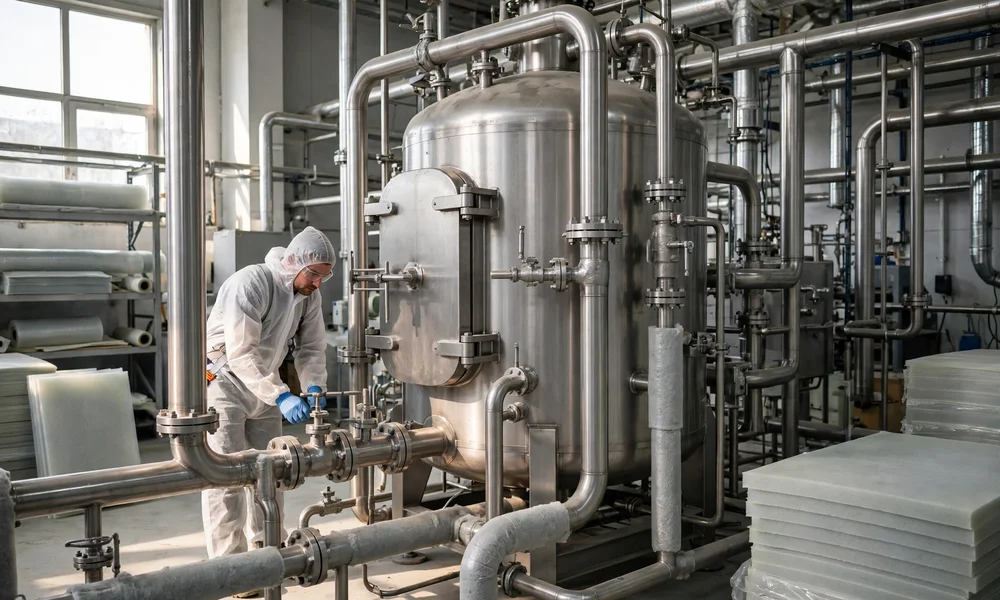
This is the step that makes aerogel possible. The gel, full of liquid carbon dioxide, is put into a pressure vessel called an autoclave and heated past the point where carbon dioxide becomes supercritical — a state that is neither liquid nor gas. In that state there is no surface tension, so the carbon dioxide can be vented away without pulling the silica network down with it. What is left is the network itself, filled with air: an aerogel. The pressure and temperature are controlled to the degree, because a mistake here turns hours of careful work into a pile of dust.
Step 5: Bonding to the blanket
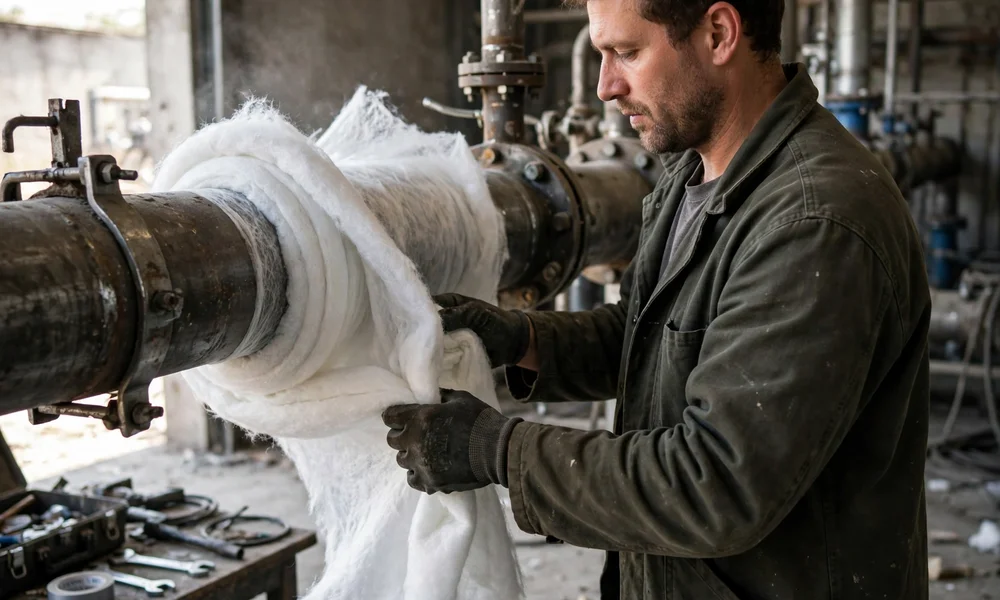
Pure aerogel is too fragile to use on its own, so in the factory it is made inside a fibre blanket. The gel is formed around glass or polyester fibres, and after drying, the aerogel clings to the fibres, making a flexible blanket that can be cut, rolled and wrapped around pipes. The blanket is trimmed to width on a cutting table, and the edges are sealed so the aerogel does not shed dust. The result is a product that handles like a thick cloth but insulates like nothing else: a few millimetres of aerogel blanket can do the work of centimetres of mineral wool.
Step 6: Testing the insulation
Every batch is tested before it ships. Samples are measured for thermal conductivity — how much heat passes through them — and the best aerogel blankets conduct less heat than still air itself. The blankets are also tested for flexibility, for how much dust they shed and for how they behave when wet, since a blanket that soaks up water loses its insulating power. The figures behind these tests, and what they mean in practice, are explained in how aerogel insulation works. Only batches that pass every test are cut to order and packed.
Step 7: Cutting, packing and shipping
Finally, the blankets are cut to the sizes customers need, rolled up and sealed in bags that keep them dry. Aerogel blanket is used to insulate oil pipelines, liquefied gas tanks, spacecraft and the coldest buildings on Earth, so orders range from a single roll for a laboratory to container loads for an industrial project. The blankets are light — a roll that would take two people to lift in mineral wool can be carried by one — but they are packed with care, because a crushed blanket never quite recovers its shape. The price reflects all of this, as explained in why aerogel insulation is so expensive.
Aerogel Insulation at a Glance
| Specification | Typical Value |
|---|---|
| Main material | Silica aerogel in a fibre blanket |
| Air content | About 99% air by volume |
| Thermal conductivity | Lower than still air |
| Blanket thickness | About 5–10 mm for most uses |
| Temperature range | From cryogenic cold to about 650°C |
| Key process | Supercritical drying in an autoclave |
| Key advantage | The best insulation known, in a very thin layer |
What Does It Cost?
Aerogel blanket is one of the most expensive insulation materials sold. A roll typically costs $10–$30 (estimate) per square foot, depending on thickness and grade, which is many times the price of mineral wool or foam. The cost comes from the process: supercritical drying needs high-pressure vessels, the production is slow and batch-based, and the material is fragile to handle. For most homes it is far too expensive to use everywhere, so it is used where space is tight or temperatures are extreme — around steam pipes, in thin wall panels and on spacecraft. Where a few millimetres must do the work of centimetres, there is no cheaper way to buy the same performance.
A Rare Fact
Aerogel was invented in 1931, when a scientist bet a friend he could remove the liquid from a jelly without shrinking it. He won the bet by swapping the liquid for gas under pressure — the same supercritical drying used today. The material was then almost forgotten for fifty years, too expensive and fragile for any real use. It came back when NASA needed insulation for the Mars rovers: aerogel kept their electronics warm through freezing Martian nights, and a block of it was used to catch dust from a comet in space, stopping the particles gently in its ghostly structure without destroying them.