Pick up a flagship smartphone and the first thing your fingers meet is not the screen, but the frame around it — a thin band of metal that holds the glass, protects the insides, and decides whether the phone feels cheap or expensive. On the best phones that band is titanium: lighter than steel, stronger than aluminium, and famously difficult to work with. Making a titanium frame is a slow, precise business, and most of the work happens in factories where a single speck of dust can ruin a part.
Titanium is the metal that aircraft and racing cars are made from, and it brings the same qualities — and the same problems — to a phone. It resists scratches and corrosion, it does not bend easily, and it feels cool and solid in the hand. A frame that is a fraction of a millimetre out will not fit its glass, and a frame with a visible scratch is scrap.
Inside the Production
Step 1: Preparing the titanium
Production starts with titanium alloy, usually grade 5 titanium — an alloy of titanium, aluminium, and vanadium that is stronger than pure titanium and easier to machine. The metal arrives as flat plates or as extruded bars, and each batch is checked for composition and for flaws before it is used. The plates are cut into blanks, each one slightly larger than a finished frame, and the blanks are cleaned and inspected. Titanium is expensive — many times the price of aluminium — so the factory plans its cutting carefully to waste as little as possible.
Step 2: CNC machining the frame
The blank is clamped into a computer-controlled milling machine, and the cutting begins. Diamond-coated tools carve away most of the metal, leaving the thin rectangular band of the frame, with openings for the screen, the buttons, the charging port, and the antennas. The machining is done in several passes, each one removing a little less metal, because titanium work-hardens — it gets harder as it is cut — and a heavy cut can blunt a tool or distort the part. A single frame can spend an hour or more in the milling machine, and the machines run day and night, tended by operators who check the first part of every batch by hand.

Step 3: Drilling, tapping, and antenna breaks
After the main shape is milled, the fine work begins. Holes are drilled for screws and for the buttons, threads are tapped for the tiny screws that will hold the phone together, and the antenna breaks — thin lines of plastic that divide the metal frame into separate antenna sections — are cut and filled. This is delicate work: the antenna breaks must be exactly the right width, or the phone’s signal will suffer, and a tapped thread that is even slightly off will not hold a screw. The way the frame is shaped is part of what how a smartphone titanium frame is made explains, and the machining stage is where most of the frame’s cost is created.
Step 4: Polishing and surface finishing
A machined titanium frame looks dull and grey, with visible tool marks, so the next stage is finishing. The frame is polished — sometimes by machine, sometimes by hand — until the surface is smooth and even, and then it is given its final texture: a brushed finish, a polished finish, or a fine blasted finish that scatters light and hides fingerprints. The finishing is done in a clean area, and workers wear gloves, because a fingerprint on a freshly polished frame would show up under the inspection lights. Each frame is checked under bright light from several angles before it moves on.
Step 5: Fitting the internal parts
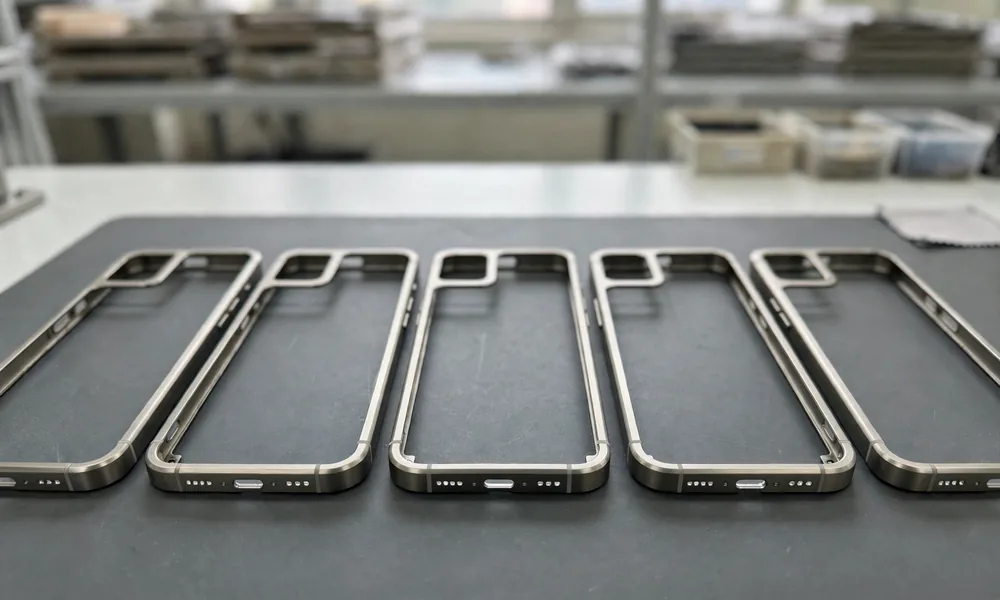
The finished frame is not just a band of metal: it is the chassis of the phone. Small brackets, threaded inserts, and mounting points for the battery, the circuit board, and the cameras are fitted inside it, and the frame is checked against a master gauge — a perfect reference frame — to prove that every dimension is correct. The glass panels, front and back, are test-fitted to a sample of frames from each batch, because a frame that is a fraction of a millimetre too large would leave a gap, and one that is too small would crack the glass.
Step 6: Inspection and packing
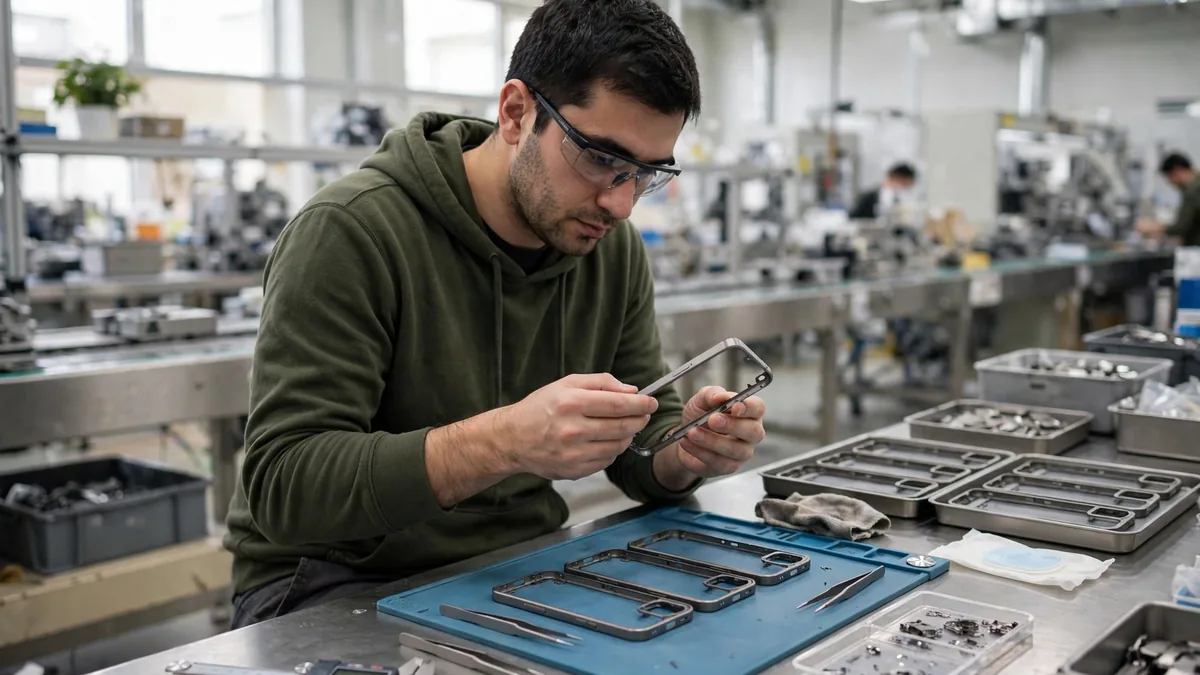
Every titanium frame is inspected before it leaves the factory. Some are checked by hand, under magnification, for scratches, dents, and uneven finishing; others pass through automated inspection stations that photograph the frame from every angle and compare it to a perfect reference. The frames that pass are cleaned once more, wrapped to protect the finish, and packed in trays that hold them apart so they cannot scratch each other. A frame that survives this whole journey — machining, finishing, inspection, and packing — is a small, precise piece of engineering that most owners will never think about, even though they touch it every day.
Specs
| Specification | Typical figure |
|---|---|
| Material | Grade 5 titanium alloy |
| Frame weight | Roughly 30–40 grams |
| Frame thickness | About 2–3 millimetres |
| Machining time | An hour or more per frame |
| Strength | Stronger than aluminium, lighter than steel |
| Finish options | Brushed, polished, or blasted |
| Antenna breaks | Plastic-filled gaps in the metal band |
| Inspection | Every frame checked, by hand or camera |
| Role | Chassis holding screen, battery, and boards |
Price
A titanium smartphone frame is never sold on its own, so any price is an estimate. As an estimate, a finished titanium frame costs roughly $20 to $50 to make, depending on the design, the finish, and the volume — several times the cost of an aluminium frame, which is one reason only flagship phones use titanium. The finished phone usually costs $1,000 to $1,500, and the frame is a small but visible share of that: the buyer is paying for a material that is harder to machine, slower to finish, and more expensive to waste.
A Rare Fact
Titanium is so hard to machine that it wears out cutting tools far faster than aluminium or steel, and the tools themselves are a major cost of making a titanium frame. A single milling cutter that might shape hundreds of aluminium parts could be worn out after only a few dozen titanium frames, because titanium holds its heat at the cutting edge instead of letting it escape into the chips. It is one of the hidden costs of a premium phone: the frame is not just expensive because the metal is expensive, but because the tools that shape it keep wearing out.
The titanium frame is the part of the phone you touch most, yet notice least. The numbers behind its strength and weight are laid out in the smartphone titanium frame specs explained guide, and the reason it costs what it does is explored in why a smartphone titanium frame is so expensive. The next time you pick up a flagship phone, run your thumb along the cool metal edge and remember the hour in the milling machine, the polishing, and the inspection that made it feel the way it does.


