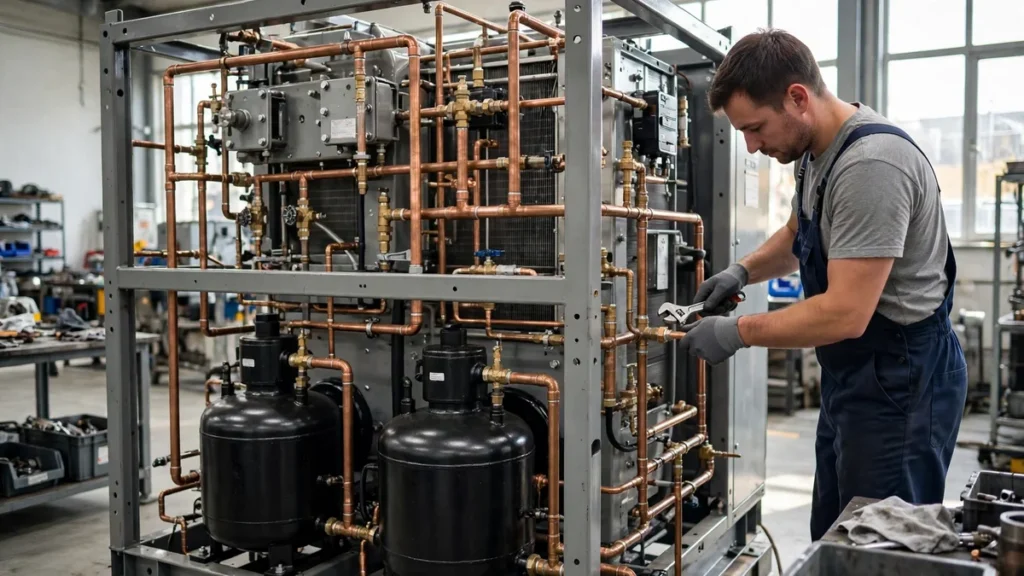
A superyacht begins not as a gleaming white ship, but as a pile of flat steel plates in a cold, echoing shed. The hull — the part that will spend its life in salt water, carrying a hundred million dollars of luxury above it — is built upside down, welded together plate by plate, by people who work at heights, in heat, and in weather that changes by the hour. It is the largest, heaviest, and least glamorous part of the yacht, and everything else depends on it.
Steel is chosen for a superyacht hull for a simple reason: it is strong, it is repairable almost anywhere in the world, and it can take a knock that would shatter a lighter material. Building one takes months, and the work is measured not in millimetres but in tonnes of steel, kilometres of weld, and thousands of hours of grinding and fairing before the hull is smooth enough to paint.

Inside the Production
Step 1: Cutting the steel plates
Production starts with flat steel plates, typically 8 to 20 millimetres thick, delivered to the yard and stored flat so they do not warp. Each plate is cut to shape — some by plasma cutters, some by oxy-fuel torches — following patterns generated from the yacht designer’s three-dimensional model. The cut edges are ground smooth, and each plate is marked with its position in the hull, like a piece of a giant jigsaw puzzle.
Step 2: Building the framing
Before the plates go on, the skeleton of the hull is built. Transverse frames — steel ribs that run across the hull — are erected on the building berth, held in place by jigs and checked with lasers and plumb lines. Longitudinal stiffeners run along the hull between the frames, and the keel, the strong backbone along the bottom, is laid first and levelled carefully. Welders join the frames together, and surveyors measure the whole structure against the design model, adjusting it until it matches within a few millimetres over a length of fifty metres or more.

Step 3: Plating the hull
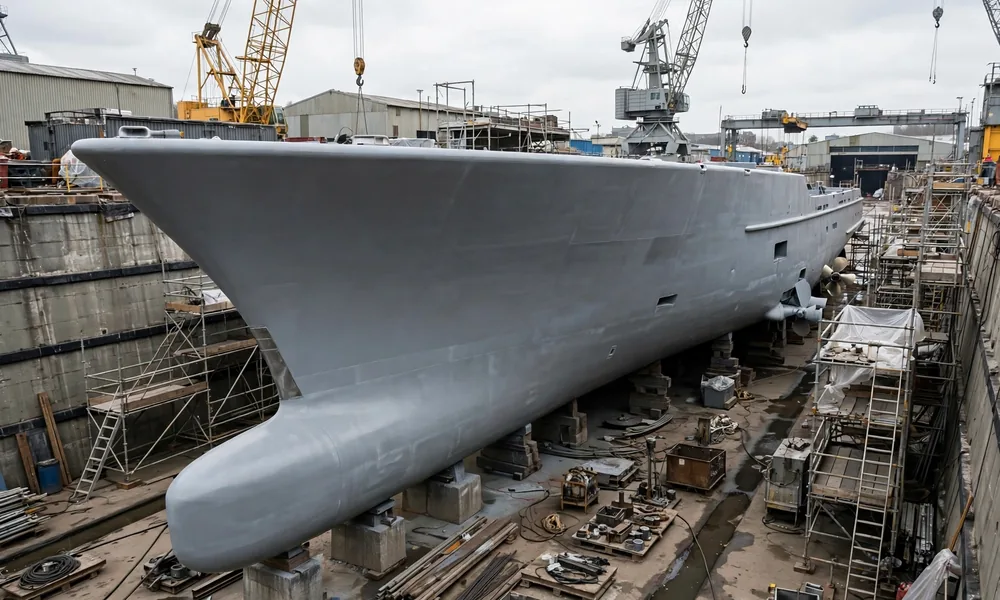
With the framing in place, the steel plates are lifted into position by crane, one at a time, and tack-welded to the frames. The work starts at the keel and moves outward and upward, plate by plate, until the whole hull is covered. The hull is usually built upside down, so the welders work above their heads for the bottom plating, then the whole hull is turned over when the shell is complete. It is slow, heavy work, and a large hull can take several months just to plate.
Step 4: Welding the shell
Once the plates are tacked in place, the real welding begins. Kilometres of weld join the plates to each other and to the frames, laid down in passes by welders working in teams. The welds are tested as they go: some are checked visually, some with dye that reveals cracks, and the most critical ones with ultrasound or X-rays that can see inside the weld. A weld that fails is ground out and redone — there is no patching over a bad weld on a hull that will face the open sea. The way the finished hull is put together is part of what how a superyacht steel hull is made describes, and the welding stage is where the hull stops being a set of plates and becomes a single watertight shell.
Step 5: Fairing and coating
A welded steel hull is strong, but it is not smooth. The surface is checked with long straightedges, and any hollows or high spots are marked. Fairing compound — a tough filler — is spread over the steel and sanded back, again and again, until the hull is fair enough that a coat of paint will look like glass. Once it is fair, the hull is blasted clean, primed with epoxy coatings that protect the steel from rust, and given its first coats of paint. Below the waterline, antifouling paint is applied to discourage marine growth; above it, the famous superyacht gloss begins to appear.
Step 6: Testing, launching, and fitting out
Before launch, the hull is tested. Compartments are filled with water or pressurised with air to prove they are watertight, and the whole hull is surveyed one last time. Then comes the launch — the hull is moved to the water, either floated out of a dry dock or slid down a slipway, and for the first time it floats on its own. After the launch, the hull returns to the yard for fitting out: engines, generators, tanks, and the entire luxury interior are installed inside the steel shell that was built months earlier. Only then does the steel hull become a superyacht.
Specs
| Specification | Typical figure |
|---|---|
| Hull material | Marine-grade steel, 8–20 mm plate |
| Hull length | 50–100 metres for a large superyacht |
| Hull weight | Several hundred tonnes of steel |
| Build position | Usually built upside down, then turned |
| Welding | Kilometres of weld, tested by ultrasound |
| Coating | Epoxy primer, antifouling below waterline |
| Fairing time | Thousands of hours on a large hull |
| Build time | Several months for the hull alone |
| Testing | Watertight tests before launch |
Price
A steel superyacht hull is never sold on its own, so any price is an estimate. As an estimate, the hull structure alone — steel, welding, fairing, and coating — costs roughly $5 million to $20 million, depending on the size of the yacht and the yard building it. The finished superyacht usually costs $50 million to $200 million or more, and the hull accounts for a modest share of that: the real money goes into the interior, the engines, and the systems.
A Rare Fact
Superyacht hulls are built upside down for a very practical reason: it is far easier to weld the bottom of a hull when it is facing up. Welders working overhead, with molten metal dripping down, make slower and weaker welds than welders working flat, with gravity helping the molten metal into the joint. So the yard builds the hull like an upturned boat, welds the bottom in the comfortable flat position, and then turns the whole thing over — a delicate operation involving cranes, calculations, and a great deal of held breath — before finishing the top. It is one of the most dramatic days in the life of a yacht, and it happens long before the yacht ever touches the water.
The steel hull is the foundation of the yacht, but it is only the beginning. The numbers behind its strength are laid out in the superyacht steel hull specs explained guide, and the reason a steel hull costs what it does is explored in why a superyacht steel hull is so expensive. The next time a superyacht glides into harbour, gleaming white in the sun, remember the flat steel plates, the kilometres of weld, and the upside-down hull that had to be turned over before it could ever float.