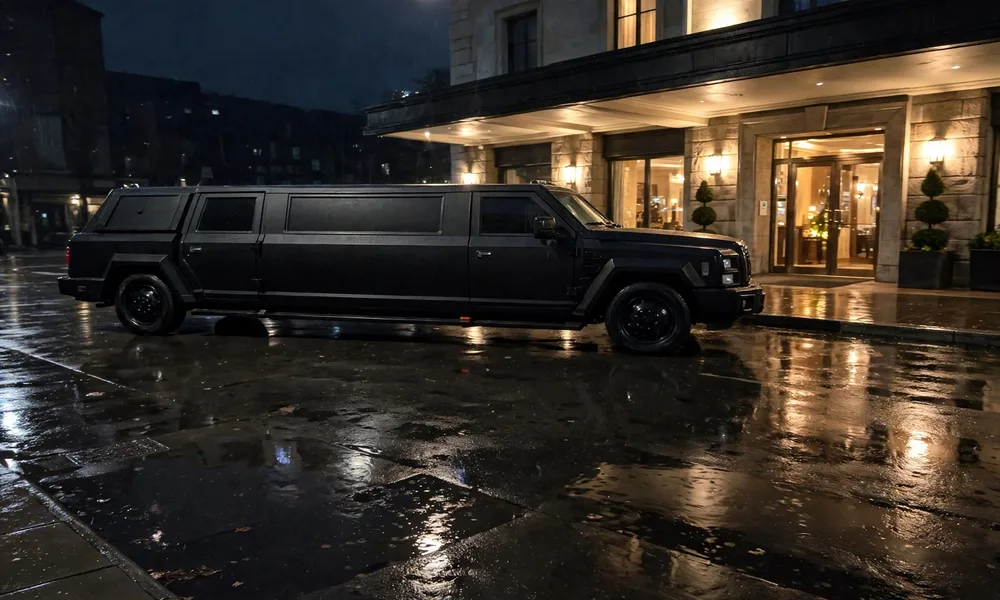
The black sedan rolls through the workshop doors on a flatbed, looking almost ordinary. It is a luxury limousine, fresh from the factory, with leather seats and a quiet engine. Over the next four months, it will be taken apart piece by piece, and put back together as something else entirely: a vehicle that can stop a bullet, survive a blast, and keep its passengers talking calmly while the world outside falls apart.
An armored limousine is not built on a production line. It is built in a secure workshop by a small team of engineers, welders, and upholsterers who sign non-disclosure agreements and work behind closed doors. The client is often a head of state, a billionaire, or a company moving executives through dangerous places, and the car they receive must look identical to the standard model. The armour is invisible by design.
The trick is weight. A standard limousine weighs about two and a half tonnes. An armored one can weigh six. Every extra kilogram of steel and glass changes how the car brakes, turns, and accelerates, so the engineers must rebuild the suspension, the brakes, and the drivetrain to match. The result is a car that looks like a limousine, drives like a truck, and protects like a tank.

How It’s Made
- Stripping the donor car. The process starts with a brand-new limousine, which is completely dismantled. Seats, carpets, dashboard, door panels, and glass all come out, leaving a bare steel shell on a lift. Engineers photograph and label every part, because it all has to go back in exactly the same place.
- Armouring the passenger cell. The heart of the car is the passenger cell, the space around the rear seats. Welders fit overlapping plates of ballistic steel and aramid fibre inside the doors, roof, floor, and pillars, creating a sealed armoured capsule. The plates are curved to follow the body shape, and every seam is overlapped so there is no straight path for a bullet.
- Bullet-resistant glass. The original windows are replaced with laminated glass up to 70 millimetres thick, built from layers of glass and polycarbonate bonded under heat and pressure. A single side window can weigh 50 kilograms. The glass is shaped to fit the original frames, so from outside the car looks untouched.
- Blast protection underneath. The floor gets a sandwich of steel, ceramic, and energy-absorbing foam designed to deflect a blast from below. The fuel tank is coated in self-sealing material that closes around a puncture, and the battery and fuel lines are rerouted inside the armoured cell. Run-flat tyre inserts are fitted so the car can keep driving for kilometres on shredded tyres.
- Upgrading the chassis. The suspension is rebuilt with heavier springs, reinforced control arms, and upgraded dampers. Brakes grow to larger discs and multi-piston callipers, and the wheels are replaced with heavy-duty rims that can carry the extra load. On some builds the engine is tuned or swapped for a more powerful unit, because a six-tonne car needs every horsepower it can get.
- Rebuilding the interior. Upholsterers refit the original leather, wood, and trim over the armour, hiding every plate and bolt. The rear cabin often gains an intercom, fresh-air filtration against gas attack, and a secure communications system. The car must feel exactly like a normal limousine inside, silent, soft, and calm, because the armour is supposed to be felt by no one.
- Testing and certification. Before delivery, the car is tested to international standards such as VR7 or B7, the highest civilian ratings. Test vehicles are shot at, blasted, and driven through attack simulations, while the client’s own car undergoes road testing for braking, handling, and cooling. Only when the engineers are satisfied does the limousine leave the workshop.
The engineering challenge is not the armour itself, but the disguise. An armored limousine must accelerate, brake, and corner well enough that a driver can escape an ambush, yet it carries the weight of a small truck. Engineers solve this with careful weight distribution, keeping the heaviest plates low and central, and with brakes the size of dinner plates. The car is slower than the standard model, but it is still fast enough to matter. A driver trained in evasive techniques can still throw the car into a J-turn, though the manoeuvre puts enormous strain on the tyres and the brakes.

Key Specifications
| Specification | Typical Value |
|---|---|
| Base vehicle | Full-size luxury sedan |
| Armour rating | VR7 / B7 |
| Glass thickness | Up to 70 mm |
| Weight | 5,500–6,500 kg |
| Engine | 6.0-litre V12 twin-turbo |
| Power | 563 hp |
| 0–100 km/h | 8.5 seconds |
| Top speed | 210 km/h |
| Run-flat range | 80 km |
| Build time | 4 months |
The VR7 rating is the benchmark that matters most. It means the passenger cell can stop armour-piercing rifle rounds and survive a hand grenade blast underneath, a standard that only a handful of workshops in the world can meet. The glass alone is an engineering marvel, layered so that each sheet absorbs part of a bullet’s energy until it stops. For context on how limousine luxury is measured before the armour goes in, see the luxury limousine specs that define the class, and the story of why vintage limousines command such extraordinary prices today.
How Much Does an Armored Limousine Cost?
A fully armored limousine costs an estimated $600,000 to $1.5 million, including the donor car. The armouring work alone typically runs an estimated $300,000 to $800,000, depending on the protection level, and the most extreme builds for heads of state can exceed an estimated $2 million. The glass is one of the most expensive parts: a full set of ballistic windows can cost an estimated $100,000 on its own.
Ownership is expensive too. The car needs specialised servicing, its brakes and tyres wear faster under the weight, and fuel consumption is roughly double that of the standard model. Insurance is steep, and many owners keep a second, unarmored car for everyday use. Yet for the people who need one, the price is not the point. The point is that the car disappears into traffic, looking like any other limousine, until the day it has to do its real job.
A Rare Fact
Some armored limousines carry their own oxygen. In the event of a gas attack, the cabin can seal itself airtight and switch to an onboard oxygen supply, keeping the passengers breathing clean air for up to an hour while the driver escapes. The system is hidden behind the rear seats, and the only visible sign is a small switch on the centre console, marked with nothing at all. The driver is trained to press it without looking.
Building an armored limousine is an exercise in contradiction: a car that must be heavy yet fast, invisible yet impregnable, luxurious yet ready for war. The best builds are the ones nobody notices, and the engineers who make them measure success in silence, in the absence of headlines. When a limousine glides past on the street, nobody can tell whether it is armored or not, and that uncertainty is exactly the point. It is a reminder that the most serious machines are often the ones that try hardest to look ordinary, much like the active wings and hidden flaps that let a hypercar reshape itself at speed without ever showing its secrets.


