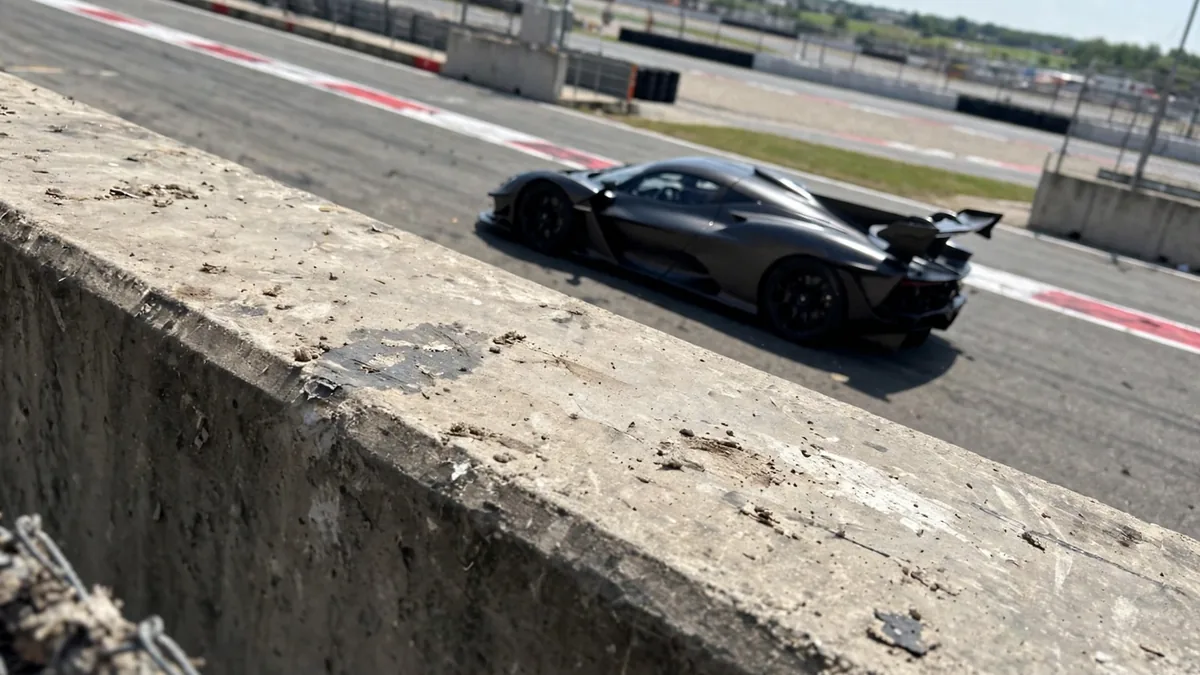
A hypercar at 300 kilometres per hour is not really driving on the road. It is flying, just very close to the ground, and the air going over it is pushing it in directions the driver does not want. Some of that air lifts the nose, some of it drags the car backwards, and all of it changes with speed. Active aerodynamics is the answer: parts of the body that move while the car is driving, changing the shape of the car to suit what it is doing right now.
The idea is that a fixed wing is always a compromise. A big wing gives huge grip in corners but creates drag on a straight, costing top speed. A small wing is fast in a straight line but leaves the car short of grip when it turns. An active system refuses to choose. It runs a low-drag shape on the straight, a high-downforce shape in the corner, and a full airbrake when the driver hits the brakes, changing between them in a fraction of a second.
Downforce, drag and the trade-off
To understand active aero, you need two forces. Downforce is the air pressing the car into the road, which gives the tyres grip. Drag is the air resisting the car’s forward motion, which costs speed and fuel. A wing creates both at once, and the ratio between them is set by its angle. Tilt the wing steeply and it makes lots of downforce and lots of drag. Flatten it and both fall away.
At low speed neither force matters much, because aerodynamic forces grow with the square of speed. Double the speed and the forces roughly quadruple, so at city speeds a hypercar’s aero is almost irrelevant, and at 300 kilometres per hour it dominates everything. That is why the system only starts working hard once the car is going fast, and why the same wing can be nearly flat at one speed and nearly vertical at another. The car’s computer watches speed, steering, throttle and brake pressure, and picks the wing position that gives the best balance for that exact moment.
Movable wings and flaps
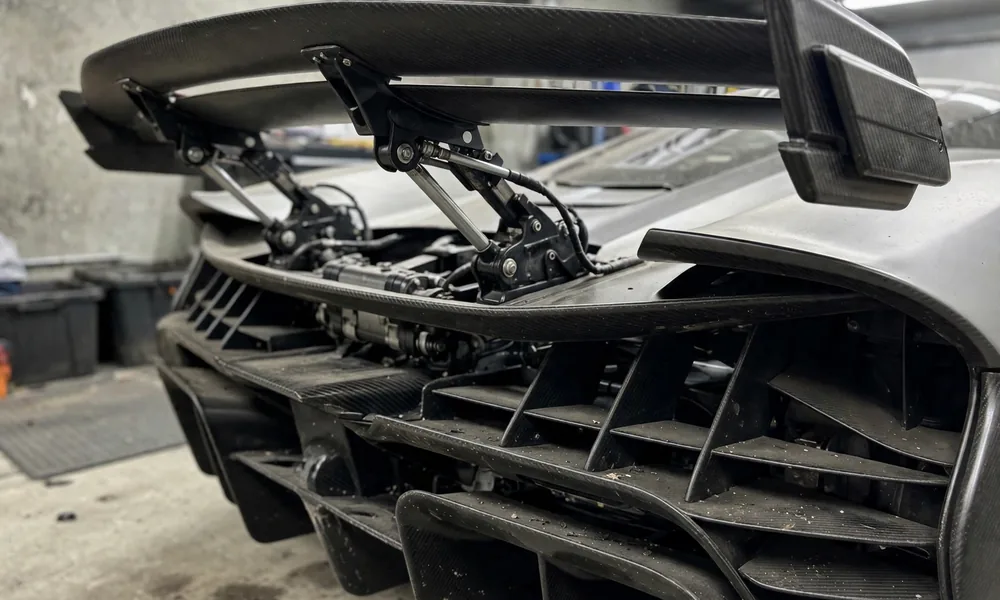
The most visible part of the system is the rear wing. On a hypercar it is not bolted in place. It sits on hydraulic or electric actuators that change its angle of attack, and on some cars its height as well. At full tilt the wing acts like a hand held out of a car window at a steep angle, catching the air and pushing the rear of the car down. Flattened, it slices through the air with far less resistance, letting the car reach its top speed.
Some cars split the job between several smaller surfaces. Flaps in the front splitter, the underbody and the rear diffuser open and close to manage the air flowing under the car, which is where much of the downforce is actually made. A flat underbody with a venturi tunnel accelerates the air beneath the car, creating low pressure that sucks the car downwards, and active flaps can open or close that tunnel. Opening a flap can also stall the diffuser on a straight, deliberately killing downforce to cut drag, a trick borrowed from Formula 1.
DRS: the straight-line trick
The most famous active aero device is DRS, the drag reduction system, taken from Formula 1. At the push of a button, or automatically when the car is on a straight, a flap in the rear wing opens, letting air through a gap that stalls the wing. Downforce drops sharply, drag drops with it, and the car accelerates harder and reaches a higher top speed. Close the flap and the full downforce returns for the next corner.
DRS has a catch, which is why the car controls it so carefully. With the flap open, the rear of the car has much less grip, so if the driver brakes hard or turns while it is still open, the rear can step out. The system is therefore wired into the braking: touch the brake and the flap slams shut instantly, restoring full downforce before the car needs it. That integration, between the aero system and the brakes and the stability control, is what separates a proper active system from a wing that merely moves.
The airbrake: a wing that becomes a wall
The most dramatic moment in active aero comes under braking. When the driver hits the brakes hard at speed, the rear wing tilts to its steepest angle, sometimes close to vertical, and becomes an airbrake. It is no longer trying to make efficient downforce. It is trying to catch as much air as possible, and the drag it creates helps slow the car while the extra downforce pushes the rear tyres into the road so the brakes can work harder.
Drivers feel it as a car that seems to dig in when they brake, rather than skittering. It is also the moment when the whole system is most visible to a spectator: a wing that was flat a second ago is suddenly standing up like a sail. The choreography is controlled by the same computer that manages the car’s braking, and it has to be fast, because the whole event lasts only a few seconds. For a sense of how the stopping hardware works alongside it, a look at the best hypercar brakes ranked shows the discs and calipers doing the rest of the work.
How the car decides what to do
The decisions are made by a control unit that reads the car’s sensors many times a second: road speed, wheel speed, steering angle, throttle position, brake pressure, suspension travel and even lateral acceleration. From those it builds a picture of what the car is doing and what it is about to do, and it commands the aero surfaces to match. The logic is usually organised into modes, each with its own priorities, from a slippery road mode that maximises stability to a track mode that chases lap time.
There are limits, and engineers are honest about them. Active aero cannot create grip that the tyres do not have, and it cannot help at low speed, where the air is too thin in effect to matter. It also adds weight and complexity, with actuators, sensors and hydraulics that a fixed wing does not need, and it has to be maintained: a sticky actuator or a failed sensor puts the car into a safe mode with the wing fixed in a conservative position. The car’s gearbox and the rest of the drivetrain have to keep up with a shape that changes mid-corner, which is one reason how a hypercar gearbox works is part of the same engineering story.

Why it exists at all
It also changes how a car feels. A hypercar with active aero feels calm at speed in a way older supercars did not, because the car is constantly trimming itself, keeping the balance steady as the speed rises and falls. The driver notices it less as a gadget and more as confidence: the car stays planted where a fixed-aero car would start to feel light or nervous. Building the body that carries all of this is its own craft, and how a hypercar aerodynamic body is built shows the carbon fibre and wind tunnel work behind the moving parts.


