Press the accelerator of a Bugatti Chiron and the world changes. Sixteen cylinders, four turbochargers, and 1,500 horsepower push a two-tonne car to 100 kilometres per hour in about two and a half seconds, and on to a top speed that most aircraft never reach. The engine behind it is the W16, a machine so large and so complicated that Bugatti builds it by hand, one at a time, in a workshop that looks more like a laboratory.
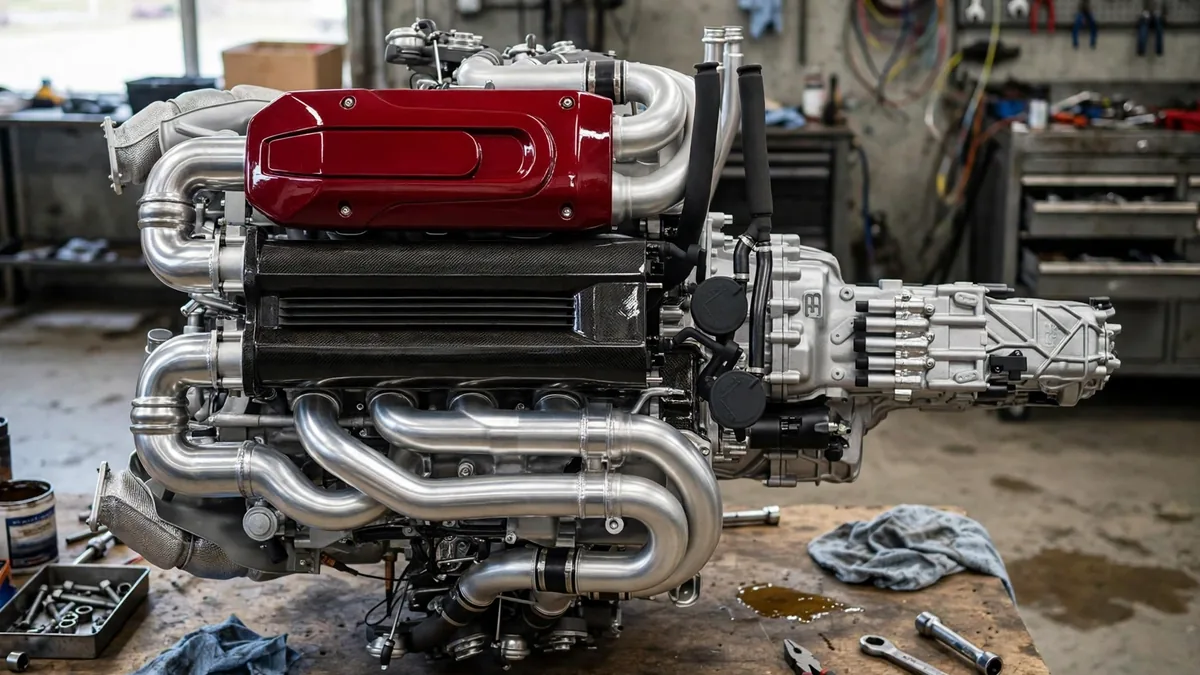
The W16 is really two narrow-angle V8 engines joined together at the crankshaft, forming a W shape when viewed from the front. That layout packs sixteen cylinders into a block barely longer than a normal V8, which is the only reason it fits in a road car at all.
Here is how the Bugatti W16 engine works, from the first breath of air to the exhaust leaving the tailpipes.
How the Bugatti W16 Engine Works
Step 1: Air is drawn in and squeezed by four turbochargers
Everything starts with air. Two large air intakes behind the doors feed the engine, and the air passes through filters before reaching four turbochargers, two on each side of the engine. Each turbocharger is a small turbine spun by exhaust gas, and it squeezes the incoming air to several times atmospheric pressure before it enters the cylinders. At low speed, only two of the four turbos are working, which keeps the engine smooth and responsive in traffic. As the revs rise, the other two join in, and the boost climbs until the engine is swallowing an enormous volume of air every second. The full numbers behind this engine are listed in the Bugatti W16 engine specs explained, which shows the power, torque, and boost figures it runs at.
Step 2: Fuel is injected and the mixture is compressed
With the air squeezed in, fuel is injected directly into each cylinder at very high pressure, and the mixture is drawn in as the piston falls. Each of the sixteen cylinders holds about half a litre, and the engine’s total displacement is just under eight litres. The pistons rise and squeeze the air and fuel mixture to a fraction of its original volume, and the W layout means the cylinders sit in four banks of four, two on each side, angled so tightly together that the whole engine is barely a metre long. The crankshaft at the bottom is a single massive forging, because it must take the push of sixteen pistons firing in turn and turn it into smooth rotation.

Step 3: The spark fires and sixteen pistons drive the crankshaft
At the top of each piston’s stroke, a spark plug fires, and the mixture explodes. The explosion drives the piston down with tremendous force, and the connecting rod pushes on the crankshaft, turning the explosion into rotation. The sixteen cylinders fire in a carefully chosen order, so that the pushes overlap and the crankshaft never has to wait for the next one. The power goes from the crankshaft to a seven-speed dual-clutch gearbox, which can change gear in a fraction of a second, and from there to all four wheels.
Step 4: Exhaust gas spins the turbos and leaves the car
The burnt gas leaves each cylinder through exhaust valves and into the exhaust manifolds, where it is still hot enough to spin the turbochargers. The gas drives the turbine wheels, which in turn drive the compressors that feed the engine, a loop that recovers energy that would otherwise be wasted out of the tailpipe. From the turbos, the gas flows into a large exhaust system with catalytic converters, and finally out through the centre-mounted tailpipes at the back of the car. The way the engine itself is assembled by hand is described in how a Bugatti W16 engine is made, which follows the build from the bare block to the finished motor.
Step 5: Ten radiators keep the heat under control
An engine making 1,500 horsepower also makes an enormous amount of heat, and cooling it is one of the hardest parts of the whole car. The Chiron carries ten radiators: three for the engine coolant, two for the intercoolers, two for the air conditioning, one for the gearbox oil, one for the engine oil, and one for the differential. Water pumps circulate coolant through the engine block, carrying heat away to the radiators at the front and sides of the car, where air flowing over them at speed dumps it into the atmosphere. If any part of that system fails, the engine’s computer cuts the power within seconds, because a W16 running hot would destroy itself in minutes.
Step 6: The computer manages everything, thousands of times a second
No driver could manage an engine this complex alone, so a computer does it. The engine control unit reads sensors for air temperature, boost pressure, fuel pressure, oil temperature, and exhaust temperature, and it adjusts the fuel injection, the spark timing, and the turbo boost thousands of times every second. The driver sees only a throttle pedal and a speedometer, but behind them, the computer is balancing sixteen cylinders, four turbos, and ten radiators in real time. It is the same kind of precision engineering that shapes other great engines, and the way a rival twelve-cylinder motor is put together is explained in how a hypercar V12 engine works, a simpler layout chasing the same goal.
Bugatti W16 Engine Specs
| Specification | Typical range |
|---|---|
| Configuration | W16, four banks of four cylinders |
| Displacement | 7,993 cc, about 8.0 litres |
| Power | About 1,500 horsepower in the Chiron |
| Torque | About 1,600 Nm |
| Turbochargers | Four, two-stage with two active at low revs |
| Redline | About 6,700 rpm |
| Radiators | Ten, for engine, intercoolers, oil, and gearbox |
| Fuel tank | About 100 litres |
What Does a Bugatti W16 Engine Cost?
Bugatti does not sell the W16 engine on its own, and the Chiron it powers is estimated at around three million dollars, but the engine itself is estimated at several hundred thousand dollars to replace, with some estimates putting a full replacement higher still. The cost comes from the hand assembly, the exotic materials, and the sheer number of parts: sixteen pistons, sixty-four valves, four turbochargers, and ten radiators, all built to tolerances measured in microns. All prices are estimates only and vary widely by model, condition, and country.
A Rare Fact
The W16 was born from a sketch. In the late 1990s, the head of the Volkswagen group drew the engine’s layout on an envelope during a train journey, showing two V8 engines joined at an angle. Engineers turned that sketch into a real motor, and the first version powered the Veyron, the car that broke the 400 kilometres per hour barrier for a production car. The W16 is now at the end of its life, with Bugatti moving to a new V16 hybrid, which makes the last W16 cars some of the final examples of an engine that will never be built again.

The W16 is an engine built without compromise, and it shows in every number it produces. Sixteen cylinders, four turbos, and a cooling system the size of a small car, all working together to do one simple thing: turn fuel and air into speed, faster than almost anything else on the road.