There is a moment, when a Bugatti Chiron accelerates, when sixteen cylinders, four turbochargers and eight litres of displacement all agree at once. The car does not so much speed up as change its mind about where the horizon is. The sound is not a scream. It is a deep, pressurised rush, like a jet engine clearing its throat, and behind it is a piece of engineering that took a decade to make work at all.
The W16 engine is the largest, most powerful production car engine ever built for the road, and it is also one of the most demanding materials puzzles in motoring. under pressures that would crush ordinary parts. The materials inside it are not exotic for the sake of it. Each one is there because nothing else survives.
This is the story of those materials: the alloys, the ceramics, the composites and the coatings that let sixteen cylinders live in a space smaller than a suitcase and still pull a car past 400 kilometres per hour.
The Materials Behind the Machine
1. The aluminium-silicon engine block
The block is the foundation, and it is cast from an aluminium-silicon alloy rather than iron, because weight matters as much as strength. The W16 is essentially two narrow-angle V8 engines sharing a crankshaft, so the block is enormously complex, with cooling passages, oil galleries and sixteen cylinder bores packed into a single casting. Aluminium alone would be too soft for the cylinder walls, so the bores are lined with a silicon-rich surface or cast-in liners that resist wear from the pistons. The alloy is heat-treated after casting to relieve the internal stresses that would otherwise warp it the first time it reached operating temperature.
2. Forged steel crankshaft and connecting rods
The crankshaft is the most stressed part of the engine, and it is forged from a high-strength steel alloy, then machined, ground and balanced to tolerances a human hair would ruin. Forging aligns the grain of the steel along the shape of the part, making it far tougher than a cast crankshaft. The connecting rods are forged from steel or, in some versions, titanium, and they have to survive being yanked and shoved thousands of times a minute while the pistons change direction at the top and bottom of every stroke. How the whole assembly is put together is shown in our guide to how the Bugatti W16 engine is made.
3. Forged aluminium pistons
The pistons are forged aluminium, chosen because they are light enough to change direction 6,000 times a minute without tearing the rods apart, yet strong enough to take the full force of combustion. Each piston carries rings of steel and cast iron that seal the burning gases in the cylinder, and the crown of the piston is often coated with a ceramic thermal barrier that reflects heat back into the combustion chamber instead of letting it soak into the metal. The pistons are cooled by jets of oil sprayed from below, a detail that matters because a piston that overheats expands, seizes, and ends the engine in seconds.
4. Titanium exhaust and Inconel
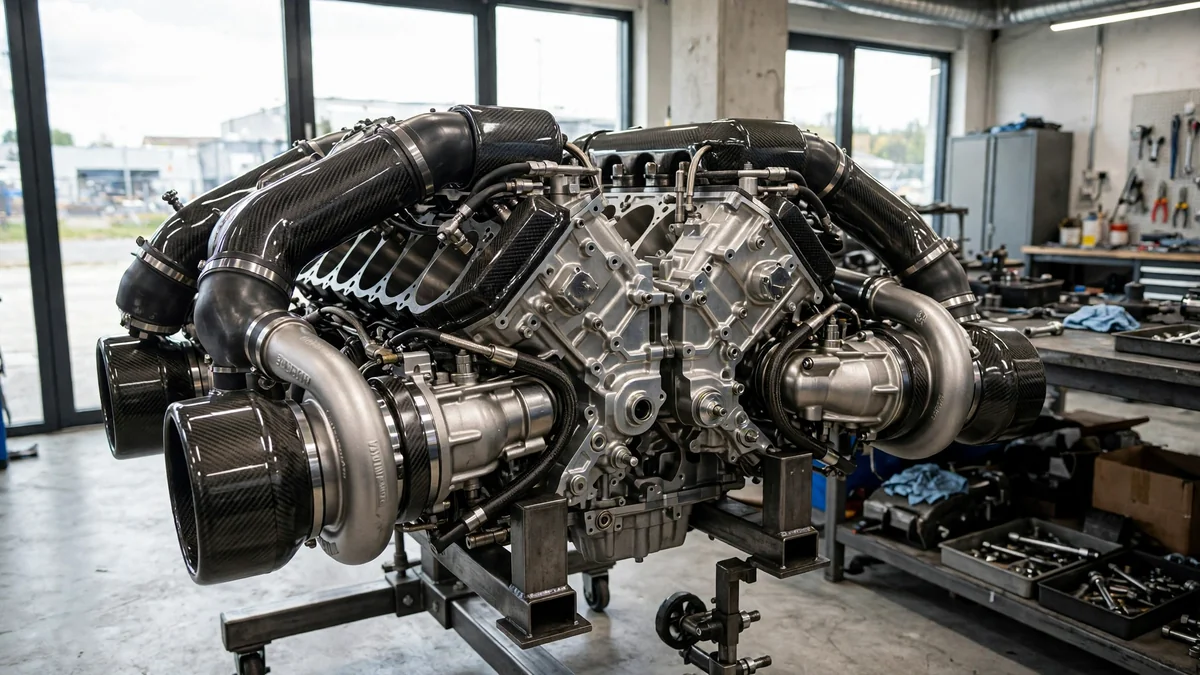
Getting the exhaust gases out of sixteen cylinders is a materials problem in itself. The exhaust system uses titanium for its lightness and heat resistance, and Inconel, a nickel-chromium superalloy, for the parts that see the very hottest gas, such as the turbocharger housings and the exhaust manifolds. The four turbochargers themselves spin at up to 200,000 revolutions per minute, and their compressor wheels are machined from aluminium or titanium, balanced so precisely that an imbalance of a fraction of a gram would destroy them. The numbers behind all of this are broken down in our guide to Bugatti W16 engine specs.

5. Carbon fibre intake and engine covers
Not everything in the engine bay is metal. The intake plenums and many of the covers are carbon fibre composite, and the reason is the same as on a racing car: stiffness and lightness, plus the ability to mould complex shapes that would be impossible to machine. The carbon fibre intake tracts are smooth inside, which helps the air flow cleanly into the cylinders, and they do not conduct heat the way metal would, so the incoming air stays cooler and denser.
6. Cooling: radiators, pumps and fluids
The W16 produces so much heat that it needs ten radiators to shed it, and the cooling system is a materials story of its own. The radiators are aluminium, brazed rather than soldered, because brazed joints survive the vibration and pressure of a hypercar. The coolant is a glycol-water mix with corrosion inhibitors that protect the aluminium from the inside, and the oil is a synthetic ester-based lubricant that stays stable at temperatures where ordinary oil would break down. Without this system, the engine would cook itself within minutes at full throttle.
7. Fasteners, gaskets and the final assembly
Holding it all together are fasteners and gaskets that most people never see. The cylinder head bolts are high-strength steel, tightened to a precise stretch rather than a torque figure, because stretch is a more accurate measure of clamping force. The head gaskets are multi-layer steel, with embossed beads that seal combustion pressure that would blow through a conventional gasket. Every seal is chosen for the fluid it touches: Viton rubber for fuel, silicone for coolant, and metal for exhaust. What it feels like when all of this works together is covered in our guide to how the Bugatti W16 engine works.
Key Specs at a Glance
| Part | Typical material | Why it is used |
|---|---|---|
| Engine block | Aluminium-silicon alloy | Light, strong, castable in complex shapes |
| Crankshaft and rods | Forged steel, titanium | Maximum fatigue strength |
| Pistons | Forged aluminium, ceramic coating | Light, heat-resistant crowns |
| Exhaust and turbos | Titanium, Inconel superalloy | Survives extreme exhaust heat |
| Intake and covers | Carbon fibre composite | Light, stiff, mouldable |
| Cooling | Brazed aluminium radiators | Fast heat transfer |
| Power output | 1,479 hp (Chiron) | Four turbochargers, 8.0 litres |
What It Costs
A Bugatti Chiron, the car the W16 is most famous for, was priced from around $3.3 million when new, with special versions such as the Chiron Super Sport costing around $3.9 million (estimates, prices varied by specification and market). The engine alone is a large part of that cost, and a replacement or rebuild is a six-figure job carried out only by the factory. The W16 was never about value. It was about building the most powerful road-car engine possible, and accepting whatever that cost.
A Rare Fact
Here is a fact that still surprises engineers: at full throttle, the W16’s four turbochargers move roughly 60,000 litres of air per minute, enough to empty a small house of air in seconds, and the engine burns fuel so fast that its tank would run dry in about nine minutes at top speed. The engine is, in effect, a small power station that happens to fit in a car, and it only works because every material inside it was chosen to survive conditions that would destroy an ordinary engine in minutes.