Run your hand along the hull of a superyacht in the yard and it feels impossibly smooth — no ripple, no bump, no seam your fingertips can find. That smoothness is not how the hull came out of the mould. It is made, layer by layer, by people with long sanding boards and an almost unreasonable patience, in a process called fairing. A hull that is not faired properly shows every flaw the moment it is painted, and drags through the water.
Fairing is the art of making a huge curved surface perfectly true. On a large yacht the hull can be thirty or forty metres long, with tolerance measured in millimetres over that whole length. It is slow, dusty, physical work, sitting between building the hull and painting it. Here is how yacht hull fairing is made.

How It’s Made
Step 1: Reading the hull
Fairing starts with finding the unfairness. The bare hull — fibreglass, aluminium, or steel — is checked with fairing battens, long flexible straightedges held against the surface. Where the batten rocks or gaps, there is a high spot or a hollow. Workers also shine raking lights along the hull, lamps set low so their light grazes the surface and throws every dip and bump into shadow. Flaws are marked with pencil or tape. This survey decides where filler goes and where material comes off, and it repeats many times.
Step 2: Filling the lows
The hollows are filled with fairing compound, a two-part epoxy filler loaded with tiny hollow glass microspheres that make it light and easy to sand. It is mixed in buckets and spread with wide trowels in thin coats, because a thick coat can crack as it cures. On a big yacht, tonnes of it can go onto a single hull. Each coat is left to harden while workers move to another section. The skill is in the spreading: a good fairer lays the compound close to the final shape, so there is less sanding later.
Step 3: Longboarding
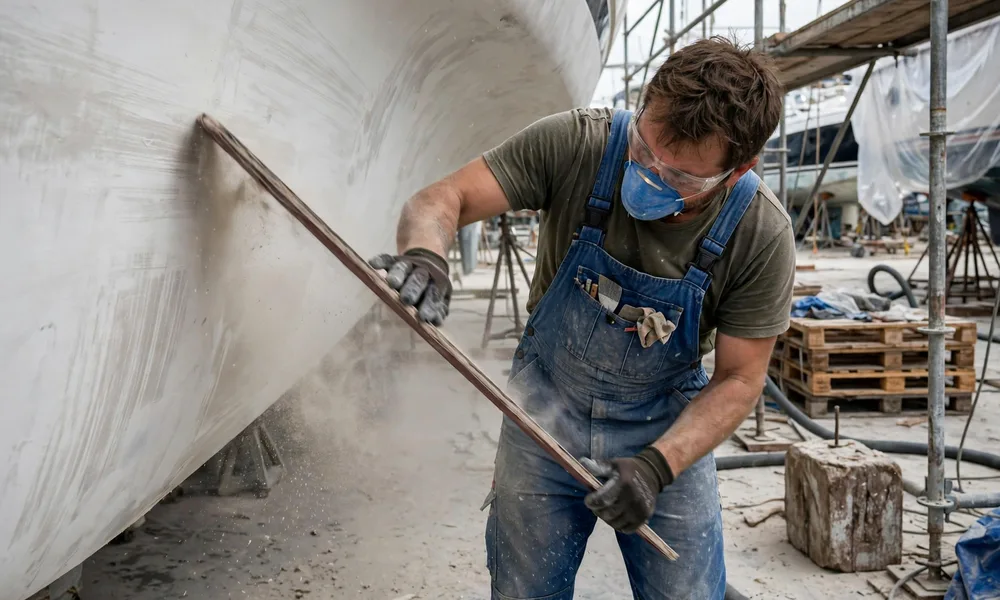
Once the filler has cured, the long, dusty heart of the job begins. Workers sand the hull with longboards — flat blocks up to a metre long, used two-handed in long sweeping strokes. The length matters: a short block follows every bump, while a long board bridges the lows and cuts only the highs, which is how a surface becomes truly fair. The dust is everywhere. A worker sands a whole side, checks it with the batten, fills the remaining lows, and sands again — three or four rounds is normal. The best yards do more.
Step 4: Guide coat and fine sanding
To see what is left, the hull is sprayed with a guide coat — a thin, contrasting mist of paint, often black over white filler or vice versa. Then sanding starts again with finer paper. Where the guide coat disappears first, the surface is high; where it stays, it is low. It is brutally honest, showing flaws the eye alone would miss. The grit gets finer with each pass, from coarse shaping paper to paper so fine it feels smooth. By the end, the hull should feel like a single continuous curve, with no edge or ripple anywhere.
Step 5: Primer and the final check
With the shape true, the hull gets its first coats of high-build epoxy primer, sealing filler and bare hull against moisture and giving the paint something to grip. Between coats, more fine sanding removes tiny imperfections the primer shows. Then comes the strictest check of all: raking lights again, and a senior fairer running a hand over the surface, feeling for the smallest flaw. The same obsession shows up elsewhere on the yacht, including the deck, as seen in the materials engineering behind a yacht teak deck. Any spot that fails is filled and sanded once more.
Step 6: Topcoat and polish
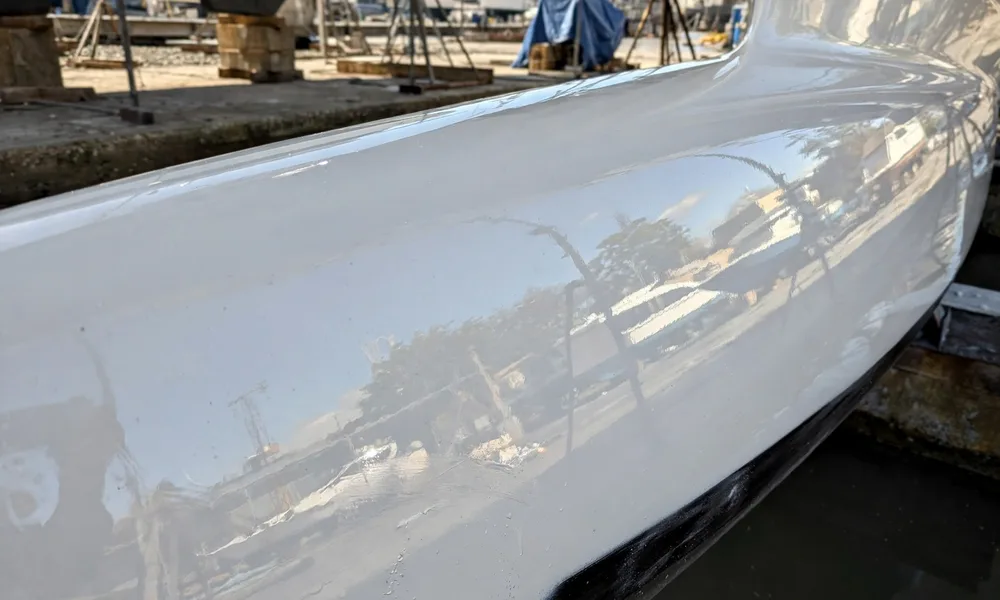
Only now does the hull get its colour. Marine topcoats are usually two-part polyurethane, sprayed in a booth or tented section of the yard in several thin coats. The painter works in overlapping passes, keeping a wet edge so the paint flows into one unbroken film. Between coats, the surface is lightly sanded to remove settled dust. After the final coat cures, the paint is polished to the deep mirror gloss a superyacht is known for. A perfectly faired hull makes paint look like liquid; a badly faired one makes even the best paint look wavy.
Step 7: Below the waterline
Below the waterline, the hull gets different treatment. Instead of gloss topcoat, it is faired to the same standard, then coated with antifouling paint, which slowly releases compounds that stop barnacles and weed from growing. A rough bottom can cost a yacht knots of speed and thousands of litres of fuel, so fairing below the waterline matters as much as the show side above it — judged by the speedometer instead of the eye. The running gear gets the same attention, as described in the specs behind a yacht propeller. When the antifouling is done, the hull is ready to meet the water.
Specs
| Specification | Typical figure |
|---|---|
| Fairing tolerance | Within 1–3 mm over the full hull length |
| Fairing compound | Two-part epoxy filler with glass microspheres |
| Filler used | Hundreds of kilos to over a tonne on a large yacht |
| Longboard length | Up to about 1 m for fairing large curves |
| Sanding grit range | From 40 grit shaping to 320 grit and finer |
| Primer | High-build epoxy, several coats |
| Topcoat | Two-part polyurethane, sprayed in thin coats |
| Time to fair | Weeks for a large yacht, months on a superyacht |
Price
Fairing is labour, and labour is what it costs. As an estimate, a full fair and paint job on a mid-sized yacht is roughly $50,000 to $150,000, while on a large superyacht it can run to $500,000 or more — these are estimates, and the real figure depends on hull size, condition, and the standard of finish. The compound itself is a small part of the bill: the cost is in the thousands of hours of sanding, typically estimated at roughly $1,000 to $3,000 per metre of hull length. It is expensive, but repainting a badly faired hull costs far more.
A Rare Fact
Some of the best fairers work almost entirely by feel. They run a bare hand over a hull in the dark, or with eyes closed, because the hand can feel a bump of a fraction of a millimetre that the eye cannot see. And the longboard is an old idea: boatbuilders have used long, flexible battens to find the true curve of a hull for centuries, long before fibreglass or epoxy. The tools have changed — the filler is modern, the paint is modern — but the test is still the same: a straight edge, a grazing light, and a hand that knows what smooth really feels like.
A faired hull is invisible work. Nobody at a marina points at a yacht and admires its fairing, because when it is perfect, there is nothing to see — just a curve that looks like it grew that way. The builders spent weeks in dust so the paint could shine and the water could slip past. The same craft shapes the rest of the build, as shown in an inside look at yacht hull fairing production. The next time a white hull glides past looking like polished glass, remember the longboards.


