A container ship is the largest moving object most people will ever see, and its hull is a steel box longer than three football fields, carrying twenty thousand containers across oceans that try to break it. The waves bend it, the salt eats it, and the cargo presses down on it, yet the hull holds together for twenty-five years or more.
The hull of a container ship is made mostly from ordinary-looking steel, but there is nothing ordinary about how it is graded, welded and protected. High-strength steel goes where the bending loads are greatest, tougher steel goes where the temperature drops, and paint stands between the steel and the sea.
The Materials Behind the Container Ship Hull
A ship’s hull is a girder as much as it is a boat. As it rides over waves, the middle is supported while the ends hang, then the ends are supported while the middle hangs, and the hull bends first one way and then the other, thousands of times on every voyage. That bending, called hogging and sagging, puts the deck and the bottom under enormous alternating stress. The steel must be strong enough to carry the load, tough enough not to crack, and weldable enough to join into a structure the size of a small town.
Step 1: High-tensile steel where the bending is worst
The main steel in a container ship hull is high-tensile shipbuilding steel, graded AH32 or AH36, which means it yields at around 315 to 355 megapascals, roughly a third stronger than ordinary mild steel. That extra strength lets designers use thinner plates, saving weight that can be spent on cargo instead. The strongest steel goes in the deck and the bottom plating amidships, where the bending stress is highest.
Step 2: Tough steel for cold water and hard knocks
Strength alone is not enough. Steel that is strong but brittle will crack, and the most famous failures in shipbuilding history came from brittle fracture in cold water. So hull steel is also graded for toughness, tested by smashing notched samples at low temperatures to make sure it bends before it breaks. Grade A steel is tested at room temperature, while grades D and E are tested down to minus twenty and minus forty degrees Celsius, for ships that work in polar waters. The bow and the parts of the hull most likely to be hit by ice or floating debris get the toughest grades, a quiet insurance policy written into the steel specification.
Step 3: Cutting, bending and building the blocks
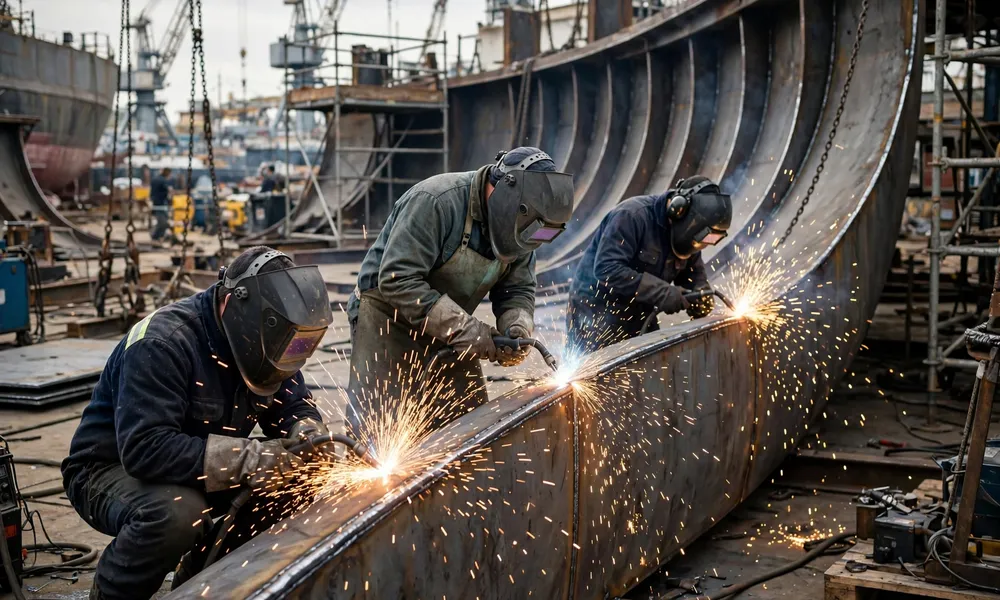
Modern hulls are not built plate by plate on a slipway. They are built in blocks, huge sections of hull assembled upside down in a workshop, then lifted by crane and welded together in the dry dock. Steel plates are cut by plasma or laser, bent into curved shapes, and welded into panels stiffened by frames — the ribs of the ship. The blocks can weigh hundreds of tonnes each. The aircraft carrier flight deck is built the same way, in blocks, because it is the only practical way to assemble something that large to millimetre accuracy.
Step 4: Welding, the joint that must be as strong as the plate
A container ship hull contains kilometres of welds, and every one of them must be as strong as the steel it joins. Most hull welding is done with submerged arc welding, where the arc burns under a blanket of flux, or with flux-cored wire for work done by hand. Critical welds are inspected by ultrasound or X-ray to find cracks and voids hidden inside.
Step 5: Double hulls and the ballast tanks inside
Since the 1990s, most large ships have been built with double hulls: an outer skin and an inner skin with a gap between them, used for ballast water. The double hull protects the cargo holds if the outer skin is damaged, and it gives the ship a second line of defence against grounding. The steel inside the ballast tanks lives a hard life, alternately full of seawater and empty, and it is protected by epoxy coatings and by sacrificial anodes bolted to the tank walls.
Step 6: Paint, antifouling and the coating system
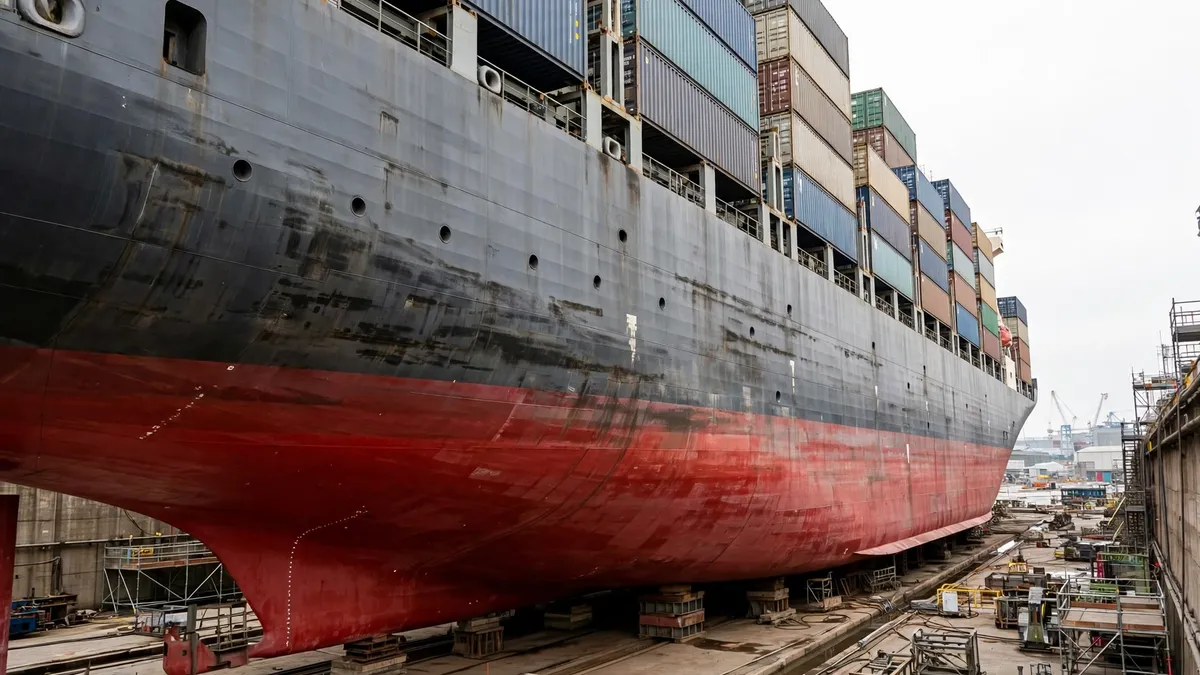
The paint on a ship is not decoration; it is a materials system in its own right. The underwater hull gets a primer, an anticorrosive epoxy coat, and a top coat of antifouling paint, which slowly releases biocides or presents a slippery silicone surface that barnacles and weed cannot grip. Above the waterline, the topsides get hard-wearing epoxy and polyurethane paints that resist sun, salt spray and the scrape of containers. The ferry hull wears the same system, repainted every time the vessel comes into dry dock.
Step 7: Cathodic protection and the anode’s sacrifice
Even the best paint has scratches, and where steel is exposed to seawater it corrodes. So the hull is fitted with cathodic protection: lumps of zinc or aluminium alloy bolted to the underwater hull, or an impressed-current system that pushes a small electric current through the steel. The anodes corrode instead of the hull, and they are replaced at every dry docking. The system is simple, cheap and effective, and it is the same principle that protects the cruise ship engine room’s seawater pipework, where different metals meet in salt water and the least noble metal must be chosen to lose.

Container Ship Hull at a Glance
| Specification | Detail |
|---|---|
| Main material | High-tensile shipbuilding steel, grades AH32 and AH36 |
| Yield strength | About 315–355 megapascals |
| Toughness grades | A, D and E, tested down to −40°C |
| Construction | Welded steel blocks, assembled in dry dock |
| Welding | Submerged arc and flux-cored, inspected by ultrasound |
| Hull form | Double hull with ballast tanks between skins |
| Coatings | Epoxy anticorrosive plus antifouling top coat |
| Typical life | About 25 years of service |
What Does It Cost?
A new large container ship costs between $100 million and $200 million (estimate) to build, and the hull steel is a large share of that: a big ship uses 30,000 to 50,000 tonnes of steel (estimate), with shipbuilding plate costing roughly $600 to $900 per tonne (estimate). Repainting a hull in dry dock costs $1 million to $3 million (estimate) depending on size, and a full dry docking with steel repairs and anode replacement runs several million dollars (estimate).
A Rare Fact
The steel in a ship’s hull is so carefully graded that the deck and the bottom are made from different recipes, and the ship’s own weight is part of the design load. When a container ship is loaded unevenly, the hull can bend visibly — by tens of centimetres over its length — and the loading computer on the bridge constantly calculates the bending and shear forces to make sure the crew never overloads one section. The hull is not a rigid box; it is a flexible girder that bends with every wave, and it is designed to flex for a quarter of a century without ever cracking. A ship that did not bend would break.


