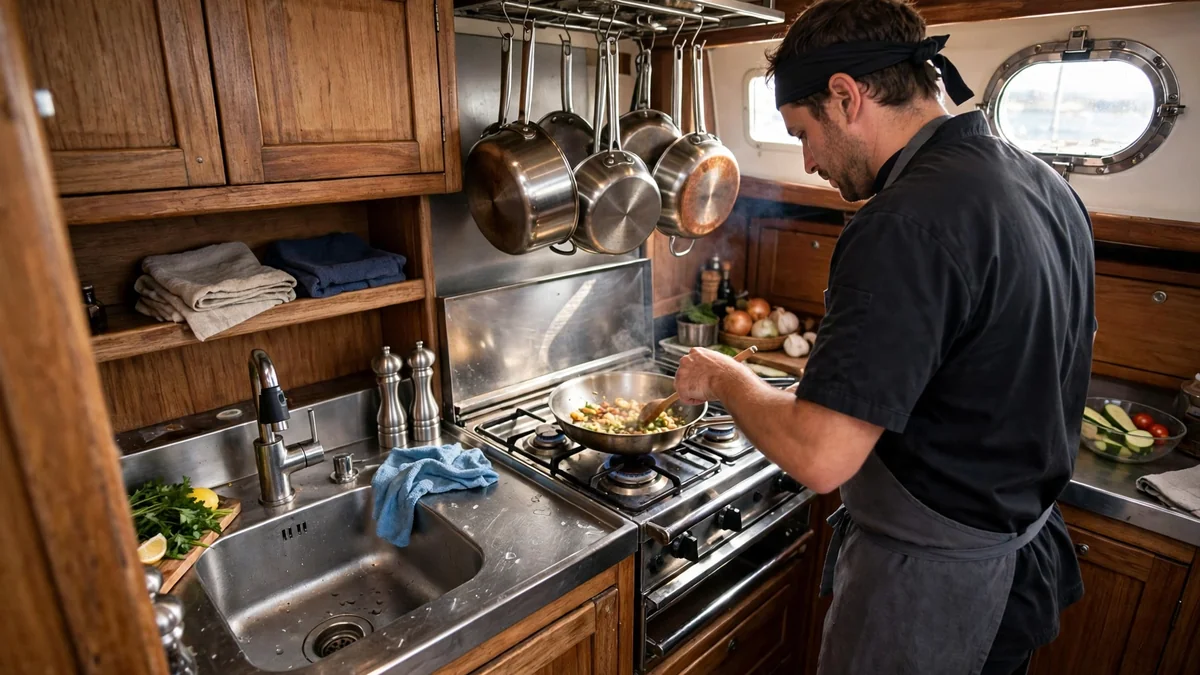
Dinner is served at eight on a luxury yacht anchored in a quiet bay, and the guests never see the room where it was made. Below their feet, down a narrow staircase, a chef is working in a kitchen the size of a walk-in wardrobe, plating food for twelve people while the yacht gently rolls.
That room is the galley, and on a luxury yacht it is one of the most engineered spaces on board. It has to do the work of a restaurant kitchen, with ovens, freezers, and a full team, inside a steel box that moves, tilts, and has nowhere for the smells, the steam, and the heat to go.
The specification sheet for a yacht galley lists the cooking equipment, the refrigeration, the ventilation, and the storage, and it reads like a puzzle: how do you fit a professional kitchen into a room smaller than a hotel bedroom?
Luxury Yacht Galley Specs Explained
1. Cooking range and oven capacity
The heart of the galley is the range, and on a luxury yacht it is usually a marine-grade unit between 90 and 120 centimetres wide, with four to six burners and at least one oven. The range is gimballed or fitted with pot holders and rails, so pans do not slide off when the yacht rolls, and the oven door locks shut. The power for all of this comes from the yacht’s generators, and the machines that make that power are built to the standard described in the superyacht engine room materials engineering.
2. Refrigeration and freezer volume
Refrigeration is the galley’s biggest space problem. A luxury yacht at sea for two weeks needs cold storage for fresh food, frozen food, drinks, and ice, and the total is usually between 1,500 and 3,000 litres, split across several separate units. The reason for splitting it is safety: if one fridge fails, the whole food supply is not lost, and the chef can keep meat, fish, and dairy at different temperatures.
3. Ventilation and extraction
A galley produces more heat and steam than any other room on a yacht, and the extraction system has to remove all of it. The canopy hood above the range is sized to pull between 1,000 and 2,000 cubic metres of air per hour, and it has to do that without pulling the air conditioning out of the guest cabins or filling the deck with the smell of frying fish. The ducting runs up through the yacht to a vent on the top deck, and it is fitted with grease filters that are cleaned daily, because a greasy duct is a fire risk.
4. Work surfaces and storage
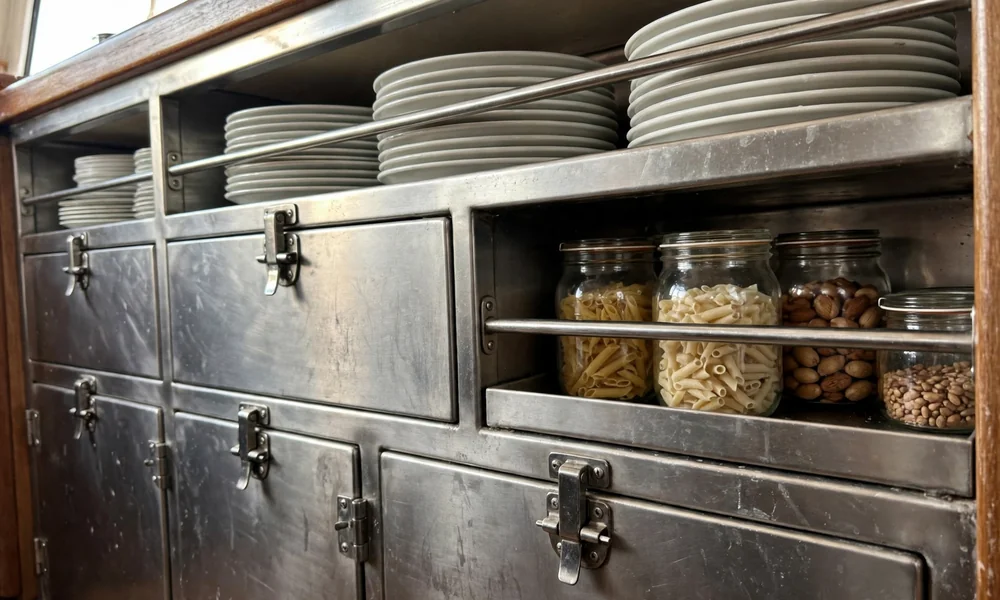
Work surfaces in a yacht galley are almost always stainless steel, because it can be scrubbed clean, it does not absorb smells, and it survives the salt air. The total surface is usually between 3 and 5 square metres, which is far less than a restaurant kitchen, so every centimetre is planned: a cutting board that slides over the sink, a shelf that folds down, a rail that holds knives and utensils within reach. The woodwork around the galley, the lockers, the panelling, and the fitted units, is made by the same craftsmen who build the guest cabins, and inside superyacht interior joinery production shows how those pieces are shaped and fitted to the curve of the hull.
5. Water supply and sinks
A galley uses a large amount of fresh water, for cooking, for washing, and for cleaning, and it draws that water from the same tanks as the rest of the yacht. The sinks are deep, usually two or three of them, with a high-pressure tap and a separate tap for filtered drinking water. The water itself is made on board by the yacht’s watermaker, and the specification for that machine is set out in the superyacht watermaker specifications. If the watermaker stops, the galley is one of the first rooms to feel it, because a chef without water cannot cook, wash, or clean.
6. Fire safety and suppression
Fire is the greatest fear in a yacht galley, because the room is full of heat, oil, and gas, and it sits below the guest cabins. The specification sheet lists a fire suppression system, usually a fixed system that floods the space with a clean gas or a fine water mist, triggered automatically by heat sensors. The gas is safe for people to breathe for a short time, which matters, because the chef may be in the room when it goes off. Every crew member is trained to use the system, and it is tested regularly, because a system that has never been tested is a system nobody trusts.
7. Crew working space and ergonomics
The last specification is the one the chef cares about most: how many people can work in the room at once. A luxury yacht galley is usually designed for two to four people, with a clear walkway about 90 centimetres wide and a ceiling high enough to stand in, usually just over two metres. That sounds cramped, and it is, but it is deliberate: in a rolling sea, a small room is safer than a large one, because the chef can brace against a counter or a wall and never be thrown across an open space.
Luxury Yacht Galley Specs
| Specification | Typical range |
|---|---|
| Range width | About 90 to 120 centimetres |
| Burners | Four to six, plus oven |
| Cold storage volume | About 1,500 to 3,000 litres |
| Wine cooler temperature | About 12 to 14 degrees Celsius |
| Extraction rate | About 1,000 to 2,000 cubic metres per hour |
| Work surface area | About 3 to 5 square metres |
| Crew capacity | Two to four people |
| Walkway width | About 90 centimetres |
| Fire suppression | Fixed gas or water-mist system |
What Does a Luxury Yacht Galley Cost?
A luxury yacht galley is estimated to cost roughly $300,000 to $900,000 to build and fit out, depending on the size of the yacht and the quality of the equipment. A compact galley on a 30-metre yacht is estimated at the lower end, while a full professional galley on a 60-metre yacht, with two ovens, a walk-in cold room, and a separate crew mess, is estimated at the top end or beyond. Running the galley costs a great deal too, because the refrigeration runs all day and night, and the chef’s provisions for a two-week cruise can run into tens of thousands of dollars.
A Rare Fact
On some of the largest yachts, the galley is fitted with a dumbwaiter, a small lift that carries dishes from the kitchen below up to the dining saloon above, so the crew do not have to carry hot plates up a narrow staircase while the yacht rolls.

The galley is the one room on a luxury yacht that guests never see and never stop talking about, because everything they eat comes out of it.


