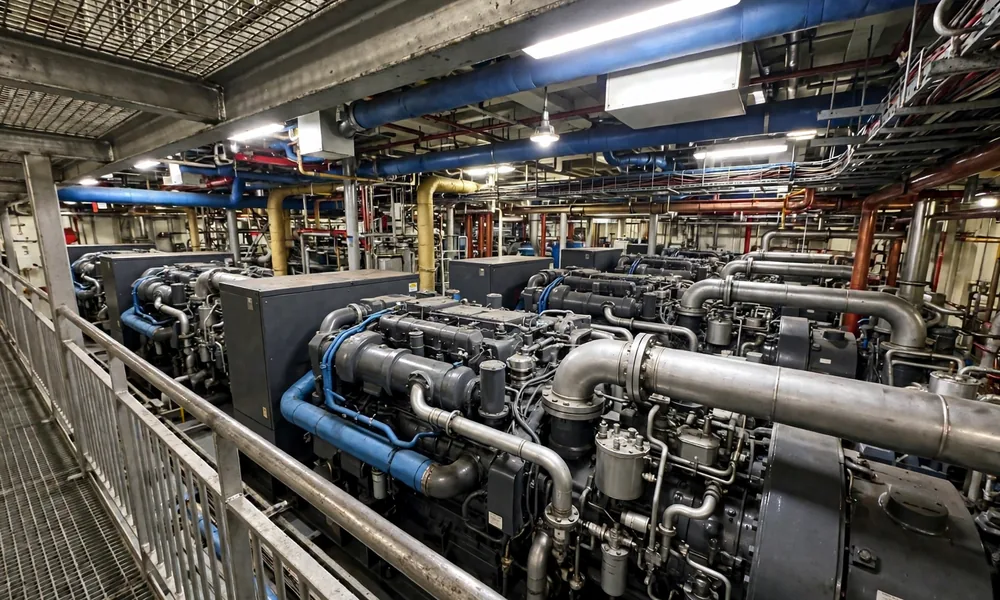
A modern cruise ship is a floating town of five thousand people, and it moves on electricity — not on a propeller shaft driven directly by an engine, the way cargo ships still do, but on a power station. Four to six diesel or gas engines turn alternators, the alternators feed a high-voltage switchboard, and the switchboard feeds everything: propellers, air conditioning, galleys, theatres, lights. Propulsion is just the biggest customer on the grid. That one decision — electricity first, thrust second — shapes how the ship moves, manoeuvres, and survives a failure.
The system is called diesel-electric, and it dominates cruise ships for a practical reason: a cruise ship’s power demand swings wildly — full speed at sea, dead slow in port, huge hotel loads all the time — while a direct-drive engine is efficient at one speed and poor everywhere else. A diesel-electric plant lets the power management system start and stop generator sets to match the load, so every running engine works near its most efficient point.

The power plant: engines that never touch the propeller
A large cruise ship carries four to six medium-speed generator sets, usually V16 or V20 marine diesels from Wärtsilä, MAN, or Caterpillar, with a combined output of sixty to one hundred megawatts. They run at constant speed, driving alternators that produce electricity at 6.6 or 11 kilovolts. None of them is connected to a propeller. Instead they all feed a common high-voltage busbar, split into two or more sections by bus-tie breakers so that a fault in one half cannot take down the other.
The fuel is changing. Most of the fleet still burns marine diesel or heavy fuel oil, but new builds increasingly burn liquefied natural gas in dual-fuel engines that can switch back to diesel when LNG is not available. LNG is cooled to minus 162 degrees Celsius, stored in double-walled insulated tanks, then regasified and burned; it cuts sulphur almost entirely and nitrogen oxides by up to 85 percent. AIDAnova, the first LNG cruise ship, entered service in 2018, and the biggest new ships — Icon of the Seas, Mardi Gras, MSC World Europa — are all LNG-powered. Gas turbines and battery hybrids have been tried, but the diesel-electric plant remains the backbone.
Azipods: the propeller becomes the rudder
The most visible change in cruise propulsion is the pod. An Azipod, developed by ABB and first fitted to a cruise ship in 1998, puts the electric propulsion motor inside a streamlined pod suspended below the stern, driving a propeller directly. The whole pod rotates through 360 degrees, so it provides thrust and steering in one unit. There is no long shaft line, no gearbox, and no rudder at all.
That freedom changes how the ship handles. Because each pod can push in any direction, two pods and a set of bow thrusters can move the ship sideways, turn it on the spot, or hold it against a crosswind without a tugboat. A mega-ship of 180,000 gross tons can berth in a narrow port under its own power. A crash stop is quicker too: instead of reversing a shaft, the pod simply turns or reverses its motor electronically. The pods also save fuel, because the pulling propeller at the front of the pod meets undisturbed water, and removing the shaft and rudder cuts drag. ABB claims fuel savings of 10 to 20 percent over a conventional shaft line, and pods now power more than a hundred cruise ships.
The trade-off is maintenance. A pod is a large electric motor hanging in seawater, sealed by complex seals and cooled by the water around it; when a seal or bearing fails, the ship must go into dry dock, because there is no fixing a pod at sea. The frequency converters that drive the pod motors are sophisticated electronics with rooms of their own. The specs of a cruise ship engine show how much electrical machinery now sits between the fuel tank and the propeller.
| Diesel-electric + Azipod | Direct-drive diesel | LNG dual-fuel electric | |
|---|---|---|---|
| Engines drive | Alternators only | Propeller shaft directly | Alternators only |
| Steering | Rotating pods, no rudder | Rudder behind propeller | Rotating pods, no rudder |
| Can berth without tugs | Yes | Rarely | Yes |
| Fuel | Diesel / heavy fuel oil | Diesel / heavy fuel oil | LNG, diesel backup |
| Where it dominates | Cruise ships | Cargo ships | New cruise builds |
Bow thrusters and staying put
Pods do the open-water work, but a cruise ship also needs to move sideways in port. Bow thrusters — propellers in tunnels across the bow, below the waterline — push the bow to port or starboard, and with the pods they let the bridge team slide the whole ship sideways into a berth. In joystick mode one control blends pods and thrusters: the officer pushes the stick sideways and the computer works out the thrust and angle for every propulsor at once.
The same system holds the ship still. Dynamic positioning software coordinates pods and thrusters to lock the ship over one spot without anchoring, useful when visiting a tender port or holding off a private island where dropping an anchor would damage the seabed. And the stabilizer fins, which work the same way on a cruise ship as on a yacht, keep the dining rooms level while all of this happens. The way a ship stabilizer works explains the other half of the comfort equation: propulsion gets the ship there, stabilizers make the journey bearable.
Surviving a failure at sea
The deepest reason cruise ships are built this way is redundancy. A cruise ship cannot be towed home easily, and it carries thousands of people who cannot be put in lifeboats in a storm, so it is designed to keep moving after something breaks. The power plant is split into two engine rooms, fore and aft, separated by a watertight bulkhead. The busbar is split. Each propulsion motor has two separate stator windings, so if one fails the other can still drive the ship at reduced power. And because the engines are not mechanically connected to the propellers, losing an engine costs the ship power, not propulsion entirely — the remaining generators simply carry more of the load.
That philosophy extends to the whole ship: the comparison of diesel and hybrid ship propulsion shows the same logic spreading to other vessel types — separate the power from the thrust, and you can lose almost any single component and still get home. On a cruise ship the stakes make it mandatory, and the Safety of Life at Sea rules enforce it.
What comes next
The next change is already arriving. Batteries are appearing as peak-shaving buffers, letting engines run at their most efficient load while the battery absorbs the peaks, and a few ships can run silently on battery alone in port. Shore power lets ships switch their engines off entirely and plug into the local grid. Methanol and ammonia are being tested as future fuels, and fuel cells have been trialled on smaller vessels. None of these replaces the diesel-electric architecture; they all plug into it, because it was designed to accept any source of electricity and turn it into thrust.
That is the real idea behind cruise ship propulsion. The ship is not a boat with an engine; it is a power station that happens to float, and the propeller is only one of its customers. Build the power station well, and everything else — speed, manoeuvrability, comfort, survival — follows.