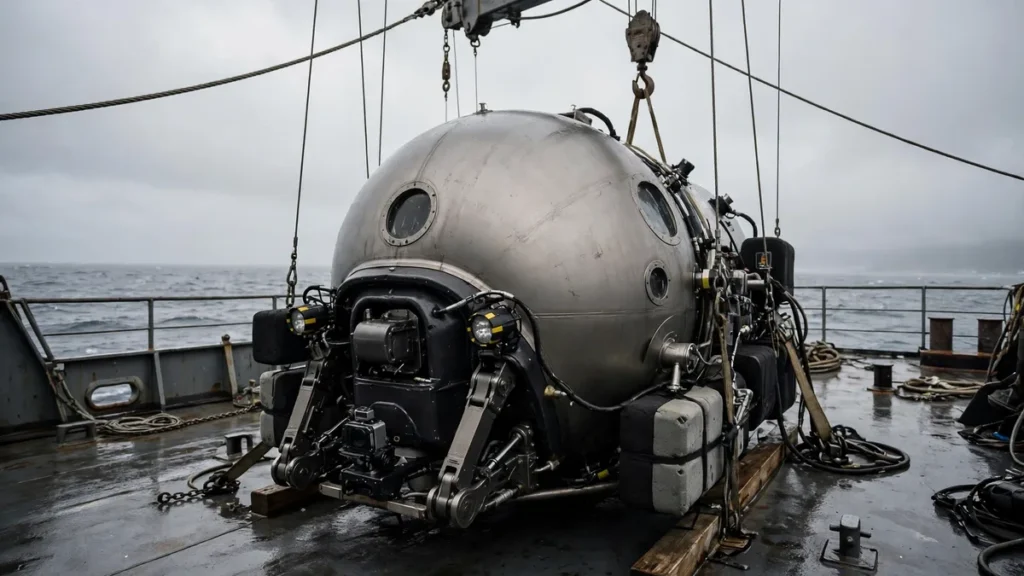
Three kilometres below the surface, there is no sunlight, no sound from the world above, and a pressure that would crush a car flat in an instant. The water is close to freezing, and the nearest help is hours away. Yet inside a small metal sphere, two people sit in shirtsleeves, watching fish drift past a window, perfectly comfortable. The vehicle around them is a deep-sea submersible, and it is one of the most extreme machines humans have ever built.
A submersible is not a submarine. It does not patrol the oceans for months or carry a crew of dozens. It is a small, specialised craft, launched from a ship, that dives straight down to a single place, does its work, and comes back up. Some carry scientists to hydrothermal vents. Some inspect pipelines and wrecks.
Everything about a submersible is a negotiation with pressure. This is how a deep-sea submersible works, from the sphere that keeps its crew alive to the weights that bring it home.

How It Works
Step 1: The sphere takes the pressure
The heart of every deep-sea submersible is its pressure hull, and it is almost always a sphere. A sphere is the strongest possible shape for resisting pressure, because the force is spread evenly across its entire surface, with no flat panels to bend and no corners to concentrate stress. The sphere is usually made from titanium or specialist steel. Its walls are thick — several centimetres of solid metal — and it is machined to near-perfect roundness, because even a tiny flat spot would become a weak point under pressure. The engineering of that hull is closely related to the larger pressure hulls of military boats, as how a submarine pressure hull works explains.
Step 2: The window holds back the ocean
The crew needs to see out, and that means cutting a hole in the perfect sphere — the most dangerous thing you can do to a pressure vessel. The window, or viewport, is a thick disc of acrylic, usually conical in shape, set into a metal seat. As the submersible dives deeper, the water pressure pushes the cone tighter into its seat, so the seal actually gets stronger with depth. Before every dive, the viewport is inspected for the tiniest scratch or crazing, because at full ocean depth a flaw in the window is not a maintenance issue; it is a catastrophe.
Step 3: Ballast decides up or down
A submersible does not have a propeller powerful enough to fight its own buoyancy. Instead, it dives and surfaces using ballast, in the simplest way imaginable: it carries heavy weights. To descend, the crew release air from buoyancy tanks or simply let the craft’s own weight pull it down, sinking at a slow, steady rate. To come back up, they drop the weights. The weights are held by mechanisms that can be released in several independent ways — electrically, hydraulically, and even by a simple corroding link that dissolves after a set time, so that a stricken submersible will eventually drop its weights and float to the surface on its own. The same principle, on a much larger scale, drives the ballast systems of full-size submarines, as how submarine ballast tanks work shows.

Step 4: Thrusters steer in the dark
Once at depth, the submersible moves with small electric thrusters, usually four or more, mounted around its frame. They are not powerful — a submersible cruises at walking pace — but they are precise, letting the pilot hover, turn on the spot, and hold position against a current while a manipulator arm works. The pilot steers with a joystick, watching through the viewport and on camera screens, and the thrusters respond instantly. Power comes from batteries, usually lithium or specialist pressure-tolerant packs, and every watt is budgeted, because there is no charging at the bottom of the ocean.
Step 5: Life support keeps the crew breathing
Inside the sphere, two or three people breathe the same small volume of air for hours. Oxygen is supplied from tanks, and carbon dioxide is removed by chemical scrubbers, usually canisters of a material that absorbs the gas as air is circulated through them. The system is monitored constantly, with alarms for oxygen, carbon dioxide, and temperature, and there is always a generous reserve — most submersibles carry enough life support for several times the planned dive duration. It is a small, quiet system, and it has to be perfect, because there is no opening a window at three thousand metres.
Step 6: The submersible finds its way home
Navigation underwater is a problem, because radio waves do not travel through seawater and there is no GPS at depth. A submersible finds its way using sound. The support ship tracks it with sonar, and the two exchange acoustic signals — slow, coded pings that carry position, depth, and short messages. Listening to the ocean is a whole discipline of its own, as how a submarine sonar array works explains. When the work is done, the pilot drops the weights, the craft rises slowly through the dark water, and the ship’s crew watches the sonar until it breaks the surface.
| Main material | Titanium or specialist steel sphere, several centimetres thick |
| Typical crew | Two or three people in a sphere barely larger than a small car |
| Maximum depth | About 6,000 metres for research craft; nearly 11,000 metres for the deepest |
| Pressure at 6,000 metres | About 600 times atmospheric pressure |
| Viewport | Conical acrylic disc, more than 15 centimetres thick for the deepest dives |
| Propulsion | Electric thrusters, cruising at walking pace |
| Descent and ascent | Drop weights to sink; release weights to rise |
| Life support | Oxygen tanks and carbon dioxide scrubbers, with large reserves |
What Does a Deep-Sea Submersible Cost?
A deep-sea submersible is one of the most expensive vehicles per seat ever built. A modern research submersible rated to 6,000 metres is estimated at roughly $30 million to $50 million, while a full-ocean-depth craft capable of reaching the deepest trenches is estimated at $50 million to $100 million or more, including its support systems. Those are estimates only, and they exclude the support ship, which can cost far more than the submersible itself. Day rates for chartering a research submersible with its ship run into hundreds of thousands of dollars.
A Rare Fact
The deepest place on Earth, the Challenger Deep in the Mariana Trench, has been visited by fewer people than have walked on the Moon. The first descent, in 1960, took the bathyscaphe Trieste nearly five hours to fall eleven kilometres, and the crew spent just twenty minutes on the bottom before starting the long climb back. More than sixty years later, only a handful of people have followed them, and every one of them travelled inside a sphere, trusting a few centimetres of metal and a single window against a thousand atmospheres of ocean.
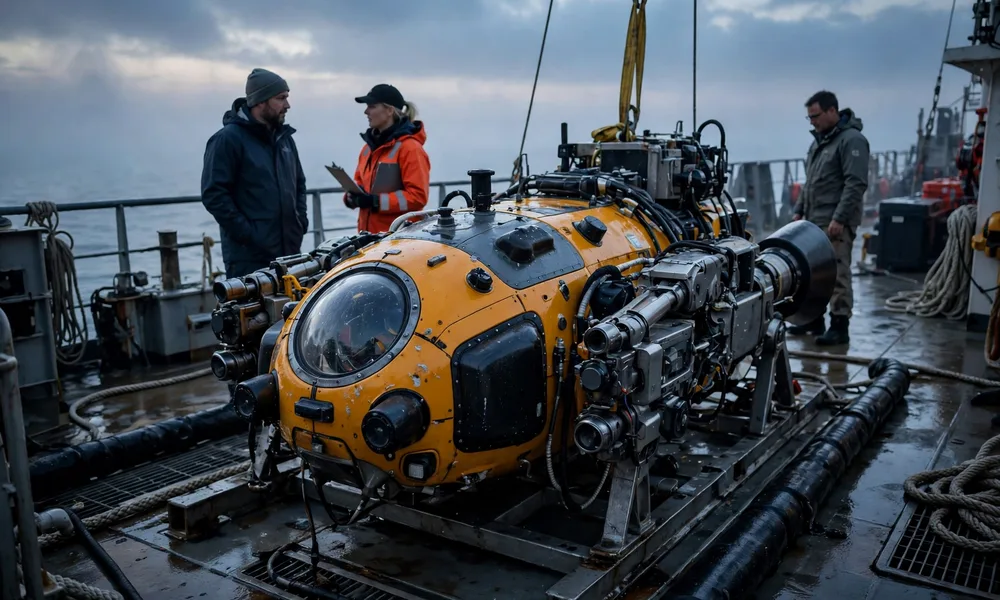
A deep-sea submersible is a reminder that the most advanced engineering is often the simplest: a sphere, a window, some weights, and a supply of air. There is no glamour in the design, no excess, nothing that is not needed. It exists for one reason — to take human eyes somewhere no human could otherwise go — and it does that job by respecting the ocean completely.