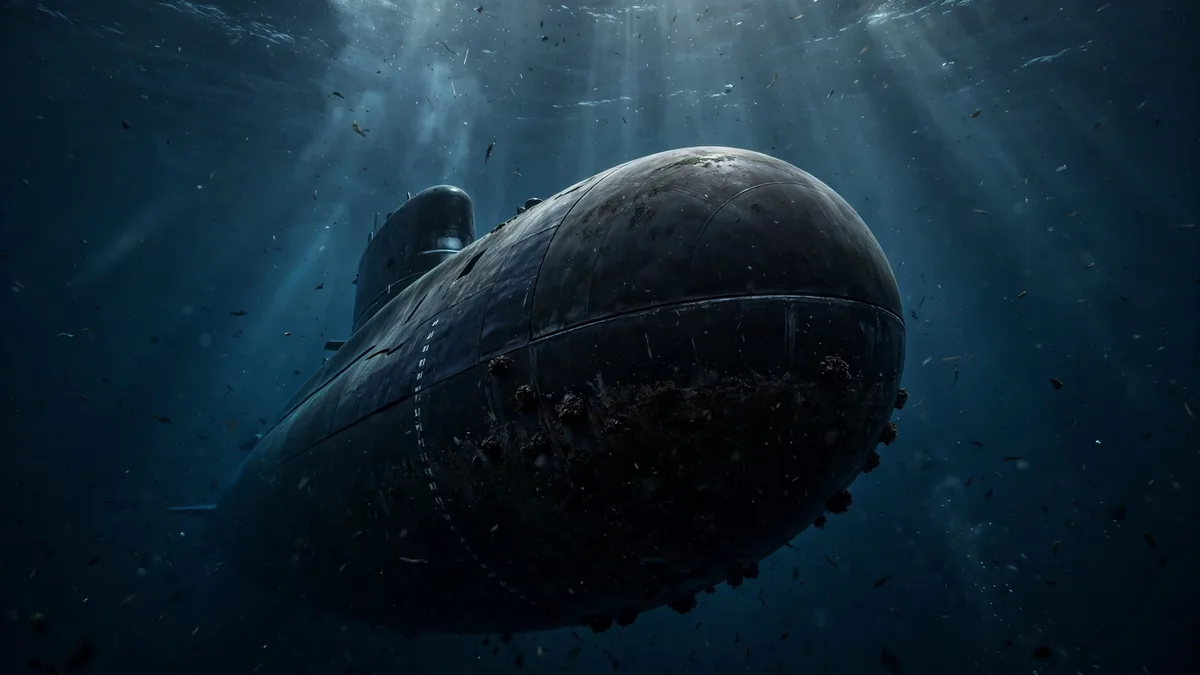
Two hundred metres below the surface, in water blacker than any night, a submarine moves without ever opening its eyes. There is nothing to see down there, and the crew would not want to be seen anyway. So the boat listens. Spread across its bow like a curved ear, and trailing behind it on a cable longer than a city block, sits a sonar array, thousands of small ceramic discs that turn sound into electricity and back again. It is how the boat finds its way, hunts its targets, and stays alive.
How a Submarine Sonar Array Works
Sonar is sound navigation and ranging, the underwater cousin of radar. Sound travels about four and a half times faster in water than in air, and it can cross tens of kilometres where light dies within metres. A sonar array is not one sensor but a grid of transducers, devices that convert pressure into voltage and voltage into pressure. Working together, they can point a beam of sound, listen for echoes, and build a picture of the ocean around the boat. The array comes in several parts, and each one listens differently.
Step 1: The bow sphere hears in all directions
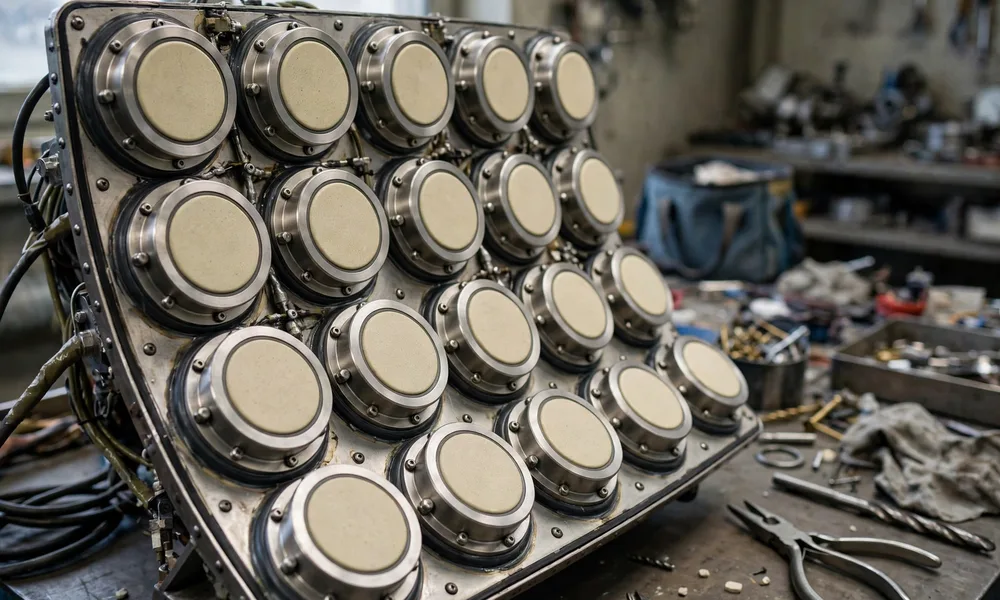
The main array is a sphere, or a cylinder, of hundreds of hydrophones mounted inside a free-flooding dome at the bow. Water flows through the dome, so the transducers sit in direct contact with the sea. Each hydrophone is a disc of piezoelectric ceramic, a material that produces a tiny voltage when squeezed by a sound wave. By comparing the arrival time of a sound at different points on the sphere, the system works out which direction it came from, to within a fraction of a degree.
Step 2: The flank arrays listen along the hull
Along both sides of the hull run long, flat panels of hydrophones called flank arrays. They are set into the hull so they do not disturb the water flowing past, and they give the boat a wide aperture, a long baseline for measuring the direction of a sound. A distant freighter’s propeller, a whale, or another submarine each has a sound signature, and the flank arrays help separate one from the other. The pressure hull of a deep-sea submersible faces the same ocean, but it is built to survive depth rather than to listen, and the two designs show how differently the same sea can shape a machine.
Step 3: The towed array trails far behind
The longest ear of all is the towed array, a cable hundreds of metres long, reeled out behind the submarine and studded with hydrophones along its length. Because it trails far from the boat’s own machinery, it hears sounds the hull arrays cannot, free from the noise of pumps, propellers and crew. It can detect a ship tens of kilometres away, and because it is so long, it can measure direction with remarkable precision.
Step 4: Transducers turn sound into signals
Every hydrophone in the array is a transducer built from piezoelectric ceramic, often lead zirconate titanate, mounted in a rubber boot that couples it to the water. When a sound wave presses on the ceramic, it bends by a fraction of a micron and produces a voltage. When the system wants to ping, the process reverses: a voltage makes the ceramic flex and push a pressure wave into the water. The same disc can do both jobs, which is why a sonar array can switch from listening to transmitting in an instant.
Step 5: Beamforming points the ear
The array never listens in all directions at once, not really. A computer takes the signals from hundreds of hydrophones and delays some of them by microseconds, then adds them together. Sounds arriving from one chosen direction line up and reinforce each other, while sounds from other directions cancel out. This is beamforming, and it lets the boat steer an invisible listening beam without moving a single part. The operator can sweep that beam around the ocean like a searchlight, or lock it onto a single contact and follow it for hours. Modern systems form dozens of beams at once, watching the whole horizon in parallel.
Step 6: Active pinging measures distance
Passive listening tells the crew a contact’s direction, but not how far away it is. For that, the boat pings: it sends out a short burst of sound and times the echo. Sound in seawater travels at roughly 1,500 metres per second, so an echo returning after ten seconds means a target about seven and a half kilometres away. The ping also reveals the target’s shape and speed, since a moving target shifts the echo’s pitch. The titanium sphere of a research submersible carries a smaller version of the same idea, pinging the seabed to map it metre by metre.

Step 7: Signal processing turns noise into a picture
The last step happens in the sonar room, where computers filter the ocean’s constant noise: waves, rain, shrimp, distant ships, the boat’s own machinery. They look for patterns, a rhythm of propeller blades, a hum at a particular frequency, a tone that repeats. The result is a display of contacts, each with a bearing, a range estimate, and a classification, the underwater equivalent of a radar screen. A good sonar team can tell a fishing boat from a warship without ever seeing either.
| Specification | Typical value |
|---|---|
| Sound speed in seawater | About 1,500 metres per second |
| Bow array hydrophones | Several hundred to over a thousand |
| Towed array length | Several hundred metres |
| Passive detection range | Tens of kilometres in good conditions |
| Operating frequencies | From tens of hertz to tens of kilohertz |
| Bearing accuracy | Within a fraction of a degree |
| Transducer material | Piezoelectric ceramic, usually lead zirconate titanate |
Cost is rarely published for military systems, but estimates from defence reporting put a modern submarine sonar suite, arrays plus processing, at tens of millions of dollars per boat, with the towed array alone costing several million. Those figures are estimates, not contract prices, and they vary widely between navies and generations of boat.
A rare fact: the ocean itself bends sonar. Sound speed changes with temperature, pressure and salt, so a sound wave can curve upward or downward, bounce off a layer of cold water, or travel hundreds of kilometres trapped in a deep channel called the sound fixing and ranging channel. Submarine crews study these layers like weather, because a target hiding just below a sharp temperature change can be almost invisible to a sonar beam passing above it. The sea, in other words, has hiding places made of nothing but water.
The sonar array is the submarine’s eyes, ears and sense of direction all at once, and it works by doing something simple at an enormous scale: listening very carefully, with thousands of ears, and letting a computer sort the whispers from the roar. In a world where being seen means being sunk, that patience is the whole craft. The escape hatch of a submarine exists for the day the listening fails and the boat must be abandoned, a reminder that even the best array is part of a machine where every system backs up another.