Watch a drone lift off and it looks like magic: four small discs spin up, the machine rises straight into the air, and then it hangs there, perfectly still, while the wind pushes at it. There is no visible engine, no exhaust, no roar. The whole trick happens inside those four little discs, each no bigger than a coin, and each one is doing something extraordinary a hundred times every second.
A drone motor is a brushless electric motor, a design with no brushes to wear out and almost no friction to waste power. It turns battery power into spinning thrust with remarkable efficiency, and it answers commands from the flight controller so fast that the drone can correct its balance before your eye notices it tilting. This is how a drone motor works, from the first signal to the spinning propeller.
How It Works
Unlike the brushed motors in a toy car, a drone motor has no parts that rub together to switch the current. Instead, the switching happens outside the motor, in a small electronic speed controller, while the only moving part inside the motor is a spinning bell carrying magnets. The result is a motor that spins faster, runs cooler, and lasts far longer than any brushed design could.
Step 1: The flight controller gives the order
Everything starts with the flight controller, the drone’s tiny brain. It reads gyroscopes and accelerometers many hundreds of times a second, works out which way the drone is tilting, and decides how fast each of the four motors should spin. To climb, it speeds all four up together. To tilt forward, it slows the two rear motors slightly and speeds the front two up. Each decision is sent as a rapid stream of pulses to the electronic speed controllers, one per motor, and the whole loop repeats so quickly that the drone feels locked in place even in a gust.
Step 2: The speed controller switches the current
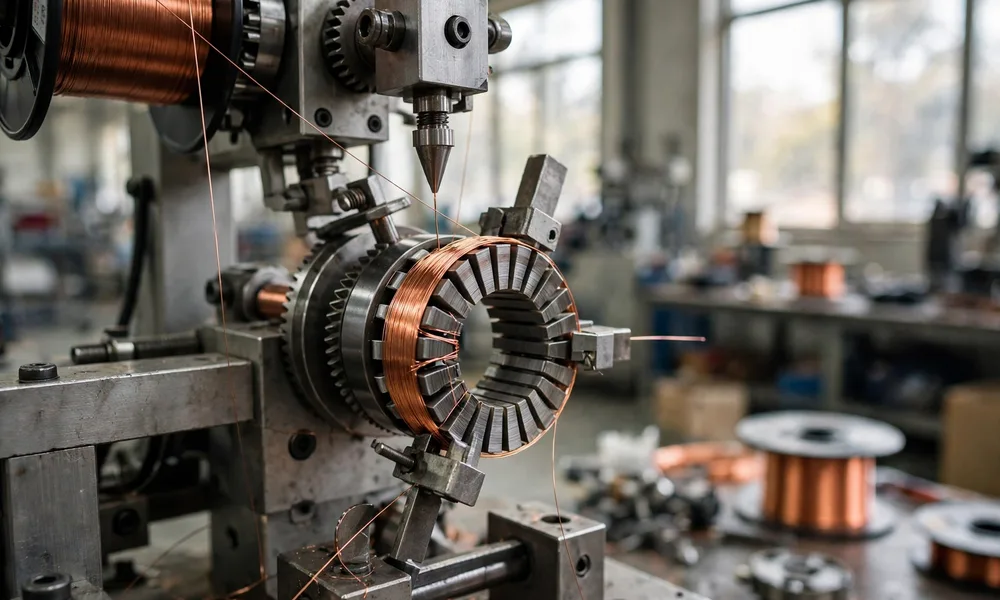
The electronic speed controller, or ESC, is the motor’s translator. It takes direct current from the battery and switches it between the motor’s three copper windings in a precise sequence, creating a rotating magnetic field inside the motor. The faster the ESC switches, the faster the field rotates, and the faster the motor spins. The craft of building these windings, turn by counted turn around a steel stator, is described in the story of how a drone motor is made, and the quality of that winding decides how smoothly the motor runs.
Step 3: The stator creates a rotating magnetic field
Inside the motor sits the stator, a star-shaped core of thin steel sheets wrapped in copper coils. When the ESC energises the coils in turn, each one becomes a temporary electromagnet, and the magnetic field appears to sweep around the stator in a circle. The stator never moves, but its magnetism chases itself around the ring dozens of times a second at full throttle. The steel is built up from paper-thin laminations rather than a solid block, because thin sheets stop wasteful eddy currents from heating the core and stealing power.
Step 4: The magnets chase the field
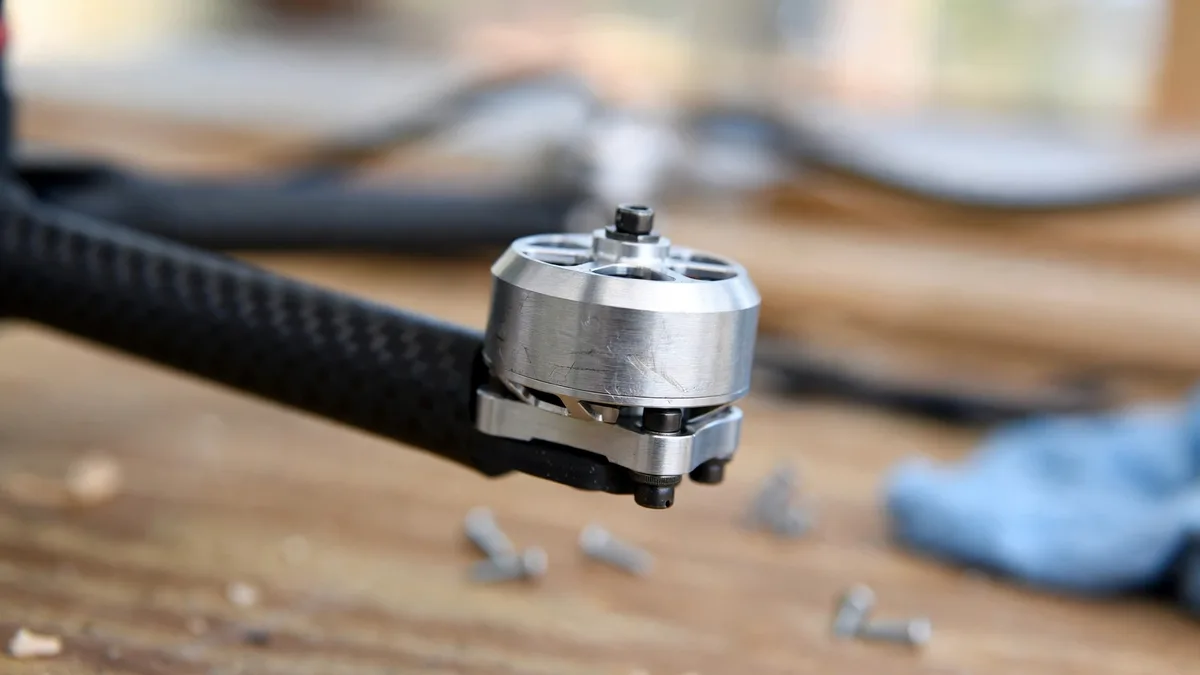
Around the stator spins the bell, a cup of aluminium or steel lined with powerful neodymium magnets, alternating north and south poles. The magnets are pulled toward the stator’s rotating field and push away from it in turn, so the bell chases the magnetic field around in a circle, always a step behind it. This is the heart of the motor: electricity becomes magnetism, magnetism becomes motion, and nothing touches anything else. In an outrunner motor, the type almost all drones use, the bell spins on the outside, which gives high torque at low speed, exactly what a propeller needs.
Step 5: The propeller turns spin into lift
The propeller is bolted to the top of the spinning bell, and as it turns it bites into the air and pushes it downward. The faster it spins, the more air it moves and the more lift it makes. A camera drone’s propellers typically spin at five to ten thousand revolutions per minute in a hover, far faster than any car engine, and the four of them together must produce more thrust than the drone weighs or it never leaves the ground. Two propellers spin clockwise and two anticlockwise, so their twisting forces cancel out and the drone does not spin like a top. The camera that rides on this spinning platform stays level thanks to the drone gimbal, and how it works to steady the shot.
Step 6: The motor reports back without a sensor
Most drone motors have no position sensor at all. Instead, the ESC listens to the tiny voltage the spinning magnets induce in the coils that are not being powered at that instant, a signal called back-EMF. From that faint electrical whisper, the ESC works out exactly where the bell is and when to switch the current next. It is a neat trick: the motor is its own sensor. If the propeller is blocked by a branch, the back-EMF changes, the ESC senses the struggle, and a good flight controller can cut the power before the motor burns out.
Specifications
| Specification | Typical value |
|---|---|
| Motor type | Brushless outrunner |
| Stator and poles | 12 slots, 14 magnet poles |
| Kv rating | 800 to 2,500 rpm per volt |
| Maximum speed | Up to 30,000 rpm |
| Operating voltage | 3S to 6S lithium battery, 11 to 22 volts |
| Efficiency | Around 80 to 85 percent |
| Weight | 20 to 80 grams |

What It Costs
A single drone motor for a camera drone typically costs between $15 and $60 at retail, depending on size and quality, with high-end racing and heavy-lift motors reaching $80 to $150. A complete quadcopter needs four, so motors account for a noticeable share of a drone’s price, though far less than the camera or the battery. The price is driven by the magnets, the bearings and the testing: a motor built with genuine neodymium magnets and sealed bearings costs more to make but lasts far longer than a cheap copy, and it runs cooler, which means longer flights.
A Rare Fact
The first camera drones were built from parts that were never meant to fly. In the late 2000s, hobbyists discovered that the tiny brushless motors sold for model aeroplanes could lift a camera, and before that, experimenters had even rewound the spindle motors from old CD-ROM drives to make their first multirotor motors. The motors were cheap, the magnets were weak, and the flights were short, but the idea worked. Within a few years, factories were building motors designed for drones from the ground up, with stronger magnets, better bearings and precisely wound stators, and the same obsession with smooth, vibration-free spinning now extends to the materials engineering of the drone gimbal that carries the camera above them.
Four small discs, no brushes, no exhaust, and a magnetic field that chases itself around a steel star a hundred times a second. That is the whole secret of the drone motor: electricity, magnetism and a propeller, spinning in perfect step.


