The delivery rider had thirty drops to make before lunch, and the route was unkind: a steep cobbled lane, then a flat stretch along the river, then a ramp up to a housing estate on the hill. His e-bike never seemed to notice the changes. On the cobbles he spun gently while the bike pulled hard; on the river path he cruised without his legs turning into a blur; on the ramp the motor dug in again.
That mechanism is the e-bike gearbox, and it earns its keep in a way that is easy to miss. It does not add power — the motor does that — but it decides what the power is worth. The gearbox is the translator between the two.
Human legs are happiest turning at roughly 70 to 90 revolutions a minute, and they lose power quickly outside that band. An electric motor has its own favourite speed, where it is efficient and quiet. The gearbox must hold both in their comfort zones at the same time, across hills, headwinds, and loaded panniers. Here is how it does it.

How It Works
Step 1: The gear ratio sets the bargain
Every gear is a bargain between force and speed. A low gear gives the wheel a small turn for each turn of the pedals, so the rider and motor can push with great force — perfect for a loaded climb. A high gear gives the wheel many turns per pedal turn, so the bike can travel fast on the flat without the rider’s legs spinning like a cartoon. The motor that works through these ratios has its own story, and the e-bike mid-drive motor guide explains why a motor mounted at the pedals gets more from the gears than any other layout.
Step 2: The derailleur earns its keep outdoors
The commonest gearbox on an e-bike is still the derailleur, a sprung arm that nudges the chain from one sprocket to another on the rear wheel. It is light, cheap, and easy to repair, and it offers the widest ranges of any system. It also has honest weaknesses. It cannot change gear while the rider is pushing hard, so a shift on a steep hill demands a moment of easing off.
Step 3: The sealed hub takes the weather out of it
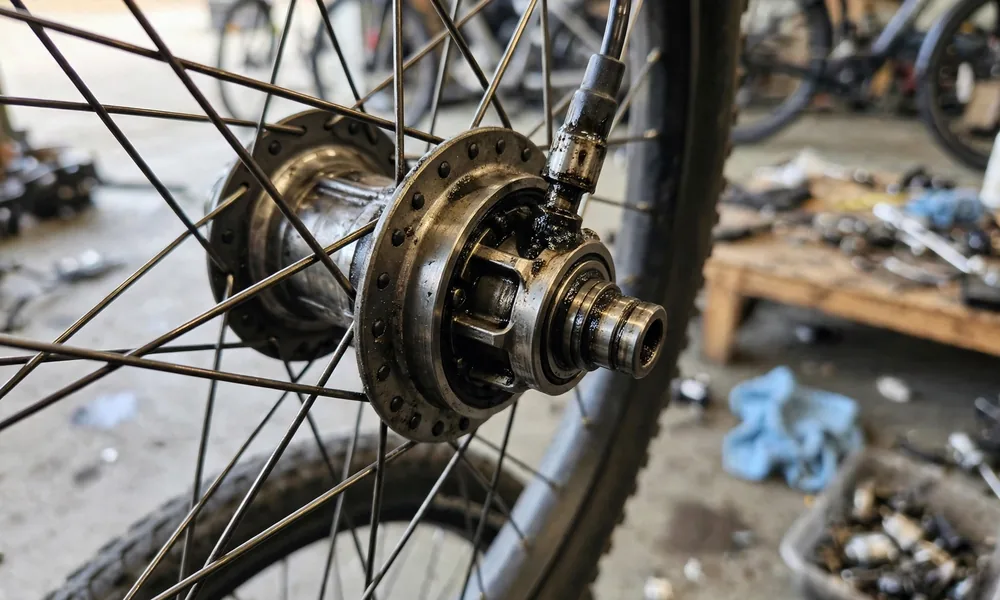
The alternative is the internal gear hub, where the gears live inside the rear wheel hub, sealed away from rain, grit, and road salt. The rider changes gear with a twist of the grip, and the hub obliges even when the bike is standing still — a small mercy at a red light on a hill. The sensor that feeds the motor its instructions about the rider’s effort is part of the same system, and the e-bike torque sensor guide explains how it measures each push of the pedals.
Step 4: The bottom-bracket gearbox changes the game
The newest approach moves the gearbox out of the wheel entirely and into the bottom bracket, where the pedals meet the frame. A sealed unit there — the best-known examples come from the German maker Pinion — holds all the gears in a single oil-bathed box, with a belt or chain running back to a single sprocket on the rear wheel. A top Pinion box offers eighteen evenly spaced gears and a range above 600 percent, wider than most derailleur setups, and it shifts at a standstill.
Step 5: Automatic shifting reads the road
Some e-bikes now shift by themselves. A controller watches the bike’s speed, the rider’s pedalling rate, and the torque at the cranks, and it changes gear to hold the rider’s cadence steady — typically around 70 revolutions a minute. Climb a hill and the bike shifts down before the rider feels the strain; reach the flat and it shifts up before the legs start spinning.
Step 6: The mid-drive motor shares the gears
Where the motor sits decides how much the gearbox can help it. A mid-drive motor turns the same crank as the rider, so it drives through the gears too: shift down for a hill and the motor gets a lower gear as well, spinning faster and producing more torque at the wheel exactly when it is needed. A hub motor cannot do this. — which is why the e-bike hub motor guide describes a very different kind of machine, one that trades climbing finesse for simplicity and silence. Choosing between the two is really choosing how much work you want the gearbox to do.
E-Bike Gearbox Specs
| Specification | Typical range |
|---|---|
| Gear range, derailleur | About 400 to 550 percent from lowest to highest gear |
| Gear range, internal hub | About 250 to 530 percent, depending on the model |
| Gear range, bottom-bracket gearbox | About 600 to 640 percent on the widest sealed units |
| Comfortable pedalling cadence | About 70 to 90 revolutions per minute |
| Shifting at a standstill | Yes for hub and bottom-bracket gearboxes; no for derailleurs |
| Automatic shifting | Electronic systems hold a set cadence, shifting in under half a second |
| Drive type | Chain on derailleurs; chain or carbon belt on hub and gearbox bikes |
| Belt life | About 20,000 to 30,000 kilometres, several times a chain |
| Hub weight penalty | About 1 to 1.5 kilograms more than a derailleur setup |
| Service interval | Hub oil change about once a year; derailleur cleaning far more often |
What Does an E-Bike Gearbox Cost?
Gearbox costs on an e-bike depend on how much of the work you want the gears to do for you. A derailleur drivetrain is estimated at roughly $200 to $600 for the shifters, derailleur, cassette, and chain. A quality internal hub is estimated at roughly $300 to $1,500, with the best expedition-grade hubs at the top of that range. A sealed bottom-bracket gearbox is estimated at roughly $800 to $1,800 for the unit alone, and it needs a frame built to accept it. Electronic or automatic shifting adds an estimated $400 to $1,000 to any of these, and a belt drive conversion is estimated at roughly $150 to $300. All prices are estimates only and vary by brand, model, and retailer.
A Rare Fact
The widest-range bicycle gearbox ever sold is not a derailleur at all. The Pinion P1.18, a sealed gearbox that bolts into the bottom bracket, offers eighteen gears with a range of 636 percent — wider than almost any derailleur drivetrain — and every step between gears is the same size, so the rider never gets a sudden jump in effort. E-bike makers have adopted it for the same reason: a motor that can always find the right gear is a motor that never has to strain.
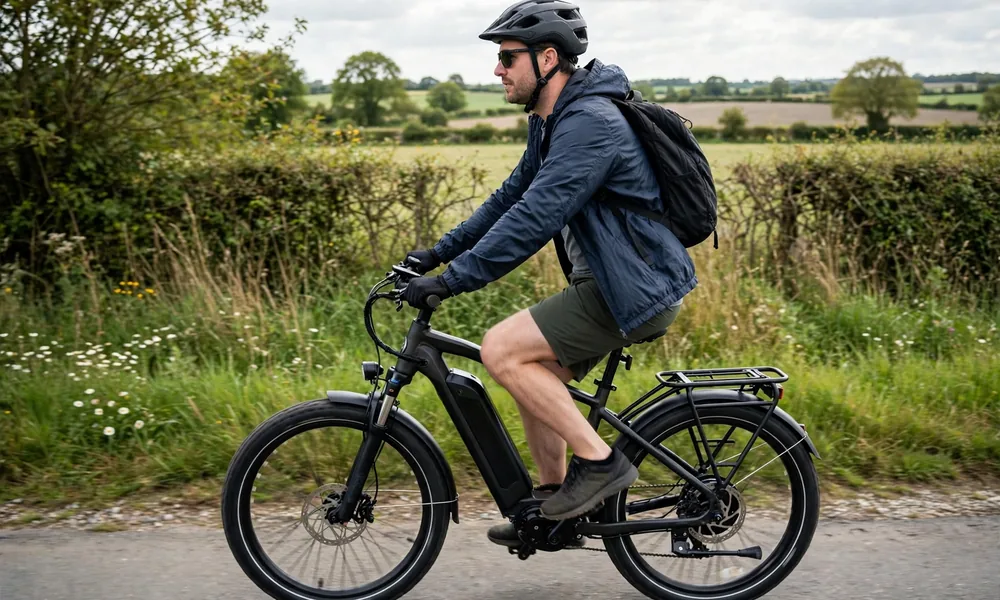
The e-bike gearbox is the part of the bike that nobody photographs and everybody depends on. It takes two very different power sources — legs that tire and a motor that does not — and makes them feel like one smooth push. That is where the ride is really decided.


