Spin the rear wheel of an electric bike and you will feel it: a faint hum, a smooth resistance, and then the wheel keeps turning long after your hand has stopped. The push comes from a motor you can barely see, hidden inside the hub at the centre of the wheel, no bigger than a grapefruit and quieter than the tyres. It has no chain, no gears you can touch and no exhaust, yet it can carry a rider and a week’s shopping up a hill that would defeat most legs.
The e-bike hub motor is a small masterpiece of compromise. It must be powerful enough to climb, light enough not to ruin the ride, sealed against rain and mud, and cheap enough to put on a bicycle. Inside its aluminium shell sit copper windings, rare-earth magnets, a planetary gearbox and a controller, all packed into a space smaller than a dinner plate. The factory that builds it makes thousands a day, each one wound, assembled and tested to tolerances a cyclist would never guess at.
How an E-Bike Hub Motor Is Made
Step 1: Stamping the laminations
The motor starts as steel, but not in the way you might expect. Thin sheets of silicon steel, each less than half a millimetre thick, are stamped into rings with slots around their edge, then stacked into a cylinder called the stator core. The thin layers stop wasteful eddy currents that would turn the motor’s energy into heat. Hundreds of laminations are pressed together and bonded, and the stack is checked for height and flatness, because a stator that is even slightly out of true will vibrate for its whole life.
Step 2: Winding the copper coils
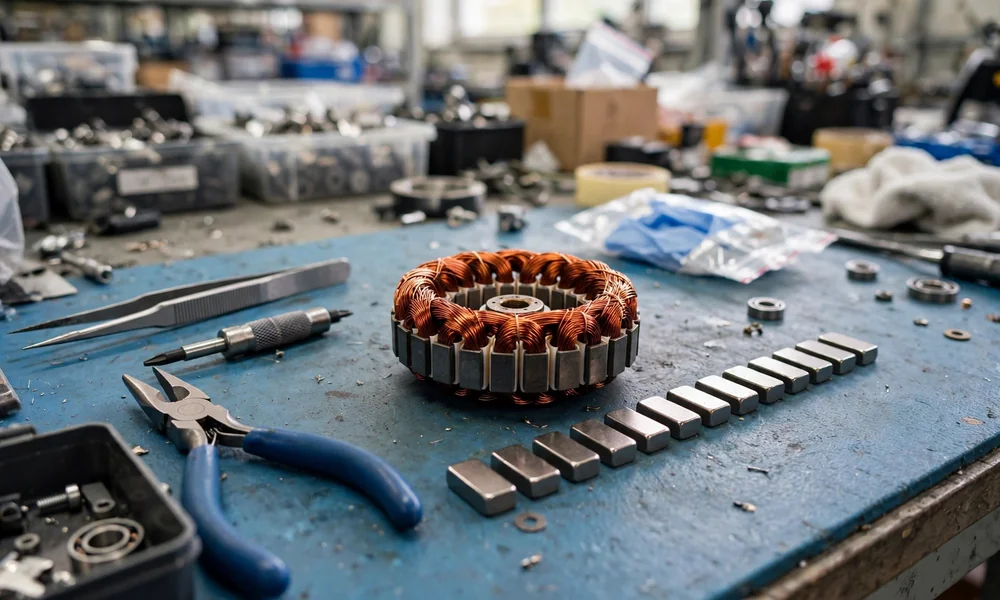
Next comes the winding, the most delicate step in the whole factory. Fine copper wire is wound into the stator slots by automated machines that lay each turn in exactly the right place, hundreds of turns per motor, without nicking the insulation. The winding pattern decides the motor’s character: more turns means more torque at low speed, fewer means higher speed. Once wound, the coils are coated in varnish and baked, locking them solid so they cannot buzz or move. A single short between two turns would ruin the motor, so every stator is tested for insulation before it moves on. The same care over copper windings shapes e-bike mid-drive motors, where the coils do the same job in a different home.
Step 3: Fitting the magnets
While the stator is wound, the rotor is built around it. Powerful neodymium magnets, each about the size of a domino, are glued and clipped into a steel ring in a precise alternating pattern. These magnets are strong enough to pinch a finger badly, and the factory handles them with jigs and spacers that keep them from snapping together. Once fitted, the whole rotor is magnetised in one pulse from a machine delivering a surge of current that aligns every magnetic domain at once. The gap between the magnets and the stator is less than a millimetre, and it is this tiny air gap that turns electricity into motion.
Step 4: Adding the planetary gears
Most hub motors are geared, because a small motor spins far too fast to drive a wheel directly. A set of planetary gears — a sun gear in the middle, planet gears around it, and a ring gear outside — reduces the motor’s speed by about five to one while multiplying its torque. The gears are made from hardened steel or tough nylon composite, and they run in grease inside a sealed chamber. A one-way clutch lets the wheel spin freely when the rider pedals without power, so the motor never drags. It is a gearbox the size of a jam jar, doing the work of a car’s transmission in miniature.
Step 5: Sealing the shell
The stator, rotor and gears are pressed into a two-part aluminium shell, cast and machined to be light and stiff. Spoke holes are drilled around the flanges, bearings pressed into the axle, and the two halves bolted together with a rubber seal between them. The seal matters more than it looks: a hub motor lives in rain, puddles and road spray, and water inside would corrode the steel and short the windings. Finished shells are checked for roundness, because a shell that wobbles would make the wheel wobble too. The sensor that tells the motor when to help shares its job with the one in e-bike torque sensors, which measure the rider’s effort hundreds of times a second.
Step 6: Lacing the wheel
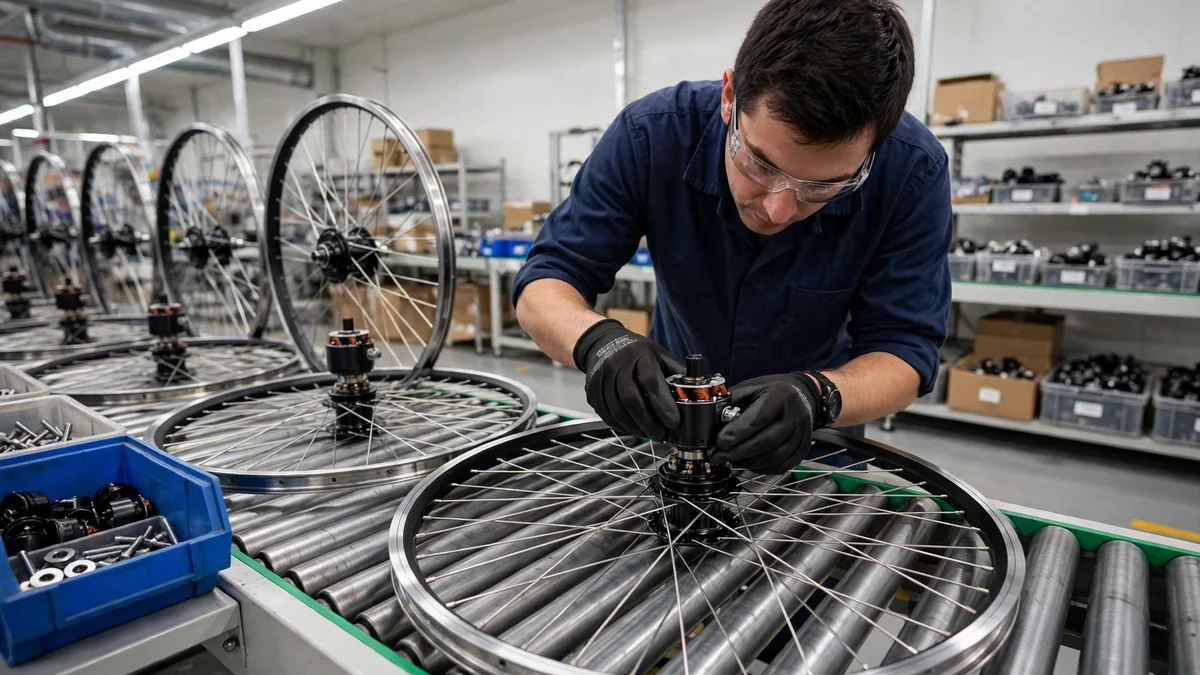
A hub motor is useless until it is a wheel. Spokes are threaded through the hub flanges, laced to a rim in a cross pattern, then tensioned one by one until the wheel is true — straight, round and evenly stressed. This is still done largely by hand, or by machines guided by a human eye, because spoke tension is a feel as much as a number. A badly built wheel would pull to one side and wear out its bearings; a good one can carry a rider for tens of thousands of kilometres. The finished wheel is spun on a stand and checked for wobble with a dial gauge.
Step 7: Testing every motor
Every hub motor is tested before it leaves the factory. It is spun up on a rig that measures power, torque, speed and efficiency, and listens for noise: a healthy motor hums evenly, a faulty one clicks. The controller is checked, the waterproofing is tested, and the motor is run under load to make sure it does not overheat. Only motors that pass every check are boxed, with their cables, connectors and fitting hardware. The battery that feeds them is built to the same test-everything standard, as e-bike battery production shows, where no cell ships without proving itself first.
E-Bike Hub Motor at a Glance
| Specification | Typical Value |
|---|---|
| Rated power | 250 W in Europe, up to 750 W elsewhere |
| Peak torque | About 40 to 80 Nm at the wheel |
| Weight | Roughly 2.5 to 4.5 kg |
| Gear reduction | About 5:1 planetary gears |
| Magnets | Neodymium, in a steel rotor ring |
| Sealing | Rubber-sealed shell, rain and spray resistant |
| Key advantage | Silent, simple, no chain wear, easy to fit |
What Does It Cost?
A hub motor is one of the cheapest electric motors you can buy, and that is the point. A complete geared hub motor — motor, gears, controller wiring and shell — typically costs a bike maker $60–$200 (estimates), and a replacement wheel with the motor built in can run $200–$600 including fitting (estimates). The cost is driven by the neodymium magnets and the copper, both of which are traded on world markets, and by the precision winding. For the rider, it is the cheapest way to turn an ordinary bicycle into something that flattens hills.

A Rare Fact
A good hub motor is more than 80 percent efficient, meaning four-fifths of the electricity from the battery becomes motion at the wheel — better than most car engines, which throw away two-thirds of their fuel as heat. And the motor can also work in reverse: when you brake, some hub motors act as generators, feeding a little energy back into the battery. It will never recharge the bike alone, but on a long downhill it can add a few precious minutes of range, all from a device smaller than a grapefruit.