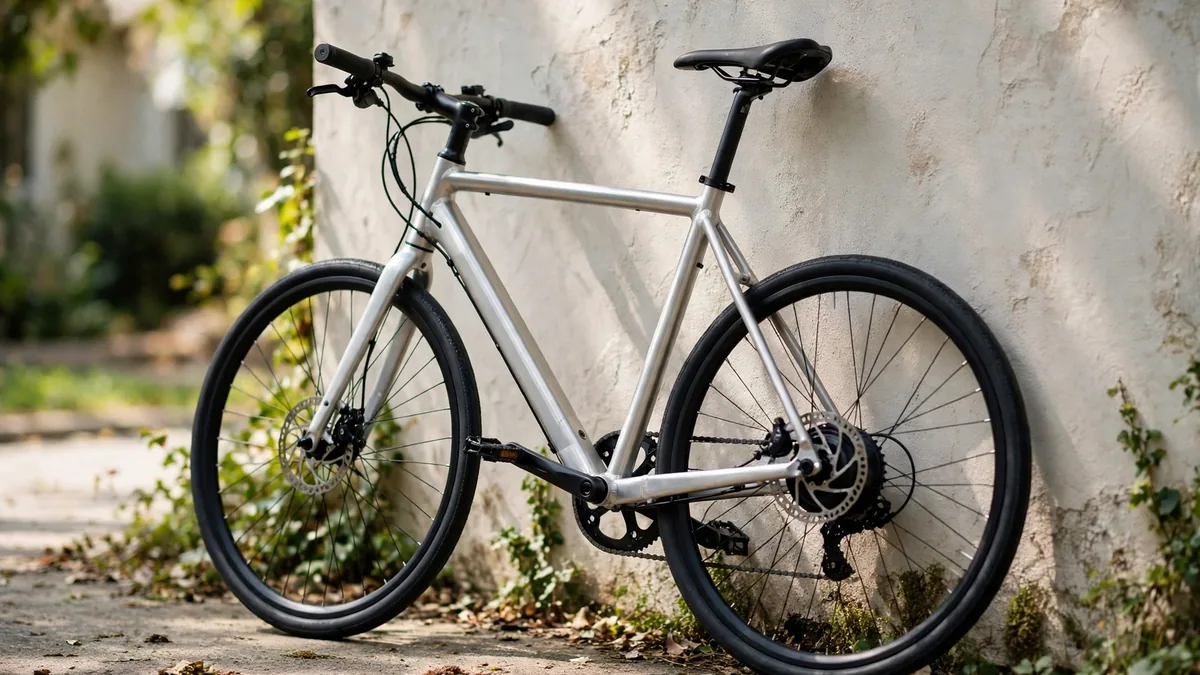
Lift an e-bike by its top tube and you can feel the whole design in your hands. A good lightweight frame weighs about as much as a bag of groceries, yet it has to carry a rider, a motor, a battery and the torque of both, over potholes and kerbs, for years.
A lightweight e-bike frame works by turning the bicycle’s oldest structure — the diamond frame — into a tuned system. This is how that system works, tube by tube and joint by joint.
How an E-Bike Lightweight Frame Works
Step 1: The diamond, rethought
Almost every e-bike frame is still a diamond: a top tube, a down tube, a seat tube, chain stays and seat stays, meeting at the head tube, bottom bracket and rear dropouts. The shape has survived for 130 years because a triangle is the stiffest structure you can build from tubes. On an e-bike the diamond is stretched and fattened — the down tube grows thick to hide the battery inside it, the bottom bracket shell grows to hold the motor, and the chain stays are widened to clear fat tyres and a belt drive. The materials behind these choices are explored in e-bike lightweight frame materials engineering.
Step 2: Butted tubes — thick where it counts
A frame tube is not one thickness all the way along. Butted tubes are thicker at the ends, where the joints concentrate stress, and thinner in the middle, where the tube mostly carries bending. A double-butted tube might be 0.9 millimetres thick at the ends and 0.6 in the middle; a triple-butted tube adds a third thickness for the highest-stress joint of all, the bottom bracket. Aluminium frames take this further with hydroforming — high-pressure fluid pressing the tube into complex shapes, fattening the down tube where the battery sits and flattening it where a water bottle mounts. Carbon frames do the same job differently, adding extra layers of fibre only where the load demands it, as in e-bike carbon frame materials engineering.
Step 3: The battery in the down tube
The defining feature of a modern lightweight e-bike frame is that the battery lives inside the down tube. The tube becomes a structural case: it has to protect the cells from impacts, keep water out, and still carry the bending loads of the whole bike. This integration is why lightweight e-bikes look like ordinary bicycles now: the motor and battery have disappeared into the structure, and the frame is doing two jobs at once — holding the bike together and housing its power.
Step 4: The motor and the torque path
A mid-drive motor can add 85 newton-metres of torque at the bottom bracket — more than a strong rider’s legs — and all of it passes through the frame. The bottom bracket shell is the most heavily loaded joint on the bike, and on an e-bike it is a machined aluminium or carbon insert, bonded or welded into the frame, that spreads the motor’s torque into the down tube, seat tube and chain stays. Getting the torque path right is the difference between a motor that feels like a tailwind and one that feels like the bike is fighting itself. The making of the frame that carries all this is covered in how e-bike lightweight frames are made.
Step 5: Stiffness where you pedal, comfort where you sit
A frame has to be stiff in one direction and soft in another, and the tubes are shaped to do both. Laterally — side to side — the frame must be rigid, so that pedalling force reaches the rear wheel instead of flexing the bottom bracket sideways. Vertically, it should give a little, soaking up road buzz before it reaches the saddle and handlebars. Designers tune this with tube shapes: a wide, flat chain stay resists sideways flex, a slender seat stay with a slight curve flexes vertically like a leaf spring, and a tapered head tube is stiff at the bottom where braking forces hit hardest.

Step 6: Joints, welds and bonds
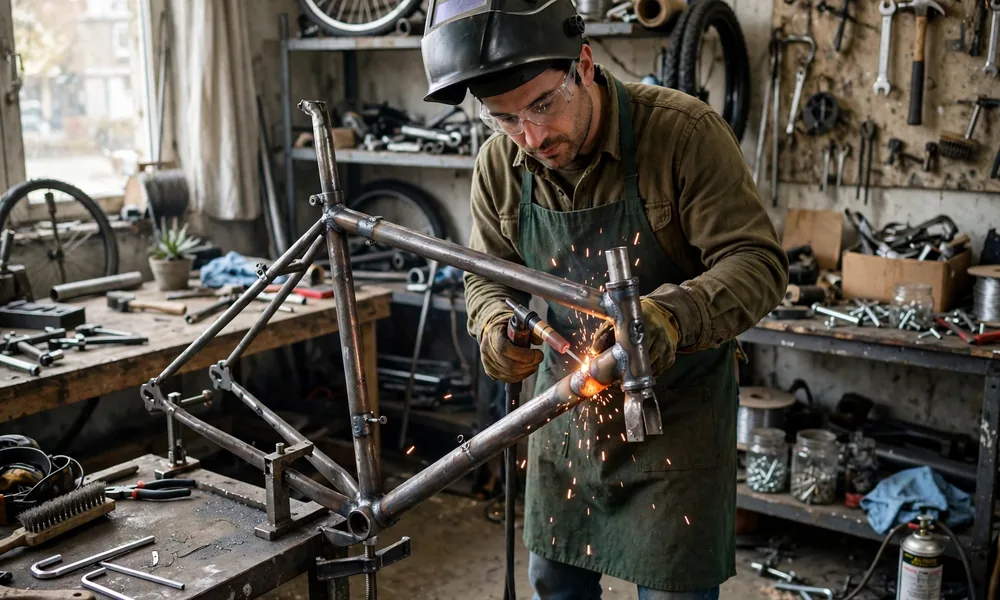
However good the tubes are, the frame is only as strong as its joints. Aluminium frames are TIG-welded, and the welds are often smoothed and heat-treated afterwards to remove stress concentrations. Carbon frames have no welds at all: the tubes are bonded and wrapped with extra fibre at the joints, and the whole frame is cured as one piece, so the joint is continuous with the tubes. A well-made joint should outlast the rest of the bike.
Step 7: In service — carrying the load, year after year
On the road, the frame’s job never stops. Every pedal stroke bends the bottom bracket, every pothole flexes the fork and stays, and the battery adds a kilogram of mass that the frame must carry without rattling. Aluminium frames are designed for a fatigue life of hundreds of thousands of load cycles, and carbon frames are designed so that the fibres, not the resin, carry the load — fibres do not fatigue the way metal does. A lightweight frame is not a fragile frame. It is a frame with nothing wasted, and that is a harder thing to build than a heavy one.
E-Bike Lightweight Frames at a Glance
| Specification | Detail |
|---|---|
| Frame weight | About 2–3.5 kilograms for aluminium, 1.5–2.5 for carbon |
| Frame materials | 6061 or 7005 aluminium, carbon fibre, occasionally titanium |
| Tube wall thickness | 0.6–0.9 millimetres, butted thicker at the joints |
| Battery housing | Integrated in the down tube, removable or fixed |
| Motor mount | Mid-drive at the bottom bracket, up to 85 newton-metres |
| Key trade-off | Lateral stiffness for pedalling versus vertical comfort |
| Main weakness | Dents in aluminium, impact damage in carbon, joint fatigue |
| Main uses | Commuter e-bikes, lightweight road e-bikes, electric mountain bikes |
What Does It Cost?
A lightweight frame is a large share of an e-bike’s price, because the engineering is in the frame, not just the motor. As rough estimates, a quality aluminium e-bike frame costs $400 to $1,000 as a frameset, while a carbon fibre lightweight frame runs from $1,500 to $4,000. Those figures are estimates, not quotes — the real number depends on material, motor, battery size and the brand’s build quality.
A Rare Fact
The lightest production e-bike frames weigh less than the battery they carry. A top carbon road e-bike frame can weigh under 2 kilograms, while its battery alone weighs 2 to 3 kilograms — meaning the power source is heavier than the entire structure that holds it, the rider and the motor together. A century ago, a bicycle frame weighed more than everything else on the bike combined. The balance has completely reversed.
The best lightweight e-bike frames are invisible engineering: you never notice them working, because every gram has already been argued over, every tube already shaped for a reason. Lift one by its top tube, and what you are feeling is not lightness. It is a hundred and thirty years of triangles, finally carrying a motor as well.