Push gently on the pedals of a good electric bike and the motor answers gently. Push hard up a hill and the motor pushes hard with you. That is not a coincidence, and it is not a simple on-off switch. Hidden in the bottom bracket, where the pedals meet the frame, a torque sensor is measuring exactly how hard you are pedalling, hundreds of times a second, and telling the motor to match your effort. It is the difference between an e-bike that feels like a machine and one that feels like a stronger version of your own legs.
Cheaper electric bikes use a cadence sensor, which only knows whether the pedals are turning, and gives the same power whether you are cruising or climbing. A torque sensor is smarter. It measures the actual force you put into the cranks, so the motor’s help is proportional to your effort: a little when you are cruising, a lot when you are climbing, and nothing at all when you stop pedalling. The result is a ride that feels natural, and it saves battery, since the motor never works harder than it needs to.

How an E-Bike Torque Sensor Works
Step 1: You push, and the crank flexes a tiny amount
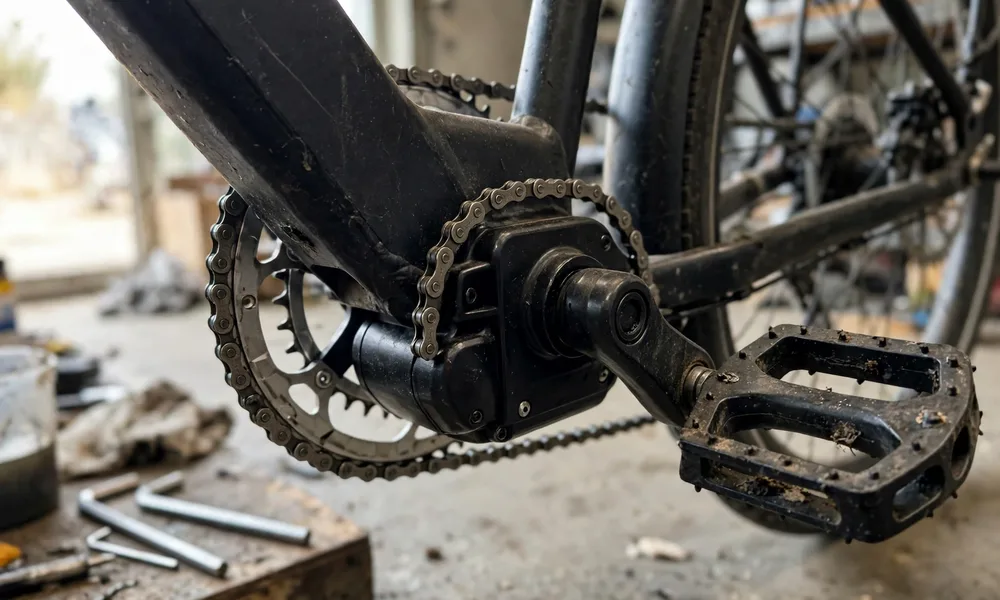
Everything starts with your feet. When you press down on a pedal, the force travels through the crank arm and into the bottom bracket spindle, and the metal flexes by a fraction of a millimetre. That tiny twist is the signal the sensor is waiting for, and its job is to measure it precisely enough to tell a gentle cruise apart from a hard climb. The motor that will answer your effort sits nearby, turning your pedalling into forward motion with its own clever engineering, as the e-bike mid-drive motor materials guide explains.
Step 2: Strain gauges turn the flex into an electrical signal
The most common way to measure that flex is with strain gauges, thin patterns of wire or foil bonded to the metal, whose electrical resistance changes when they are stretched. As the crank twists, the gauges stretch with it, their resistance shifts by a tiny amount, and an electronic circuit turns that shift into a voltage. The change is minuscule, measured in thousandths of a volt, so the circuit amplifies it carefully and filters out vibration and road noise. Some sensors measure the twist with magnets instead, but the idea is the same: force becomes an electrical signal the bike’s computer can read.
Step 3: The controller reads your effort hundreds of times a second
The sensor’s signal flows to the bike’s controller, the small computer that manages the motor, and it is sampled hundreds of times every second. That speed matters, because pedalling is not steady: it peaks each time a pedal passes the top of its stroke and dips between pushes. By sampling so fast, the controller sees the real shape of your effort, not a blurred average, and it can respond to changes almost instantly. If you suddenly stand up and stamp on the pedals, the motor knows within a fraction of a second, and if you ease off, the assistance fades just as quickly. The battery that powers all of this has its own careful engineering, and the way its cells are packed and protected decides how far the bike can go, as the e-bike battery materials guide shows.
Step 4: The motor adds power in proportion to your push
With your effort measured, the controller decides how much help to give. In the most common setup, the motor multiplies your power: on a low setting it adds half as much as you produce, on a high setting three times as much. Push with one hundred watts and the motor adds three hundred, and the bike surges forward as if you had suddenly become much stronger. Because the help is proportional, the ride feels natural: the harder you work, the harder the bike works with you, and when you stop pedalling, the motor stops too, as the law requires in most countries.
Step 5: Cadence and speed sensors complete the picture
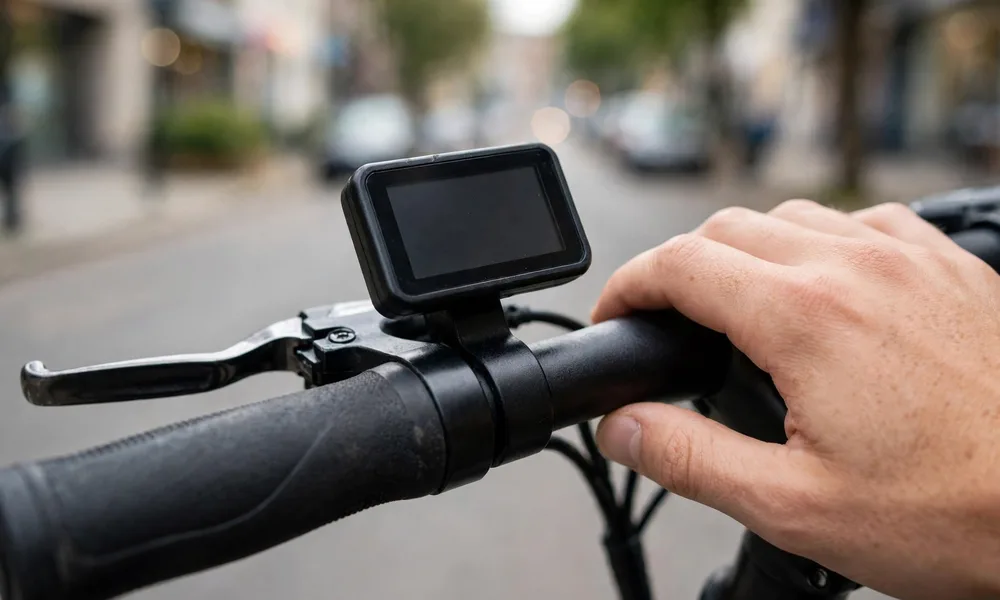
Torque alone is not the whole story, so the bike combines it with other sensors. A cadence sensor measures how fast you are pedalling, and a speed sensor watches the wheels so the motor can taper off as you approach the legal assistance limit, usually 25 kilometres per hour in Europe. Together, the three measurements let the controller calculate your power output in watts and deliver exactly the right assistance: full power uphill into a headwind, a gentle sip from the battery on the flat. The display on the handlebars shows the result of all this calculation, and learning to read it properly turns a good ride into a great one, as the e-bike display specs guide explains.
Step 6: The system calibrates itself and stays accurate
A torque sensor has to stay accurate for years, through rain, mud and vibration, so it calibrates itself constantly. When the bike is switched on and the pedals are still, the controller records the sensor’s resting value as zero, and re-checks it whenever you coast. The electronics compensate for temperature drift, and the sensor is sealed against water and dirt. If the readings ever look wrong, the controller falls back to a safe mode rather than giving a sudden surge of power. That quiet self-checking is why a torque-sensing e-bike still feels the same after years of use.
E-Bike Torque Sensor at a Glance
| Specification | Detail |
|---|---|
| Sensor type | Strain gauge or magnetic torque sensor in the bottom bracket |
| What it measures | How hard you push the pedals, as a twisting force |
| Sampling rate | Hundreds of readings per second |
| Assistance style | Proportional: motor multiplies your own power output |
| Typical multiplication | From 0.5 times your effort up to 3 times or more |
| Combined with | Cadence sensor and wheel speed sensor for full picture |
| Cut-off | Assistance stops when you stop pedalling or hit the speed limit |
| Main advantage | Natural feel, efficient battery use, no throttle needed |
| Main drawback | More expensive and complex than a simple cadence sensor |
What Does It Cost?
A torque sensor is a premium component, and it is one of the reasons torque-sensing e-bikes cost more than basic models. As rough estimates, a replacement torque sensor unit costs from around 50 to 200 dollars, while a complete torque-sensing e-bike typically starts at around 1,500 to 3,000 dollars, depending on the motor, battery and frame. Those figures are estimates, not quotes.
A Rare Fact
The torque sensor in your e-bike is a close relative of the sensors that weigh trucks on motorways and measure rocket thrust. Strain gauges were invented in the 1930s, and the first ones were made by gluing fine wire to a piece of metal and watching its resistance change. Nearly a century later, the same idea is hidden inside a bicycle, measuring your legs hundreds of times a second so that a hill feels flat.
An e-bike torque sensor works because it listens to your legs instead of guessing. It feels the tiny flex of the crank, turns it into an electrical signal, and tells the motor to match your effort, watt for watt. The result is a bicycle that does not ride you, but rides with you, and that is why it feels less like a machine and more like a superpower.


