At two in the morning, the house is dark and silent, and a small round machine wakes itself up. It spins a little turret on its head, throws out a fan of invisible light, and starts to draw a map of the rooms it has never seen in daylight. Within a minute it knows where the sofa is, where the hallway narrows, and where the stairs drop away. It does all of this without bumping into a single chair leg. The part that makes it possible is barely bigger than a jam jar — a spinning LiDAR turret — and it is one of the most precisely built pieces of consumer electronics on the market.
LiDAR works by timing light. The turret fires thousands of laser pulses every second and measures how long each one takes to bounce back, building a picture of the room from millions of tiny distance readings. For that to work in a robot vacuum, the spinning mirror inside must turn at a perfectly steady speed, the laser must fire at exactly the right instant, and the whole assembly must survive years of dust, knocks and pet hair.
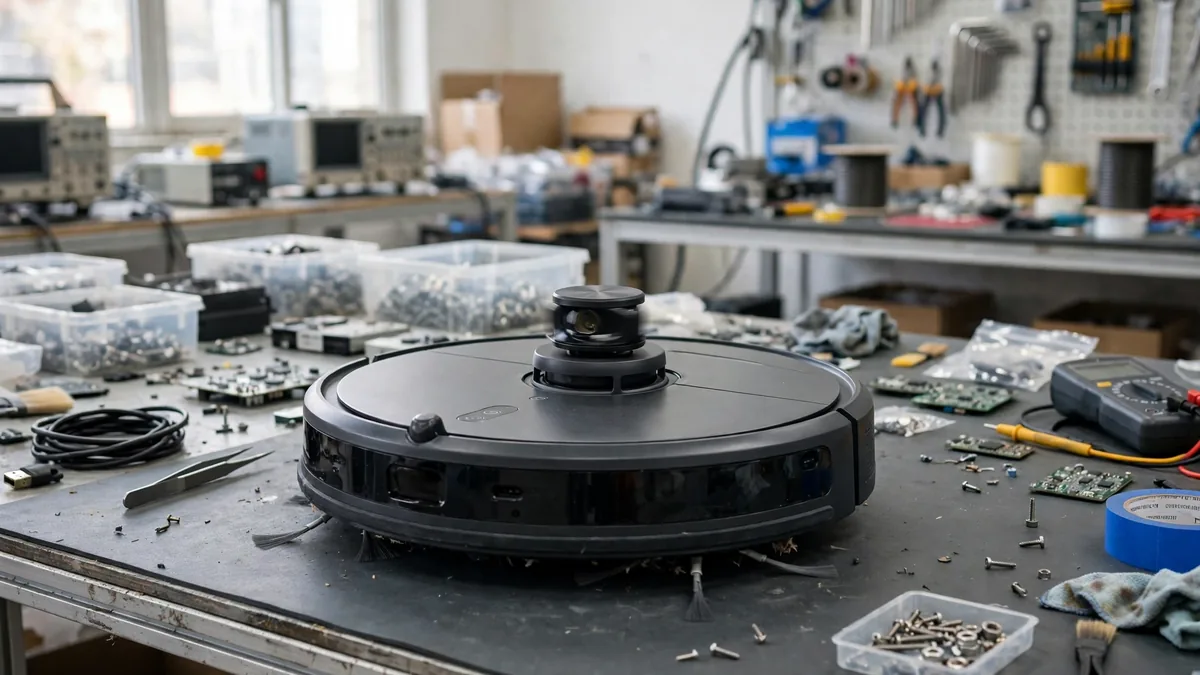
Inside the Factory
Step 1: The laser and the receiver
Every LiDAR turret starts with two matched components: a tiny infrared laser diode and a light-sensitive receiver. The laser is chosen for a wavelength the human eye cannot see, so the vacuum can scan a room without throwing visible light across the walls at night. The receiver has to catch the faint reflection of a pulse that has travelled to the far wall and back, so it is tested for sensitivity before it is ever fitted — a weak receiver means a blind robot. The same pairing of an emitter and a sensitive detector sits at the heart of how a LiDAR sensor is made, where the same physics is scaled up for cars and drones.
Step 2: The spinning mirror
The beam has to sweep a full circle, and it does so by bouncing off a small angled mirror mounted on a motor shaft. The mirror is polished to an optical finish and balanced like a tiny gyroscope, because at several revolutions per second even a fraction of a gram of imbalance makes the turret wobble, and a wobbling mirror smears the map. The motor is a brushless unit chosen for quiet, steady rotation, and it is paired with an encoder that tells the electronics the exact angle of the mirror at every moment.

Step 3: The optics and the window
The laser and receiver sit behind a curved transparent window in the turret, and that window has to be optically clear at infrared wavelengths while shrugging off dust and scratches. It is moulded from a specialist plastic, coated to reduce reflections, and fitted into the turret housing with a seal that keeps out the fine dust the vacuum itself stirs up. The housing around the window is built to survive being knocked against table legs, so it is made from a tough polycarbonate shell with the window recessed slightly below the surface, where furniture cannot reach it.
Step 4: The circuit board and timing electronics
The turret’s brain is a small circuit board that fires the laser, reads the returning pulse, and stamps each reading with the mirror’s angle — thousands of times per second. The timing has to be accurate to billionths of a second, because light travels about thirty centimetres in a single nanosecond, and a sloppy clock would put the sofa in the wrong place. A sensor that cannot separate a real reading from noise is useless, so the filtering is tuned and re-tuned until the signal is steady at every speed the factory can simulate. The engineering choices behind the board, the housing and the window are laid out in robot vacuum LiDAR materials engineering, from the laser diode to the shell.
Step 5: Assembly and balancing
With the parts tested, the turret is assembled by hand on a bench where each unit is spun up and checked for vibration before it is sealed. A turret that wobbles is stripped down and rebuilt; there is no adjustment that can fix an unbalanced mirror once it is sealed inside. The finished turret is then fitted to the vacuum’s body, wired into the main board, and given its first real task — scanning the test room that the factory keeps for exactly that purpose.
Step 6: Mapping tests and the final check
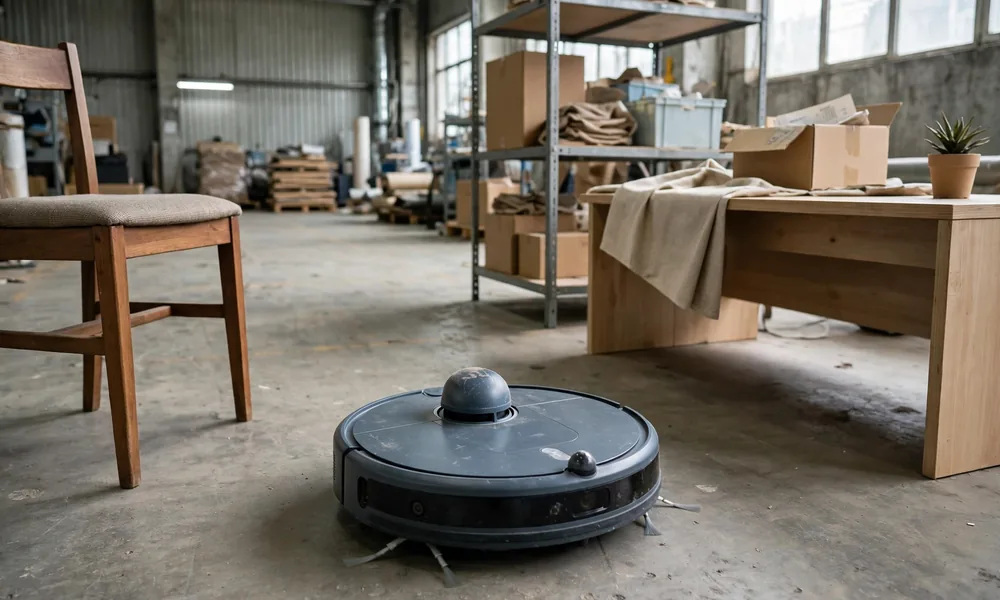
No LiDAR unit leaves the factory without proving it can map. Each vacuum is set loose in a test room full of furniture, doorways and a staircase edge, and the map it builds is compared against the room’s known layout. The robot must find every wall, miss every chair leg, and stop at the stair edge without fail. Units that drift, that lose track of where they are, or that take too long to finish the map are pulled aside for diagnosis. What the finished machine does with that map — how it plans its route, avoids obstacles and remembers rooms — is explained in how robot vacuum LiDAR works, from the first spin to the finished floor plan.
Robot Vacuum LiDAR at a Glance
| Specification | Detail |
|---|---|
| Laser type | Infrared laser diode, invisible to the human eye |
| Scan rate | Thousands of pulses per second, full 360-degree sweep |
| Spinning mirror | Optically polished, balanced, driven by a brushless motor |
| Typical range | Roughly 6–10 m indoors, depending on the model |
| Timing accuracy | Measured in nanoseconds — light travels about 30 cm per nanosecond |
| Window material | Coated specialist plastic, clear at infrared wavelengths |
| Key test | Mapping a known test room, plus drop and dust tests |
| Main weakness | Dust or scratches on the window, and mirror imbalance |
What Does It Cost?
A robot vacuum with a spinning LiDAR turret typically sells for around $250 to $600, while premium models with faster scanning and longer range usually cost roughly $600 to $1,200. The LiDAR unit itself is one of the most expensive parts inside the machine, which is why cheaper vacuums often use cameras or simple bump sensors instead. The price climbs with scan speed and range, because a faster, more accurate turret needs a better motor, a finer mirror and tighter timing electronics. Those figures are estimates, not quotes, and they do not include replacement brushes, filters or batteries.
A Rare Fact
LiDAR was mapping the Earth long before it was mapping living rooms. Airborne LiDAR surveys have revealed lost cities hidden under jungle canopy in Central America, ancient road networks under forest in Europe, and the true shape of the seabed under murky water. The principle is identical — fire light, time the return, build a map — and the robot vacuum is simply the smallest, cheapest version of a technology that once needed an aeroplane to carry it.
The turret is the part of the vacuum nobody sees working, and it is the part that decides whether the machine is clever or just noisy. A vacuum without it cleans by luck; a vacuum with it cleans by map. And every map starts the same way, in a factory test room, with a little mirror spinning in the dark and a beam of invisible light feeling its way around the walls.


