An electric ferry moves without burning fuel on board. Instead of a diesel engine turning a shaft, it carries a battery bank, and the energy in that battery drives electric motors that turn the propellers. The power comes from the grid, stored while the ferry sits at the berth, and the boat spends its crossings drawing that stored energy down. On routes with short crossings and regular stops, the system is simple, quiet and surprisingly efficient.
The basic chain is easy to follow: shore power charges the battery, the battery feeds an inverter, the inverter drives the motor, and the motor turns the propeller. Around that chain sit the systems that make it work in practice — cooling for the battery, controls that manage the power, and charging gear that can refill the battery in the minutes between sailings. This explainer follows the energy from the quayside to the propeller.
The battery bank
The battery is the fuel tank of an electric ferry, and it is usually the largest and heaviest part of the propulsion system. Most ferries use lithium-ion cells, the same chemistry as in electric cars but packed into much larger modules. The cells are grouped into racks inside fire-protected compartments, often below the car deck or in a dedicated room, with cooling pipes and sensors watching every module for temperature and voltage.
Size is set by the route. A ferry crossing a short fjord may need only enough energy for a few crossings plus a reserve, while a longer route needs a bigger bank or charging at both ends. Designers size the bank so the ferry never drops below a safe charge level, even if a sailing is delayed or a charger is out of service. That reserve is part of the safety case, in the same way a diesel ferry carries spare fuel.
From battery to propeller
A battery stores direct current, but the motors that drive a ferry run best on alternating current, so an inverter sits between them. The inverter takes the battery’s direct current and turns it into alternating current at exactly the frequency the motor needs at any moment. Change the frequency and the motor speeds up or slows down, which is how the ferry controls its speed without a gearbox.
The motor itself is usually a permanent magnet or induction machine, mounted low in the hull and connected to the propeller shaft, or built into a pod beneath the hull. Electric motors make their full torque from a standstill, which suits a ferry perfectly: pulling away from the berth with a full load of cars needs a lot of low-speed thrust, and an electric motor delivers it without straining. There is no clutch and no gearbox in the usual sense, just the motor, the shaft and the propeller.
Some ferries use azimuthing pods, where the whole motor and propeller unit can rotate to steer the boat. A pod removes the need for a rudder and gives the ferry remarkable manoeuvrability in a tight harbour. Others keep a conventional shaft and rudder, which is simpler and cheaper to maintain. Either way, the propeller is often a fixed-pitch design, because the motor’s speed control does the job a variable-pitch propeller used to do.

Charging between sailings
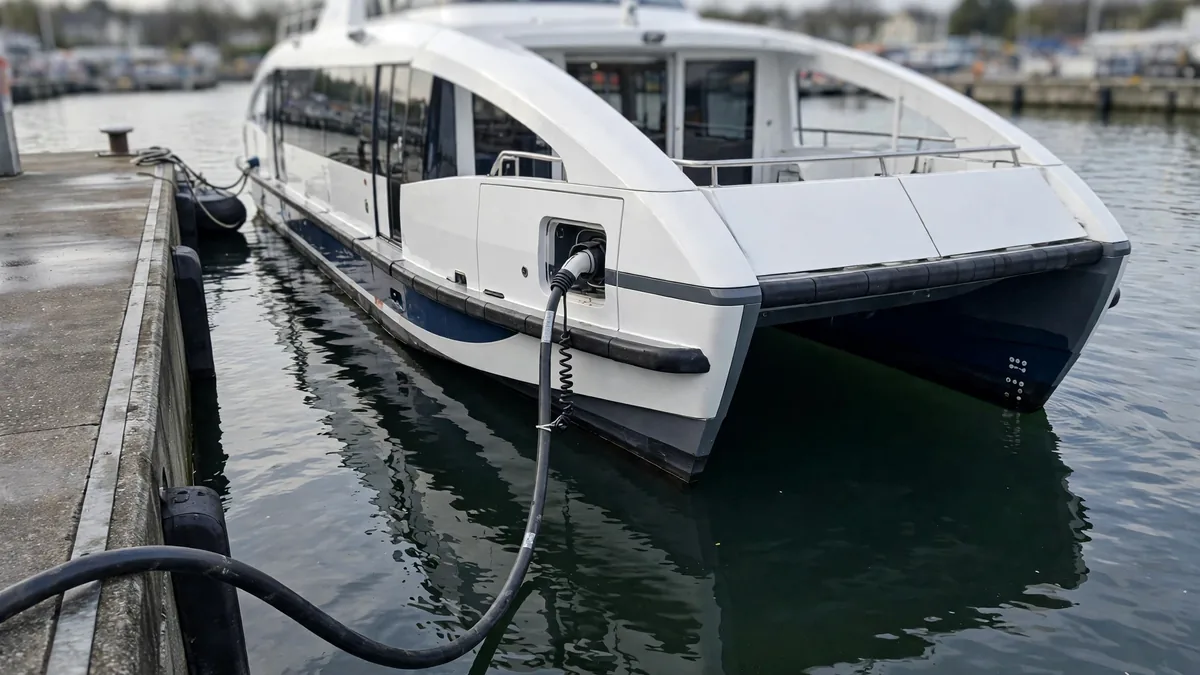
Charging is where the timetable and the propulsion system meet. A ferry that crosses in twenty minutes and turns around in ten has only those ten minutes to take on energy, so the charger has to be powerful. Modern ferry chargers deliver several megawatts, far more than a car charger, through a heavy cable or an automated connection that plugs in as the ferry berths.
The most common arrangement is a pantograph or a plug on the quayside that connects automatically when the ferry arrives. The crew does not handle high-voltage cables by hand. Charging runs while passengers and cars load, so the turnaround time does not grow. On some routes the ferry also charges overnight at a lower power, which is gentler on the battery and cheaper, because night-time electricity often costs less.
Battery swapping is a rarer alternative. Instead of charging the battery on board, the ferry carries a battery pack that is lifted out and replaced with a charged one. It removes the wait entirely, but it needs cranes, spare packs and a shoreside store, so only a few operators use it. For most routes, fast charging at the berth is the simpler answer.
Keeping the system safe and cool
A battery the size of a ferry’s produces a lot of heat when it charges and discharges, and heat is the enemy of battery life. Cooling loops carry a water and glycol mix through the battery racks and the power electronics, dumping the heat into the sea through heat exchangers. Temperature sensors watch for hot spots, and the control system can slow the charge or reduce the power if anything runs warm.
Safety goes further than cooling. Battery rooms are sealed against fire, with gas detection, ventilation and suppression systems, and the battery is split into separate strings so a fault in one does not take the whole bank offline. The crew trains for battery incidents just as a diesel crew trains for fuel fires. In practice the record is good: electric ferries have run millions of crossings in Norway and Denmark with very few propulsion failures.
What changes on board
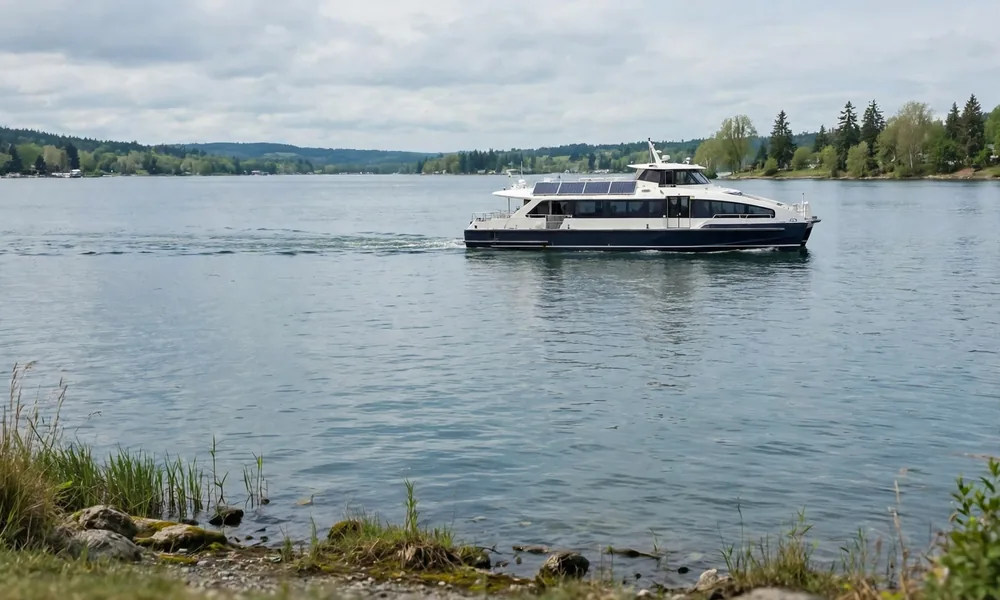
For passengers, the biggest change is the quiet. An electric ferry has no diesel rumble and almost no vibration, so the cabin feels more like a train than a ship. For the crew, the change is in the machinery space: no fuel handling, no exhaust, and far fewer moving parts to maintain. A diesel engine has hundreds of parts that wear; an electric motor has one spinning part, the rotor, and needs little more than bearing checks.
The limits are honest ones. Batteries hold less energy per kilogram than diesel, so electric ferries suit short and medium routes best. A long open-sea crossing would need a battery too large and heavy to carry. Hybrid ferries fill that gap, using a battery for harbour work and a diesel generator for the open-water leg. But on the short routes they were built for, electric ferries are cheaper to run, cleaner at the quayside, and far quieter than the diesel boats they replace.
The Takeaway
Electric ferry propulsion is a short, clean chain: grid power charges a battery bank, an inverter turns that stored energy into alternating current, and an electric motor turns the propeller, with fast charging at the berth refilling the bank between sailings. Cooling and safety systems protect the battery, and the reward is a quiet, low-maintenance ferry that suits short routes well. The comparison with the older technology is laid out in diesel versus electric ferry propulsion compared, the charging side is covered in how electric ferry charging works, and the same ideas on smaller boats are explained in how electric boat propulsion works.


