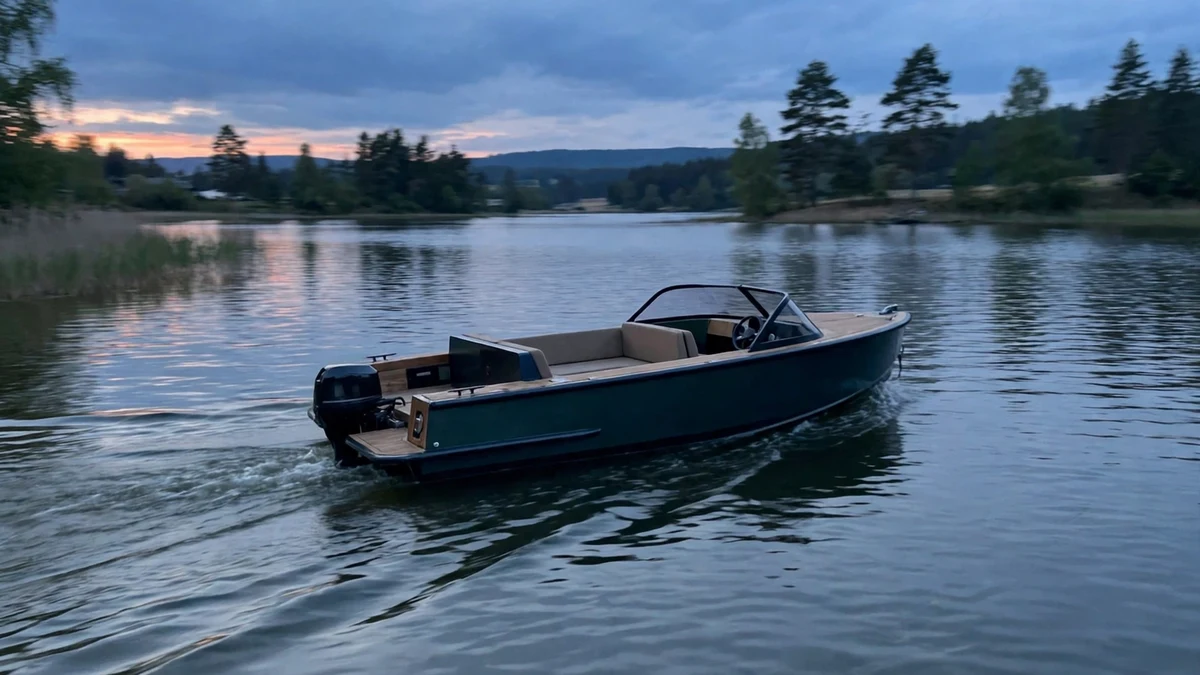
The ferry left the dock without a sound. No diesel rumble, no puff of smoke, no vibration through the deck, just the water parting at the bow. Passengers looked around for the noise they expected and found none. That is the first thing people notice: the power is there, but the noise and the smell are gone.
Under the deck, the system is simpler than a diesel in some ways. A battery pack feeds an electric motor, the motor turns a shaft or a pod, and the propeller pushes the boat forward. The challenge is making it move far enough, fast enough, and safely enough on water, where there is nowhere to pull over. This is how electric boat propulsion works, from the battery in the hull to the thrust at the stern.
How It Works
Step 1: The battery stores the energy
Everything starts in the battery pack, usually lithium iron phosphate cells grouped into modules and bolted low in the hull. The pack stores energy as direct current, and its size decides how far the boat can go: a harbour launch might carry 20 kilowatt-hours, while a ferry carries hundreds. The battery management system watches every cell, and it will cut power before a cell can overheat. The cells are sealed in a watertight case, because salt water and high-voltage electrics are a dangerous mix.

Step 2: The controller turns battery power into motor power
Between the battery and the motor sits the motor controller, a box of power electronics that turns direct current into the alternating current the motor needs. The controller switches the current on and off thousands of times a second, shaping it into a smooth wave, in response to the throttle: push the lever forward and the controller sends more power, pull it back and the power falls away. The controller also handles regeneration, turning the motor into a generator when the boat slows and feeding energy back into the battery. It is cooled by water or by a heat sink, because switching that much power makes heat.
Step 3: The electric motor turns power into spin
The motor itself is usually a permanent magnet motor, chosen because it is compact, efficient, and strong for its size. Inside it, magnets on the rotor are pulled around by fields in the stator, and the rotor turns the shaft. There are no pistons, no explosions, and no exhaust, which is why the motor is so quiet and why it needs so little maintenance. The motor can deliver full torque from a standstill, so the boat accelerates smartly from the dock, and it can spin in either direction, giving the boat reverse without a gearbox. The motor is sealed against water and bolted to the hull on mounts, though there is far less vibration to absorb than a diesel makes.
Step 4: The drive turns the shaft into thrust
The motor’s spin has to reach the water, and there are three common ways to do it. A shaft drive runs a shaft through the hull to a propeller at the stern, the oldest and simplest layout. A saildrive hangs a small leg below the hull with the propeller on it, and a pod drive puts the motor itself in a pod under the hull, with the propeller attached directly. Pod drives are the most efficient, because the motor sits in the water flow and stays cool, and the pod can rotate to steer the boat. Whichever layout is used, the propeller does the pushing, and it is shaped to move water cleanly, as described in how a yacht propeller is made. A ship propeller is built on the same principles at a much larger scale, as shown in how a ship propeller is made.
Step 5: The throttle and helm tell the system what to do
The skipper controls the whole system from the helm, with a throttle lever that talks to the controller over a data cable, not a mechanical linkage. The throttle sends a position signal, the controller turns it into power, and the motor responds in a fraction of a second. The helm also shows the battery state of charge, the power being used, and the estimated range, so the skipper can judge whether to slow down. Some boats add a joystick that blends throttle and steering, letting the skipper slide the boat sideways into a berth. The system is designed so that if the throttle signal fails, the motor stops safely rather than running away.
Step 6: The system is cooled, charged, and kept safe
Running the system makes heat in the battery, the controller, and the motor, so all three are cooled with seawater pumped through heat exchangers that keep the salt water away from the electrics. When the boat returns to the dock, it plugs into shore power, and the charger refills the battery, often overnight, while the battery management system balances the cells. Safety systems watch for water in the motor, overheating, and insulation faults, and they shut the system down before a small fault becomes a fire. The range of systems on a big ship is wider, as explained in the top ship propulsion systems explained, but an electric boat follows the same logic: store energy, control it, turn it into thrust, and keep it all safe.

Electric Boat Propulsion Specifications
| Specification | Typical figure |
|---|---|
| Battery type | Lithium iron phosphate |
| Battery size | 20 to 500 kilowatt-hours |
| Motor power | 10 to 500 kilowatts |
| Motor type | Permanent magnet electric motor |
| Drive layout | Shaft, saildrive, or pod drive |
| Top speed | Usually 6 to 25 knots |
How Much Does Electric Boat Propulsion Cost?
Electric boat propulsion costs more up front than a diesel of the same power, because the battery is expensive, but it costs far less to run and maintain. Industry estimates put a small electric propulsion package at roughly $10,000 to $50,000 (estimate), and a ferry-sized system at $500,000 to several million dollars (estimate), depending on battery size and power. The battery is the biggest single cost, and it will need replacing after a decade or so, but there is no fuel bill, no oil changes, and far fewer moving parts to wear out. For a harbour ferry that runs the same short route all day and charges at the dock, the maths already works.
A Rare Fact About Electric Boat Propulsion
Here is something few people realise: an electric boat can be far more efficient at low speed than at high speed, because the power a boat needs rises steeply with speed. Doubling a boat’s speed can take eight times the power, since the hull has to push aside far more water, so an electric boat that cruises gently can go much further than one pushed hard. Skippers learn to read the power gauge the way drivers read a fuel gauge, and a knot slower often means an hour more range. It is why electric boats are at their best on calm, unhurried water.
So the next time a boat slips away from the dock in silence, remember what is happening below the deck: a battery pack low in the hull, a controller shaping current thousands of times a second, a magnet-filled motor turning power into spin, and a propeller pushing water astern, all of it cooled, watched, and kept safe. Electric boat propulsion is not a diesel with the noise taken out; it is a different way of moving on water.


