The rider pulled into the garage after a long evening ride, killed the motor with a thumb, and did something that still feels odd to anyone raised on petrol bikes. She lifted a small flap on the side of the tank, took a cable off the wall, and plugged the motorcycle in, the way you would plug in a phone. A light on the dash turned green. By morning the battery would be full, the bike would be ready for another two hundred miles, and the garage would smell of nothing at all.
Charging an electric motorcycle is simpler than charging a car, and in some ways trickier. The battery is smaller, so it fills faster, but it is also squeezed into a frame built for a petrol tank, with less room for cooling and less weight to spare for a big onboard charger.
Under the bodywork, charging is a chain of small decisions made in fractions of a second. This is how that chain works, from the plug in the wall to the last percent on the dash.

How Electric Motorcycle Charging Works
Charging happens in three stages: the connection, the conversion, and the battery management. Power flows from the wall or the public charger into the bike, where an onboard charger turns it into the direct current the battery needs, and a management system watches every cell as it fills.
Step 1: The plug and the charging port
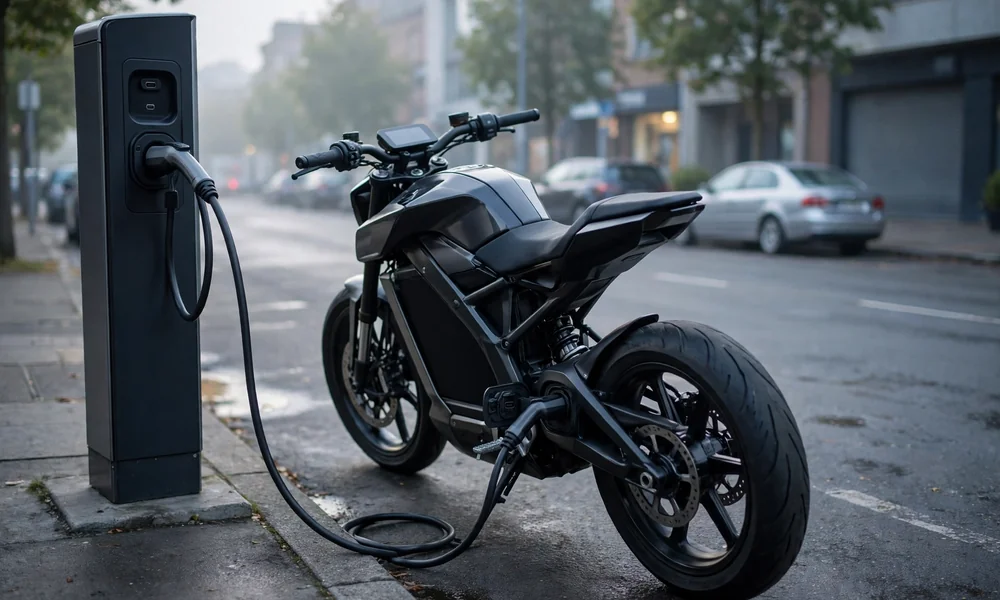
It starts with the plug. Most electric motorcycles use the same connectors as cars, a standard home plug for slow charging, a larger Type 2 or J1772 plug for faster home and public charging, and on some models a CCS plug for DC fast charging. The port sits where the fuel cap used to be, behind a weather-sealed flap, and the connector locks in place so a passer-by cannot pull it out and the bike cannot ride away while it is still plugged in.
Step 2: The onboard charger converts the power
Power from the wall is alternating current, but a battery only stores direct current, so the bike carries its own converter. The onboard charger, usually a sealed box tucked under the seat or the false tank, turns the wall’s alternating current into the direct current the battery needs, at the right voltage. The size of the motor it feeds is a separate question, and the range of motors a bike can carry is covered in the best electric motors for EVs explained, where power, weight, and efficiency decide how far a charge will take you.

Step 3: The battery management system takes over
Once the power is flowing, the battery management system runs the show. The battery is made of hundreds of lithium cells, and the system measures the voltage and temperature of each one, balancing them so none is overcharged or left behind. If a cell gets too hot, the system slows the charge or stops it entirely. If the battery is nearly full, it tapers the power down, because the last ten percent is the hardest on the cells, and a gentle finish adds years to the battery’s life.
Step 4: Home charging, public charging, and fast charging
Most charging happens at home, overnight, on an ordinary wall socket or a small wall box, and it is the cheapest and easiest way to fill a bike. At a public charger the bike can take more power, and on models with DC fast charging the conversion happens in the charger itself, so high-voltage direct current flows straight into the battery and a useful charge takes twenty to forty minutes. The principle is the same one used at a bigger scale by electric ferry charging, where vessels take megawatts in the minutes between sailings, and by electric yacht charging, where a marina berth fills a battery bank overnight.
Step 5: Cooling while it charges
Charging makes heat, and heat is the enemy of a battery, so the bike manages temperature while it charges. Many motorcycles use passive cooling, fins and airflow, for slow home charging, and switch on a small liquid cooling loop or a fan when fast charging pushes the cells harder. Some bikes will even delay a fast charge on a hot day, or warm the battery first on a cold morning, because a cold cell charges slowly and a hot cell ages quickly. The rider may notice the fan humming under the bodywork, and that is the bike looking after its own battery.
Step 6: The charge curve and the morning departure
A battery does not charge at a steady speed. It takes power quickly when it is empty, then slows as it fills, a curve the rider learns to plan around, topping up to eighty percent for a fast stop and saving a full charge for overnight. When the charge is done, the bike locks the port, the dash shows full range, and the rider unplugs, coils the cable, and rides away in silence. There is no fuel smell, no warm engine ticking as it cools, just a machine that filled up while its rider slept.
Electric Motorcycle Charging Specifications
| Specification | Typical figure |
|---|---|
| Battery capacity | 10 to 22 kilowatt-hours |
| Home charging, Level 1 | 1.4 kilowatts, 8 to 12 hours |
| Home charging, Level 2 | 3 to 7 kilowatts, 3 to 5 hours |
| DC fast charging | Up to 25 kilowatts, 20 to 40 minutes to 80 percent |
| Typical range | 100 to 200 miles per charge |
| Connectors | Type 2 or J1772, CCS on fast-charge models |
| Battery life | Typically 8 to 12 years with careful charging |
What Does Electric Motorcycle Charging Cost?
The electricity is the cheap part. Filling a typical 15-kilowatt-hour motorcycle battery at home costs an estimated $2 to $4, against an estimated $10 to $15 of petrol for the same distance on a comparable bike, which is why riders who charge at home see real savings. A home wall box costs an estimated $500 to $1,200 installed, and public fast charging costs more per unit of energy, roughly an estimated $5 to $8 for a full charge, but it is still far cheaper than petrol. The expensive part is the bike itself, which typically costs an estimated $8,000 to $25,000, though the fuel savings add up over years of riding. Those figures are estimates, and they vary by region and electricity price, but the pattern is clear: the bike costs more, the miles cost less.
A Rare Fact About Electric Motorcycle Charging
Here is the detail most riders miss: an electric motorcycle can charge itself while it slows down. When the rider rolls off the throttle, the motor reverses and becomes a generator, feeding power back into the battery, a trick called regenerative braking. On a twisty road, with a braking zone before every corner, it can add several miles of range over a long ride, and it also means the brake pads last far longer than on a petrol bike. Some riders barely touch the brakes at all, letting the motor do the slowing and the charging at the same time.
Charging an electric motorcycle is still new enough to feel strange, and already ordinary enough to forget about. Plug it in at night, ride it in the morning, and the only thing you notice is what is missing: the petrol station, the smell, and the noise. The grid has become the fuel tank, and the bike has become the simplest machine on it.


