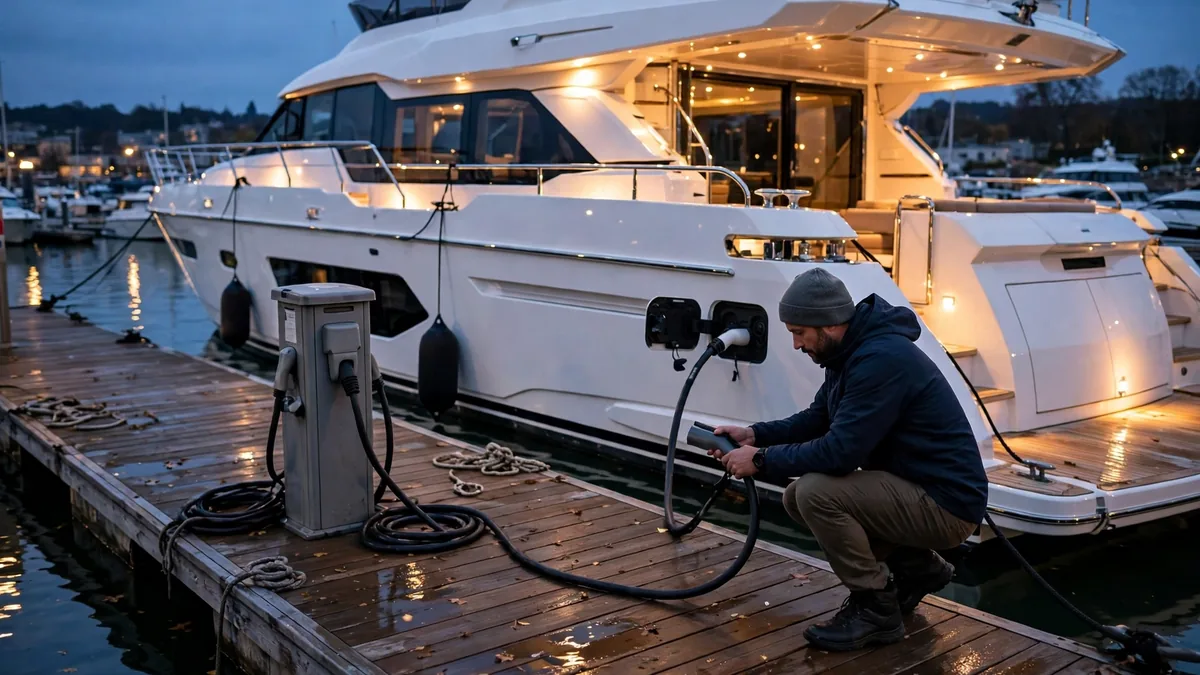
The yacht slid into the marina at dusk, and the crew did something the old hands still find strange: they plugged it in. A thick cable ran from the quay pedestal to a socket on the hull, a light on the panel turned green, and the yacht began to drink electricity the way it used to drink diesel. No fuel truck, no smell, no noise. By morning, the battery bank would be full, the air conditioning would have run all night on shore power, and the yacht could leave the harbour in silence. This is electric yacht charging, and it is changing what a marina is for.
Charging a yacht is not like charging a car. A large electric yacht carries a battery bank measured in megawatt-hours, roughly a hundred times the battery of a family electric car, and it needs to fill that bank safely in a wet, salty environment where the boat is moving, the shore supply is shared with other vessels, and the crew may be asleep. When it works, it feels simple. The engineering behind that simplicity is anything but.
How Electric Yacht Charging Works
Charging happens in four stages: the shore connection, the conversion, the battery management, and the monitoring. Power flows from the marina pedestal through a cable to the yacht’s shore inlet, where it is converted to the right voltage and form, then delivered to the battery bank under the control of a battery management system that watches every cell. The captain can choose how fast to charge, and the system will slow down or stop if anything gets too hot or too full.
Step 1: Connecting to shore power
The connection starts at the quay, where a pedestal supplies alternating current, often at 400 volts three-phase in a modern marina, and sometimes at much higher power through a dedicated fast-charging berth. The crew runs a marine-grade cable, thick, flexible, and waterproof, from the pedestal to the yacht’s inlet, and locks it in place with a connector designed so it cannot be pulled out by accident or by the yacht moving on its lines. Electric yacht propulsion is what the power is for, but the shore connection is where the whole system meets the outside world.
Step 2: Converting the power on board
Once the power is aboard, it passes through the yacht’s charger, a bank of power electronics that converts the shore alternating current into the direct current the batteries need, at the right voltage. The charger is usually built into the yacht’s power management system alongside the inverters that run the air conditioning and the galley, so the same equipment that charges the batteries also powers the yacht at the quay. Modern chargers are liquid-cooled and can handle hundreds of kilowatts, which is what makes a fast charge possible: at 500 kilowatts, a yacht can take on a useful amount of energy in a few hours rather than overnight.
Step 3: The battery management system takes over
The battery bank is made of hundreds of lithium-ion cells grouped into modules, and the battery management system watches every one of them. It measures voltage, temperature, and state of charge, and it balances the cells so none is overcharged or left behind. If a cell gets too hot, the system slows the charge or stops it entirely and switches on the battery cooling. A yacht solar panel can add a slow trickle to the same bank during the day, but the shore charger is the main source, and the management system treats both as inputs to the same careful accounting.
Step 4: Sharing power with the hotel loads
While the batteries charge, the yacht is still a home: the air conditioning runs, the refrigerators hum, and the crew cooks dinner. The power management system decides how much shore power goes to the batteries and how much goes to the hotel, and it will pause charging if the hotel load spikes, so the shore breaker never trips.
Step 5: Fast charging at a dedicated berth
Some marinas now offer DC fast charging, where the conversion happens on the quay and high-voltage direct current flows straight into the yacht’s battery. This can cut charging time dramatically, but it needs a berth built for it, with heavy cables, liquid cooling, and a grid connection that can supply megawatts. Electric ferry charging works on the same principle at a bigger scale, with ferries taking megawatts in the minutes between sailings, and yachts are following that lead as the infrastructure spreads.

Step 6: Monitoring, safety, and the morning departure
Charging is watched the whole time, by the yacht’s own system and often by the crew’s phone. Temperature sensors sit in the battery compartment, smoke and gas detectors guard against the rare cell failure, and the system can isolate a faulty module without shutting down the whole bank. In the morning, the crew unplugs the cable, stows it, and the yacht leaves the marina on stored electricity, its generators silent, its wake the only sign it is moving at all.
Electric Yacht Charging Specifications
| Specification | Typical figure |
|---|---|
| Battery capacity | 200 kilowatt-hours to 3 megawatt-hours |
| Shore power connection | 400 volts, three-phase, up to 250 kilowatts |
| DC fast charging | Up to 1 megawatt at a dedicated berth |
| Full charge time | 4 to 12 hours on shore power, 1 to 3 hours on DC fast charging |
| Silent range on batteries | 20 to 80 nautical miles at low speed |
| Charging connector | Marine-grade locking plug, waterproof when mated |
| Battery life | Typically 8 to 15 years with careful charging |
What Electric Yacht Charging Costs
The charging equipment on the yacht itself is part of the propulsion package, which typically adds an estimated $500,000 to $3 million to the price of a large yacht compared with a conventional diesel setup, depending on battery size. The electricity is the cheap part: filling a one-megawatt-hour battery at marina rates costs an estimated $150 to $400, against several thousand dollars for the equivalent diesel, which is why owners who cruise in areas with good shore power see real savings. The expensive part is the marina: a single DC fast-charging berth can cost an estimated $500,000 to $2 million to build, which is why they are still rare, and why most yachts still charge overnight on ordinary shore power, slowly and quietly, while the crew sleeps.
A Rare Fact About Electric Yacht Charging
Some electric yachts can charge in reverse: when they are under way, the propellers can be turned by the water and used as generators, feeding power back into the batteries while the yacht sails. It is the marine version of regenerative braking, and on a long downwind passage it can add hours of silent running without ever visiting a marina. Even rarer, a few yachts are fitted with shore connections that let them feed power back to the marina grid during a blackout, turning the yacht into a floating battery for the harbour, a trick borrowed from electric cars that turns a luxury toy into a piece of infrastructure.

Electric yacht charging is still young, but it is already changing the rhythm of life aboard: plug in at dusk, sleep in silence, and leave at dawn without starting an engine. As fast-charging berths spread and batteries grow, the day is coming when a yacht will charge the way a phone does, overnight and without a thought, and the diesel fuel dock will be the thing that looks old-fashioned.