The courier kicked his scooter into life outside the bakery, dropped a parcel into the top box, and was gone before the door had finished swinging shut. Nobody on the pavement gave the machine a second look, which is exactly the point. An electric scooter frame is supposed to disappear under its rider, carrying a battery, a motor, and a person over potholes without flexing. It looks simple, but it is one of the hardest small frames in transport to get right.
A scooter frame has no triangle to brace it, the way a bicycle does. It is a long lever, with the rider standing at one end and the front wheel at the other, and every bump tries to bend it in the middle. The deck must stay flat, the steering column must stay true, and the battery inside must stay dry and cool. This is how an electric scooter frame is made, from a length of aluminium tube to a machine that can carry a rider all day.
How It’s Made
Step 1: The deck extrusion is shaped
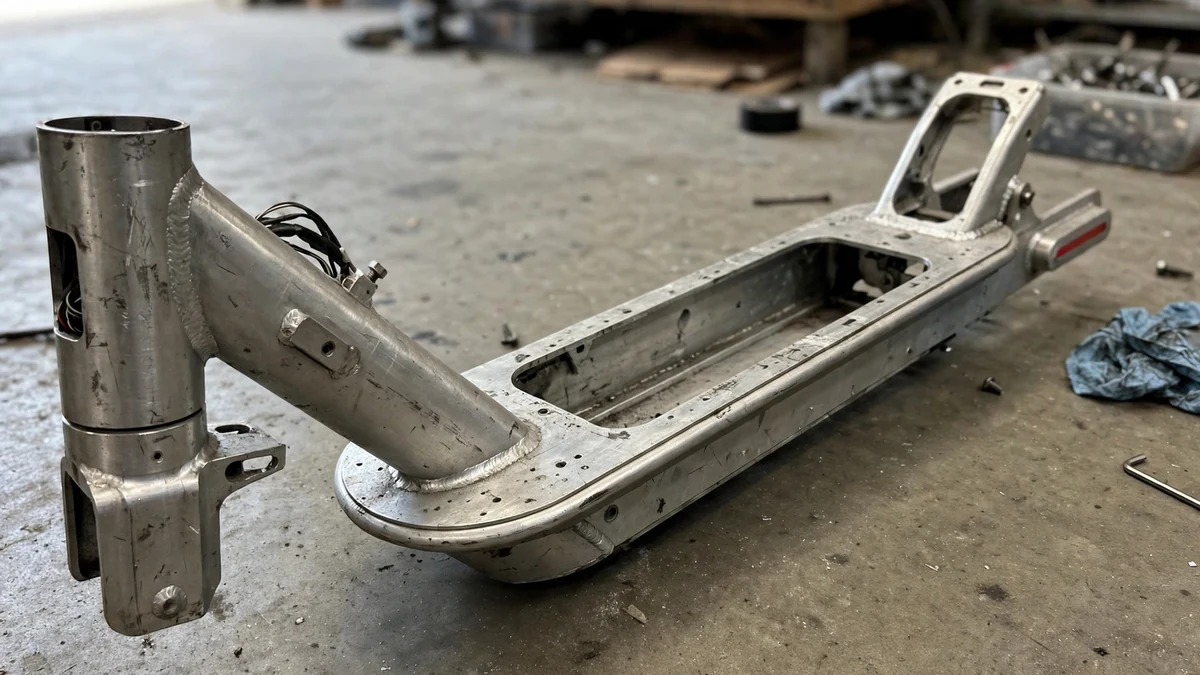
The frame starts life as an aluminium extrusion, a long hollow profile pushed through a die. The extrusion is wider than it is tall, which gives the deck its stiffness, and inside it are channels for the battery cables and ribs that stop the deck flexing. The extrusion is cut to length, and its ends are milled square so the front and rear sections meet cleanly. Builders choose 6061 aluminium, because it extrudes well and welds cleanly, and the profile is designed so the battery slides in from one end like a drawer.

Step 2: The steering column tube is bent and cut
The steering column is a separate tube, bent on a mandrel bender to the angle the designers chose, usually raked slightly back. The bend must be smooth, with no ripple on the inside of the curve, because a ripple is a weak spot where a crack can start after thousands of bumps. The tube is cut to length, its top end machined to take the handlebar clamp, and its bottom end prepared to meet the front fork. The column is checked against a template, since a column bent a degree too far changes the steering feel, and a channel inside carries the brake and throttle cables.
Step 3: The frame is jigged and welded
The deck, the steering column, and the rear motor mount are laid into a steel jig that holds every part in place. The jig is the most expensive tool in the workshop, because it has to be right to a fraction of a millimetre. A welder joins the parts with TIG welding, working around the joints in a set order so the heat does not pull the frame out of square, and the weld at the base of the steering column gets special care, since it carries the whole load of the rider leaning on the bars. Once the welds cool, the frame is checked on a flat table, and any frame that has moved is straightened cold or scrapped.
Step 4: The frame is heat-treated and machined
Welding softens aluminium, so the welded frame goes into an oven for heat treatment to bring the alloy back to full strength. After cooling, the frame is machined: the headset bearing seats are reamed, the folding mechanism is fitted if the scooter folds, and the mounting points for the motor and brakes are faced flat. The battery compartment is checked for sharp edges, and drain holes are drilled so rainwater cannot pool inside the deck. The folding latch, where fitted, is adjusted until it clicks shut with no play, because a loose latch is felt in the handlebars at once. This is where the frame stops being a welded shape and becomes a precise machine part, done the same way other precision parts are made, as described in how precision CNC machining is made.
Step 5: The frame is painted and sealed
The frame is cleaned, primed, and powder-coated, with the bearing surfaces and the inside of the battery compartment masked off. Powder coating is used because it is tougher than wet paint against stone chips and scrapes. After coating, the seals are fitted: rubber gaskets around the battery cover, a seal where the steering column enters the deck, and caps over any unused mounting holes. The aim is to keep water out of the electrics. A lightweight e-bike frame faces similar sealing and strength choices, as shown in how an e-bike lightweight frame is made, though a scooter deck has to protect a battery in a much flatter space.
Step 6: The scooter is assembled and tested
Finally the battery, motor, controller, brakes, and wheels are fitted, and the complete scooter is tested. The frame is loaded on a rig that simulates a heavy rider hitting potholes, the steering is turned lock to lock thousands of times, and the scooter is ridden over a test track with kerbs and speed bumps. Testers listen for creaks and check for any sign of flex, and if anything moves that should not move, the scooter goes back to the bench. The suspension fork on an e-bike does a similar job of smoothing the ride, as described in how an e-bike suspension fork is made, but on a scooter the frame itself has to absorb much of the shock. Only when the frame is still tight and silent after testing is the scooter boxed and shipped.

Electric Scooter Frame Specifications
| Specification | Typical figure |
|---|---|
| Frame material | Aluminium alloy 6061 |
| Frame weight | Roughly 4 to 7 kilograms |
| Maximum rider weight | Usually 100 to 120 kilograms |
| Deck width | About 15 to 20 centimetres |
| Steering column | Bent aluminium tube, folding latch |
| Water protection | Sealed deck, usually IPX4 or better |
How Much Does an Electric Scooter Frame Cost?
The frame is a large share of what an electric scooter costs to build, because the extrusion, the jig, the welding, and the heat treatment are all expensive for a machine that sells at a modest price. Industry estimates put a good aluminium scooter frame at roughly $80 to $250 (estimate), and a complete commuter scooter usually sells for $400 to $1,500 (estimate), depending on the battery, motor, and brakes. The cheapest scooters cut costs in the frame first, using thinner walls and skipping heat treatment, which is why they develop a wobble in the steering column after a few months.
A Rare Fact About Electric Scooter Frames
Here is something few riders realise: the deck of an electric scooter is also its battery box, and the battery is a structural part of the frame. On many scooters the battery pack is bolted tightly into the deck extrusion, and its rigid casing helps stop the deck bending, so a scooter with a loose battery is actually weaker than one with the battery fitted. Designers count on that stiffness when they size the deck walls, which is why a replacement battery has to match the original exactly.
So the next time you step onto a scooter and glide away without a thought, remember what is under your feet: an extruded deck that is also a battery box, a steering column bent to a precise angle, welds laid in a jig, and a test rig that tried to break it all before you ever rode it. The electric scooter frame is small, flat, and easy to ignore, and that is the highest compliment it can earn.


