The rider twisted the throttle on a quiet street, and the scooter moved off without a sound, without a shudder, and without any visible effort. There was no engine roar, no gear change, no puff of exhaust, just a smooth, silent push that carried the rider up the gentle hill and away. Inside the rear wheel, a motor no bigger than a dinner plate was turning electricity into motion, with an efficiency no petrol engine could match. The electric scooter motor is small, simple, and clever, and it is the reason the scooter works at all.
The secret is that an electric motor does not burn anything. It uses magnets, and magnets do not get tired. When electric current flows through coils of wire, it creates a magnetic field, and that field pushes against permanent magnets fixed inside the motor, forcing the wheel to turn. Control the current and you control how hard the motor pushes; reverse the pattern and the motor acts as a brake, turning motion back into electricity. This is how an electric scooter motor works, from the battery in the deck to the wheel on the road.
How It Works
The battery supplies the power
Everything starts with the battery, a pack of lithium-ion cells hidden in the deck under the rider’s feet. The battery stores energy as direct current, usually at 36 or 48 volts, and it can deliver a large burst of current when the rider twists the throttle. The battery is the fuel tank, and its size decides the range: a bigger pack means more miles, but also more weight, and the scooter’s frame has to carry it all. The frame that holds that battery is a piece of engineering in its own right, as described in how an electric scooter frame is made, and the motor and the frame are designed together, not separately.
The controller turns battery power into motor power
The battery’s direct current cannot drive the motor directly, because the motor needs a rotating magnetic field, and direct current does not rotate. That is the controller’s job. The controller is a small box of electronics, usually hidden in the deck, that switches the battery current on and off thousands of times a second, sending pulses to the motor’s coils in a carefully timed sequence. It reads the throttle to decide how much power to send, and limits the current so the motor does not overheat on a long hill. In effect, the controller is the motor’s brain, and a good controller is the difference between a smooth, silent ride and a jerky, buzzing one.

Coils and magnets make the wheel turn
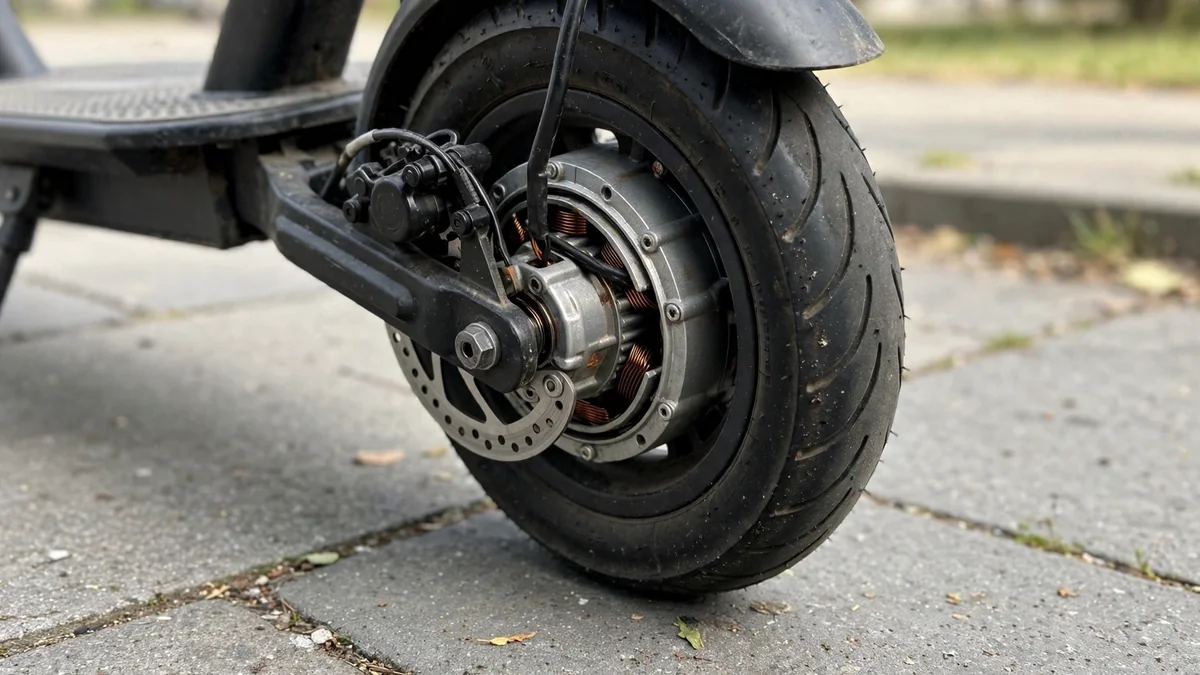
Most electric scooters use a brushless hub motor, which means the motor is built into the wheel itself, with no gears, no chain, and no belt. Inside the hub, coils of copper wire are fixed to the axle, and permanent magnets, usually made from neodymium, are fixed to the inside of the wheel rim. When the controller sends current through the coils in sequence, each coil becomes a magnet that attracts the nearest permanent magnet and repels the one behind it, and the rim turns. The next coil fires, the rim turns a little more, and the sequence repeats hundreds of times a second. The same brushless idea drives many small electric vehicles, and a close cousin of this motor is explained in how an e-bike hub motor works, where the same magnets and coils push a bicycle instead of a scooter.
Regenerative braking turns motion back into charge
When the rider brakes, the motor can run in reverse, as a generator. The spinning wheel turns the magnets past the coils, and the coils generate electricity, which the controller feeds back into the battery, slowing the scooter at the same time. But it does extend the range slightly, and more importantly it gives the scooter a smooth, controlled braking feel without wearing out the brake pads. The mechanical brakes are still there for a hard stop, and they do the heavy work, but the motor’s gentle braking is what the rider feels first, every time.
Cooling, sealing, and the limits of a small motor
A scooter motor is sealed against rain and dust, because it lives a few centimetres from the road, and its casing is designed to shed heat into the passing air. The biggest limit is heat: push a small motor hard up a long hill and the coils get hot, the controller cuts the power to protect them, and the scooter slows down. That is why a motor rated at 250 watts can briefly deliver far more, and why the headline power figure on a scooter is usually the peak, not the continuous rating. Good motors use more copper and stronger magnets, and they hold their power on a hill instead of fading. The wider world of electric motors is full of the same trade-offs between power, weight, and heat, as covered in the best electric motors for EVs explained, and a scooter motor is simply the smallest, most honest version of the same idea.

Electric Scooter Motor Specifications
| Specification | Typical figure |
|---|---|
| Motor type | Brushless DC hub motor, usually in the rear wheel |
| Rated power | About 250 to 500 watts continuous |
| Peak power | About 500 to 1,000 watts for short bursts |
| Battery voltage | Usually 36 or 48 volts |
| Top speed | About 25 kilometres per hour, often limited by law |
| Efficiency | About 80 to 90 percent |
| Maintenance | Almost none, no brushes, gears, or chain |
How Much Does an Electric Scooter Motor Cost?
The motor is one of the most expensive parts of a scooter, after the battery, because the magnets and the copper are costly and the hub must be machined precisely. Industry estimates put a good hub motor at roughly $50 to $200 (estimate) as a component, while a complete commuter scooter usually sells for $400 to $1,500 (estimate), depending on the battery, motor, and brakes. Riders who buy a scooter with a stronger motor pay more up front, but they get a machine that climbs hills without fading and lasts longer before the motor wears out.
A Rare Fact About Electric Scooter Motors
Here is something few riders realise: an electric scooter motor can be more efficient going downhill than a petrol engine is going anywhere. When the scooter rolls downhill with the throttle closed, the motor generates electricity and feeds it back to the battery, so a long descent can actually add range, and on a hilly commute the scooter recovers a little of the energy it spent climbing.
So the next time a scooter glides away in silence, remember what is happening inside that little wheel: a battery feeding a controller, a controller firing coils thousands of times a second, magnets pulling the rim around with no gears and no noise, and a motor that turns into a generator the moment you brake. The electric scooter motor is the smallest motor most people will ever ride, and it is also one of the cleverest.