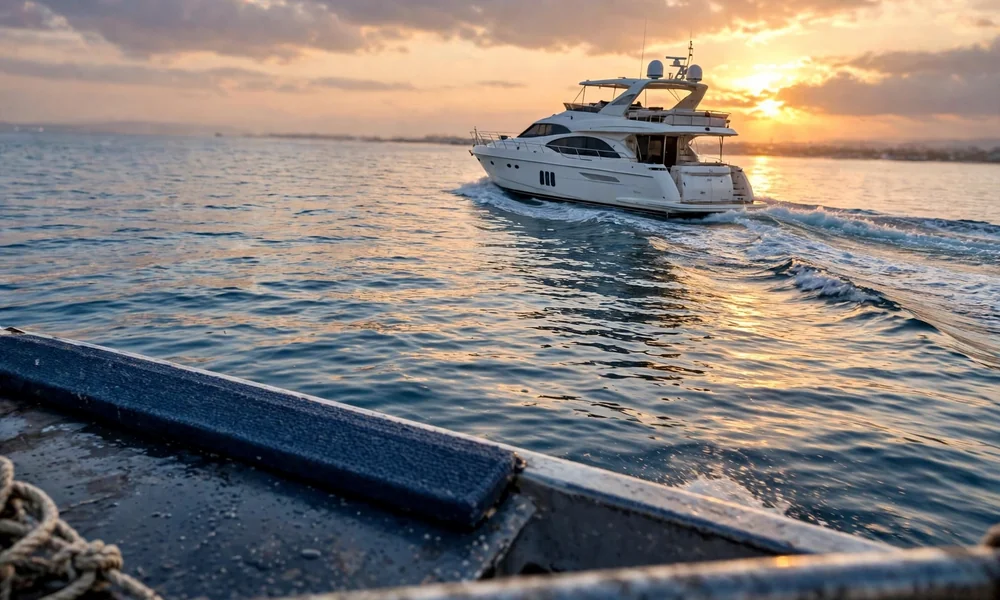
The captain eased the throttle forward and the yacht moved away from the quay without a sound. No engine note rose through the deck, no vibration rattled the glasses in the saloon, and the only sign of power was the water sliding past the hull. Below deck, in a room that used to hold two roaring diesels, a pair of electric motors was turning the propellers with a quiet efficiency that felt almost unnatural. This is what electric yacht propulsion feels like from the bridge, and it is changing how large yachts are built.
Electric propulsion on a yacht is not just a small electric boat scaled up. A yacht carries a hotel’s worth of electrical load, from air conditioning to stabilisers, and it has to keep going for days at sea, far from any charger. So a yacht’s electric drive is really a small power station: batteries, generators, and motors working together, with the captain choosing at any moment whether the power comes from stored charge, from a generator, or from both at once.

How Electric Yacht Propulsion Works
The system has four main parts, and they work in a loop: the battery stores energy, the generators make more when needed, the power electronics direct it, and the motors turn it into thrust. Understanding the loop is the key to understanding the whole yacht.
Step 1: Storing power in the battery bank
At the heart of the system is a bank of lithium-ion batteries, usually sized between 200 kilowatt-hours and several megawatt-hours on a large yacht. The batteries live in a dedicated, ventilated compartment with fire suppression and cooling, and they supply the motors directly for silent running. On a typical yacht the battery alone can power a few hours of slow cruising, or a whole night at anchor with the engines off, running the air conditioning and lights without a generator. Electric yacht battery specs decide how long that silent window lasts, and owners treat it as one of the most valuable numbers on the boat.
Step 2: Making power with diesel-electric generators
When the batteries run low, or when the yacht needs to cruise fast for hours, diesel generators take over. These are not the old main engines; they are smaller, quieter units that run at a constant, efficient speed and do nothing but generate electricity. The yacht can carry two or three of them and switch them on one at a time, so it only burns as much fuel as the moment demands. That is the core advantage of diesel-electric: the generators never have to match the propeller speed, so they always run where they are most efficient.
Step 3: Directing the power through converters
Between the batteries, the generators, and the motors sits the power management system, a set of converters and switchboards that route electricity where it is needed. It decides in milliseconds whether the motors draw from the battery, from a generator, or from both, and it protects the batteries from overcharging or overheating. It also handles the yacht’s hotel load, so the same system that drives the propellers also runs the galley, the stabilisers, and the air conditioning, prioritising silently and automatically.

Step 4: Turning electricity into thrust
The motors themselves are usually permanent-magnet or induction units, mounted either inboard on a shaft or inside a steerable pod beneath the hull. Pod drives are increasingly popular on yachts because they can rotate 360 degrees, giving the vessel remarkable manoeuvrability in a marina, and because they free up space inside the hull. An electric motor delivers full torque from a standstill, so the yacht accelerates smoothly and holds a precise speed, which matters when you are docking a forty-metre boat in a crosswind. The general principles are the same as on a smaller boat, and how electric boat propulsion works explains the basic motor and propeller relationship, but a yacht adds scale, redundancy, and a whole power station behind it.
Step 5: Regenerating power under sail
On a sailing yacht, the system has a trick that a motor yacht cannot match. When the yacht is sailing under wind power, the propellers can be left to spin in the water, turning the motors into generators and feeding electricity back into the batteries. The captain balances sail trim against regeneration, because a spinning propeller creates drag, and the art is in taking just enough power without slowing the boat.
Step 6: Running silent, and knowing when not to
The final step is operational, not mechanical. The captain chooses the mode: silent battery running near shore or at anchor, efficient generator cruising on a long passage, or a boost mode that uses battery and generators together for maximum speed. Each mode has a cost in range, noise, and fuel, and a good crew learns the trade-offs by heart. The system watches it all, warning the crew when the batteries are low, when a generator needs service, and when the yacht can afford another quiet hour.
Electric Yacht Propulsion Specs
| Specification | Typical figure |
|---|---|
| Battery capacity | 200 kWh–3 MWh |
| Motor power | 2 × 300–1,000 kW |
| Silent range | 10–40 nautical miles |
| Cruising speed | 10–14 knots |
| Top speed | 16–20 knots |
| Generators | 2–3 diesel-electric units |
| Propulsion | Pod drives or shaft drive |
| Hotel load | 100–500 kW at anchor |
The numbers depend heavily on the yacht’s size and purpose. A yacht built for silent nights in a quiet bay will carry a bigger battery than one built for fast ocean crossings, and the choice of diesel or electric is a real one: diesel versus electric yacht propulsion compared lays out the trade-offs in fuel, noise, and cost that every owner has to weigh.
How Much Does Electric Yacht Propulsion Cost?
An electric propulsion system for a large yacht typically costs an estimated $1–5 million, including batteries, motors, generators, and power electronics, on top of the hull and interior. That is more than a conventional diesel drivetrain, which might cost an estimated $500,000–$2 million. The running costs tell the other half of the story: owners report fuel savings of 20–30 percent, far less vibration and maintenance, and the priceless benefit of silent nights at anchor. Battery replacement, needed after roughly 8–12 years, costs an estimated $200,000–$1 million depending on capacity.
For now, pure battery-electric yachts are limited to short-range and day boats, because the energy density of batteries still cannot match diesel for a long ocean passage. The diesel-electric hybrid is the sweet spot, and it is the system most new large yachts are being built with.
A Rare Fact
Some of the quietest places on a modern electric yacht are also the loudest to build. During sea trials, engineers measure noise in the owner’s cabin in decibels, and a well-built electric yacht at anchor can be quieter than a bedroom in a city flat, measuring under 30 decibels. The irony is that the silence makes every other sound louder: a rattling locker or a humming pump that nobody would have noticed on a diesel boat suddenly becomes the loudest thing on board, and the shipyard has to chase down noises that the old engines used to hide.
Electric yacht propulsion is not a single invention. It is a system: a battery, a generator, a converter, and a motor, all talking to each other, and all tuned to one goal, which is to move a floating hotel through the water as quietly and efficiently as possible. When it works, the most impressive thing about it is how little you notice it at all.


