The yacht is anchored in a quiet bay, the engine is off, and nothing is running except the gentle lap of water against the hull. Yet the lights are on below deck, the fridge is humming, the navigation instruments are awake, and the batteries are slowly filling up. Nothing is plugged in, nothing is burning, and no generator is growling. The only thing working is the sun, falling on a dark glass panel stretched across the cabin roof. A yacht solar panel is one of the quietest machines on the water, and also one of the most useful: it turns a sunny afternoon into free electricity, day after day, without a single moving part.
A solar panel on a yacht is not the same as one on a house roof. It has to survive salt spray, flexing decks, and the occasional green wave over the bow, all while lying almost flat in the worst possible angle for catching the sun. Building one means sealing fragile silicon cells inside a sandwich of glass and plastic tough enough for the sea, then wiring it to a controller that squeezes every watt out of whatever light is available.

How a Yacht Solar Panel Works
A yacht solar panel works by turning sunlight into electricity inside silicon cells. When sunlight hits a cell, it knocks electrons loose, and the cell’s internal structure sweeps those electrons into a current. Wire dozens of cells together and the current adds up to useful power, which flows through a controller into the yacht’s batteries. There are no moving parts, no fuel, and no exhaust: the panel simply sits in the sun and quietly makes power for as long as the light lasts.
Step 1: Sunlight hits the silicon cells
Each cell is a thin slice of silicon treated so that one side carries a slight negative charge and the other a slight positive charge. When a photon of sunlight strikes the cell, it frees an electron, and the charge difference pushes that electron in one direction, creating a flow of current. A single cell makes only about half a volt, far too little on its own, so a yacht panel wires sixty or more cells in series to reach the twelve or twenty-four volts the boat’s batteries need.
Step 2: The cells are sealed against the sea
Bare silicon cells are fragile, and salt water would destroy them in days, so they are sealed inside a tough sandwich. The front is tempered glass, strong enough to stand on and clear enough to let the light through; behind the cells goes a waterproof backing sheet, and the whole stack is bonded with a clear plastic that holds it together even if the glass cracks.
Step 3: The panel feeds a charge controller
Power from the panel does not go straight to the batteries, because a panel’s voltage swings with the sunlight, and an unguarded battery would be overcharged on a bright day. Instead, the panel feeds a charge controller, usually a maximum power point tracking unit, which constantly adjusts itself to draw the most power the panel can give in that moment. On a cloudy morning it hunts for the best point; at noon it backs off as the batteries fill. It is a small box, often hidden in a locker, but it can add a fifth more power from the same panel on a changeable day.
Step 4: The batteries store the power
From the controller, the power flows into the yacht’s house batteries, usually lithium or deep-cycle lead-acid, which store it for use after sunset. The batteries are the boat’s real fuel tank, and the panel’s job is to keep them topped up while the crew is ashore or asleep. A well-matched system can replace everything the fridge, lights, and instruments use on a sunny day, which means the engine never has to run just to charge the batteries, saving fuel, noise, and wear.
Step 5: Shade, heat, and angle shape the output
A yacht panel rarely works at its headline rating, because life on a boat conspires against it. The mast and rigging cast moving shadows, the panel lies flat instead of tilted toward the sun, and a hot deck actually makes silicon cells less efficient. Even so, a panel rated at 400 watts might deliver 250 on a good day, which is still enough to matter.
Step 6: The system runs itself for years
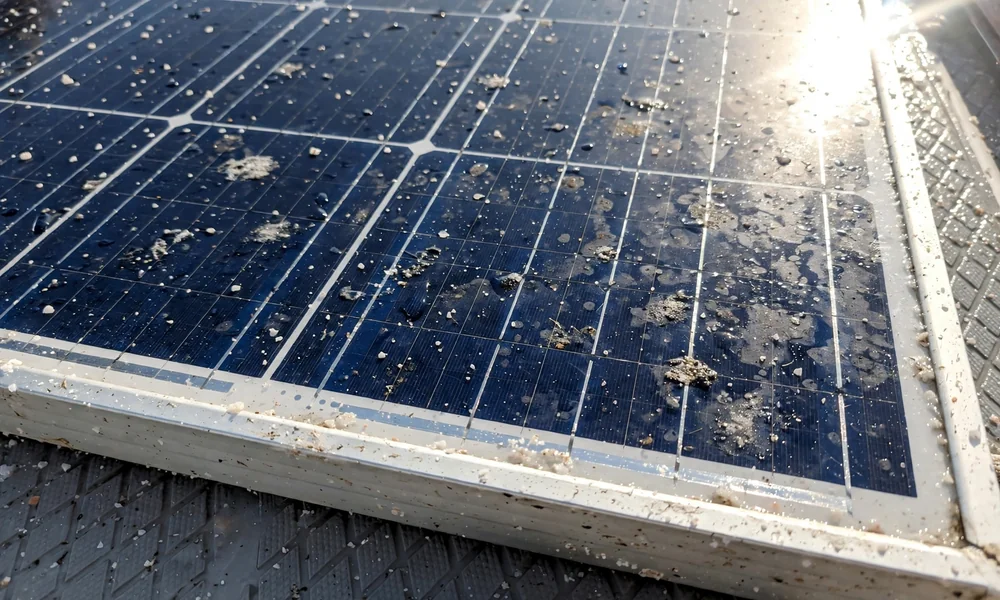
Once installed, a yacht solar system needs almost nothing. The panel has no moving parts, the controller watches itself, and the only maintenance is a rinse with fresh water to wash off salt and gull droppings, which can cut output surprisingly fast. Quality marine panels are rated to last twenty years or more at sea, slowly losing a little power each year as the cells age. The owner’s job is mostly to check the controller’s display in the morning and enjoy the silence of a boat that powers itself.
Yacht Solar Panel Specs
| Specification | Typical figure |
|---|---|
| Panel type | Monocrystalline silicon |
| Rated power | 100–400 W per panel |
| Efficiency | 19–22 percent |
| Output voltage | 12 V or 24 V systems |
| Controller | MPPT charge controller |
| Panel weight | 5–20 kg |
| Expected life | 20–25 years |
| Daily yield | 0.4–1.6 kWh per panel |
The numbers vary a lot by boat and latitude, because a panel in the Mediterranean makes far more power than the same panel in northern waters. A cruising yacht often carries two to four panels, adding up to a kilowatt or more. What they share is the basic deal: sunlight in, stored power out, and silence in between. How solar sailing yacht systems work explains the bigger picture, how panels, controllers, and batteries are sized together as a complete system for life at anchor.
How Much Does a Yacht Solar Panel Cost?
A marine solar panel typically costs an estimated $200 to $800, depending on size and build quality, and a complete installation with a charge controller, wiring, and mounting usually costs an estimated $1,000 to $3,000 for a single panel system. Larger yachts with several panels, lithium batteries, and a full energy refit can spend an estimated $5,000 to $15,000, but the running costs after that are close to zero, since sunlight is free and the panels need little more than a wash.
The price buys independence as much as electricity, which is why solar has become standard on cruising yachts. The fastest electric yachts show where the technology is heading, with solar and batteries replacing diesel across the whole boat. The best electric boat propulsion systems explain the other half of the electric yacht, the motors and drives that turn stored solar power into silent motion.
A Rare Fact

The first solar panels ever fitted to yachts were tiny trickle chargers, barely enough to keep a single battery alive while the boat sat in the marina. Today, some ocean-crossing yachts carry enough solar to run the whole boat, including the autopilot, the watermaker, and the electric winches, without ever starting an engine.
That is the real story of the yacht solar panel: not a gadget, but a quiet revolution in how a boat lives. A dark sheet of glass on the cabin roof, a small controller in a locker, and a battery bank below deck add up to something simple and hard to argue with: a yacht that makes its own power from the sky, and asks nothing in return but sunlight.


