A hypercar V12 engine does not come off a conveyor belt. It is built slowly, in a quiet room, by a small team of people who sign their work and remember every engine they have touched. The room smells of oil and hot metal, the benches are spotless, and the engine on the stand in the middle of it is worth more than most houses. Twelve cylinders, two banks of six, and a sound that no turbocharged engine has ever quite matched — that is what this room exists to create.
The V12 survives because it does something nothing else does: it delivers enormous power with a smoothness that feels almost electric, yet with a voice that is unmistakably mechanical. Building one takes days, not hours, and every stage is checked, measured, and checked again before the next one begins.
Inside the Production
Step 1: Casting and machining the engine block
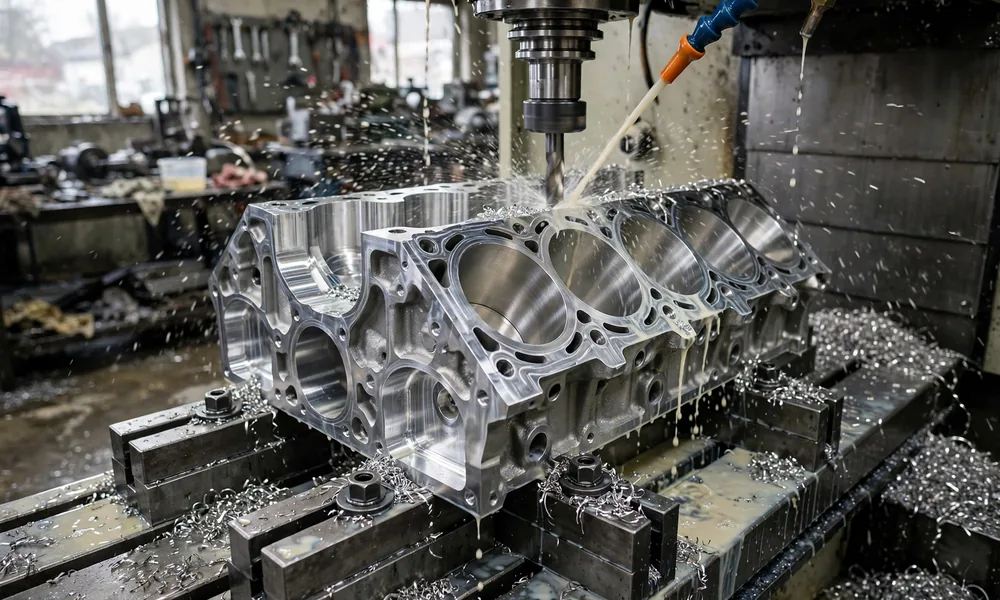
Production starts with the engine block, the single largest piece of the engine and the foundation everything else bolts onto. The block is cast from aluminium alloy in a foundry, then it travels to the machine shop, where computer-controlled mills cut the cylinder bores, the bearing seats, and the oil passages to tolerances measured in hundredths of a millimetre. The block is then washed, dried, and inspected under bright light, because a single speck of grit left inside would destroy the bearings within minutes of the first start.
Step 2: Building the crankshaft and pistons
While the block is being machined, the rotating parts are prepared. The crankshaft is forged from steel, ground to a mirror finish, and balanced so precisely that it can spin at 9,000 revolutions per minute without shaking the engine apart. Twelve forged pistons, each lighter than a smartphone, are matched to twelve connecting rods, and the whole set is weighed so that every piston-and-rod pair matches its brothers to within a fraction of a gram. It is slow, fiddly work, and it is the reason a hand-built V12 feels so smooth: nothing in it is merely close enough.
Step 3: Assembling the bottom end
The crankshaft is lowered into the block and held by main bearing caps, each one torqued down in a precise sequence with a torque wrench that clicks at exactly the right force. The pistons are then pushed up into their bores from below, connected to the crankshaft, and the whole rotating assembly is turned over by hand to check that it moves freely, with no tight spots and no scraping. Once it turns freely, the sump is fitted underneath, the oil pump is installed, and the bottom end is sealed.
Step 4: Fitting the cylinder heads and valvetrain
Next come the two cylinder heads, each one carrying six combustion chambers, twenty-four valves, and the camshafts that open and close them. The heads are cast and machined just as carefully as the block, and the valves are lapped into their seats by hand until each one seals perfectly. Four camshafts — two per bank — are timed to the crankshaft with chains or gears, and the timing is checked with dial gauges, because a camshaft that is one tooth out would make the engine run badly or, in the worst case, let a piston strike a valve. The way the heads are put together is part of what how a hypercar V12 engine is made explains in detail, and the care taken here is the same care that goes into the rest of the build.
Step 5: Adding the intake, exhaust, and ancillaries
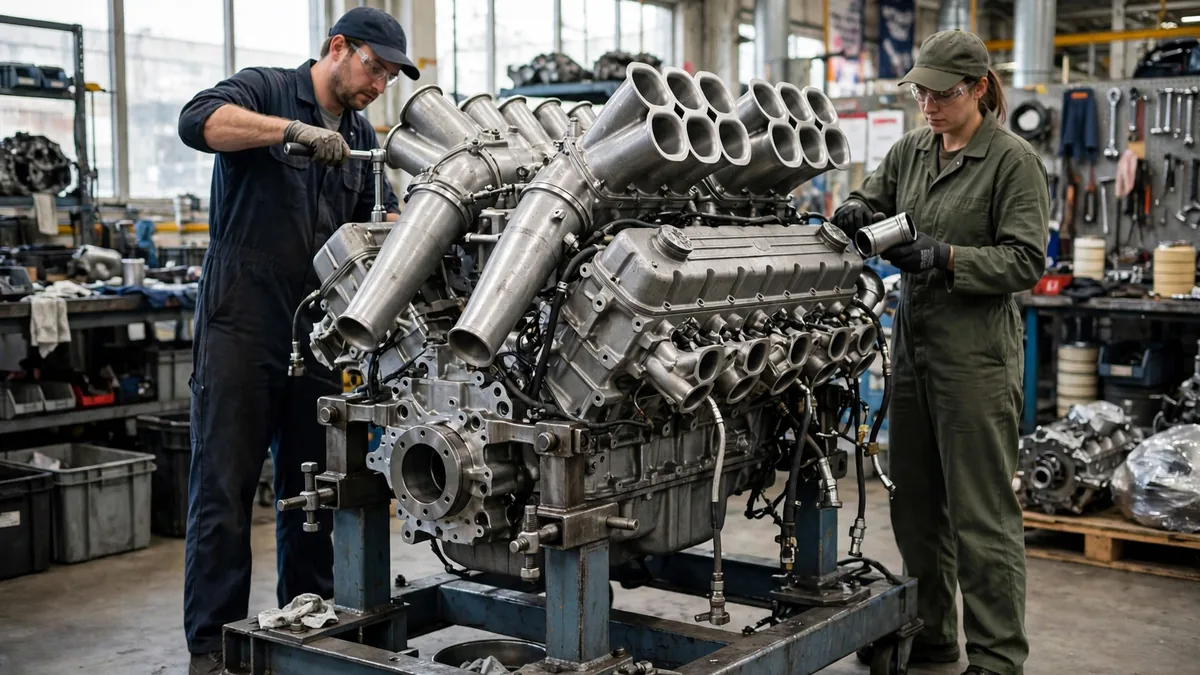
With the long block complete, the engine starts to look like an engine. The intake system — often a set of individual throttle bodies with long, polished trumpets — is bolted on top, and the exhaust manifolds, usually made from thin-walled Inconel or stainless steel, are fitted to the outside of each bank. The water pump, the alternator, the starter motor, and the oil and fuel lines are all fitted and routed, with every hose clipped and every connector checked. At this stage the engine is almost complete, and the technicians go over it with a checklist, ticking off every bolt, every hose, and every electrical plug before it is allowed to move to the test cell.
Step 6: Testing on the dynamometer
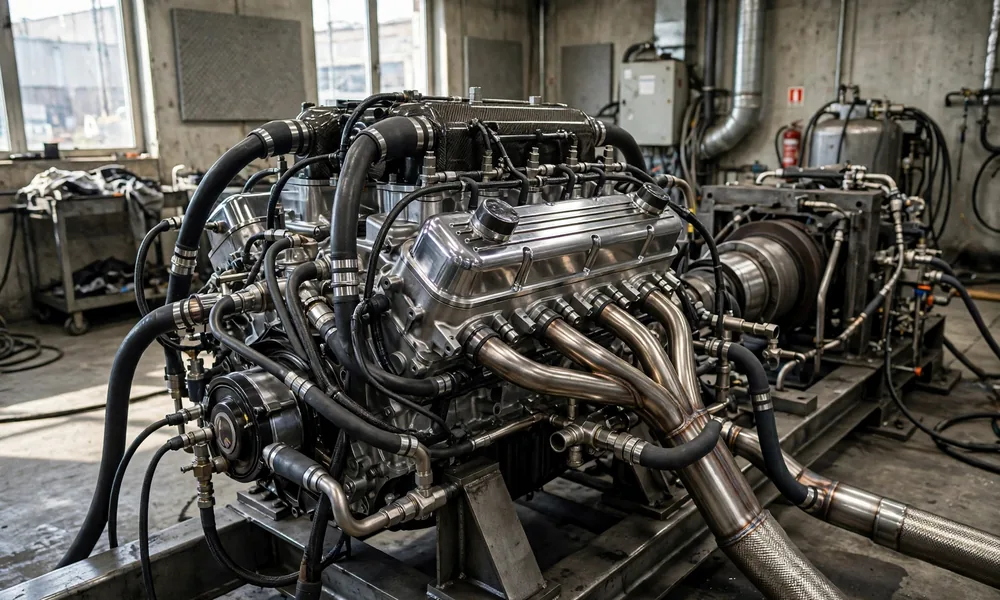
Every hand-built V12 is run before it leaves the factory. The engine is mounted on a dynamometer, connected to fuel, cooling water, and exhaust extraction, and started for the first time. Technicians watch oil pressure, water temperature, and exhaust readings as the engine warms up, then run it through a carefully planned programme: gentle running-in at low speed, then progressively harder pulls to full power. The dynamometer measures the power at every speed, and the result must match the specification within a narrow band, or the engine comes off the rig for investigation. Only when the engine has passed its full test, with its power curve printed and filed, is it signed off and crated for the car assembly line.
Specs
| Specification | Typical figure |
|---|---|
| Configuration | 60-degree V12, naturally aspirated |
| Displacement | 6.0–6.5 litres |
| Power output | 800–1,000 horsepower |
| Maximum speed | Up to 9,000–9,500 rpm |
| Valves | 48, four per cylinder |
| Block material | Cast aluminium alloy |
| Crankshaft | Forged steel, fully balanced |
| Build time | Several days, by a small team |
| Testing | Full dynamometer run before delivery |
Price
A hypercar V12 engine is never sold on its own, so any price is an estimate. As an estimate, the engine alone costs roughly $150,000 to $350,000 to build, depending on the maker, the materials, and how much of the work is done by hand. The finished hypercar usually costs $2 million to $4 million, and the engine accounts for a large share of that figure: the materials are expensive, the machining is slow, and the testing ties up a dynamometer cell for hours. A buyer is paying for an engine that a named team built, tested, and signed, not for one that rolled off a line in minutes.
A Rare Fact
In the best hypercar engine shops, a single technician — often called the engine builder — assembles the entire engine from start to finish, and then signs a small plaque that is fixed to the finished engine. The idea comes from racing, where one person taking responsibility for one engine meant there was never any doubt about who had built it. It is a small detail, but it captures why the V12 still matters: in a world of identical electric motors, this is an engine with a human fingerprint on it, built by someone whose name is on the work.
The V12 is the heart of the hypercar, but it is only half the story. The way it breathes and revs is explained in how a hypercar V12 engine works, and the numbers behind its performance are laid out in the hypercar V12 engine specs explained guide. The next time a V12 hypercar pulls away and the revs climb past 8,000, remember the quiet room, the torque wrench, and the builder who turned the crankshaft over by hand and listened before they let it run.


