The most important part of an electric car is also the heaviest, the most expensive, and the hardest to build well. The battery pack sits under the floor, out of sight, and most drivers never think about it — until it defines how far the car can go, how fast it can charge, and how long it will last. Inside the factory that builds it, the work is a strange mix of spotless clean rooms, heavy machinery, and quiet, careful hands.
An EV battery pack is not one battery. It is hundreds or thousands of individual cells, grouped into modules, wired together, cooled, sealed, and tested until the whole pack behaves like a single, safe unit. Every cell is tested before it is used, every weld is checked, and every finished pack is charged, discharged, and shaken before it is allowed near a car.
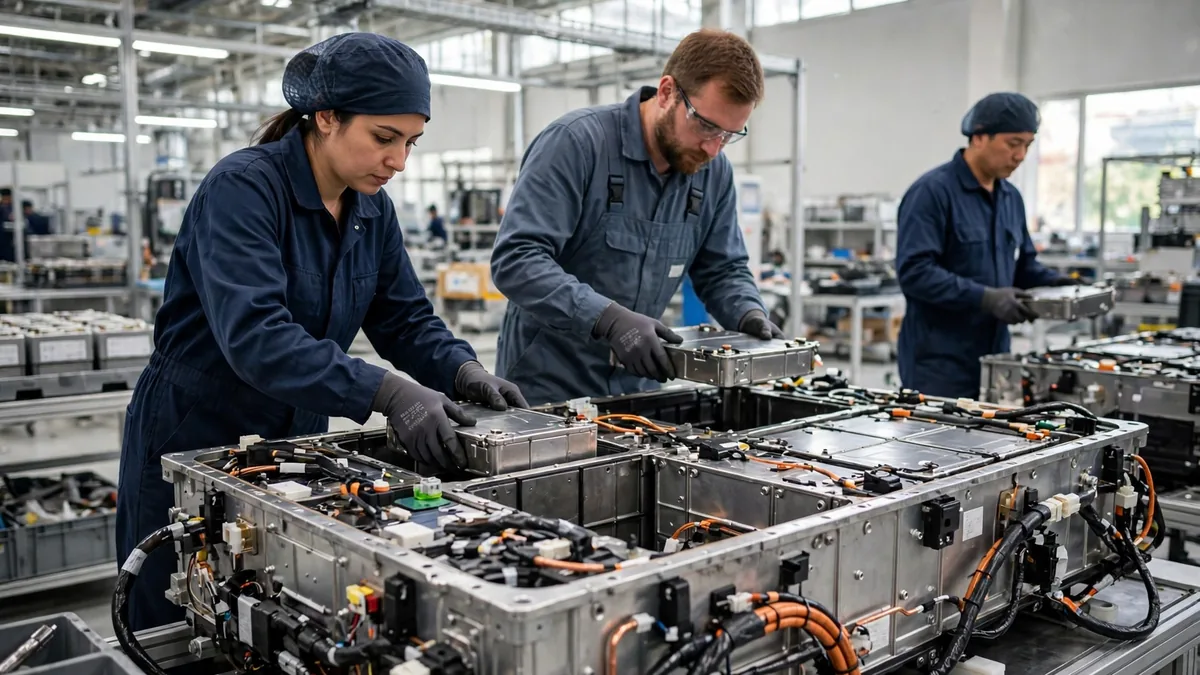
Inside the Production
Step 1: Testing and sorting the cells
Production begins with the cells themselves — usually cylindrical or pouch-shaped lithium-ion cells that arrive from a cell maker in huge batches. Each cell is measured for voltage, capacity, and internal resistance, and any cell that falls outside a narrow range is rejected. The survivors are sorted into groups of closely matched cells, because a pack built from mismatched cells would age unevenly: the weakest cell would wear out first and limit the whole pack. The cells are then stored in dry, temperature-controlled rooms until they are needed on the line.
Step 2: Building the modules
Matched cells are grouped into modules, each one a self-contained block of dozens of cells held in a frame. In a cylindrical-cell module, the cells stand upright like batteries in a torch, connected top and bottom by metal busbars. In a pouch-cell module, flat cells are stacked like books, pressed together, and clamped in a frame that stops them swelling as they age. The connections are made by laser welding or ultrasonic bonding — fast, precise, and strong enough to carry hundreds of amps. Temperature sensors and voltage sensing wires are added to every module, so the car will always know exactly what each group of cells is doing.
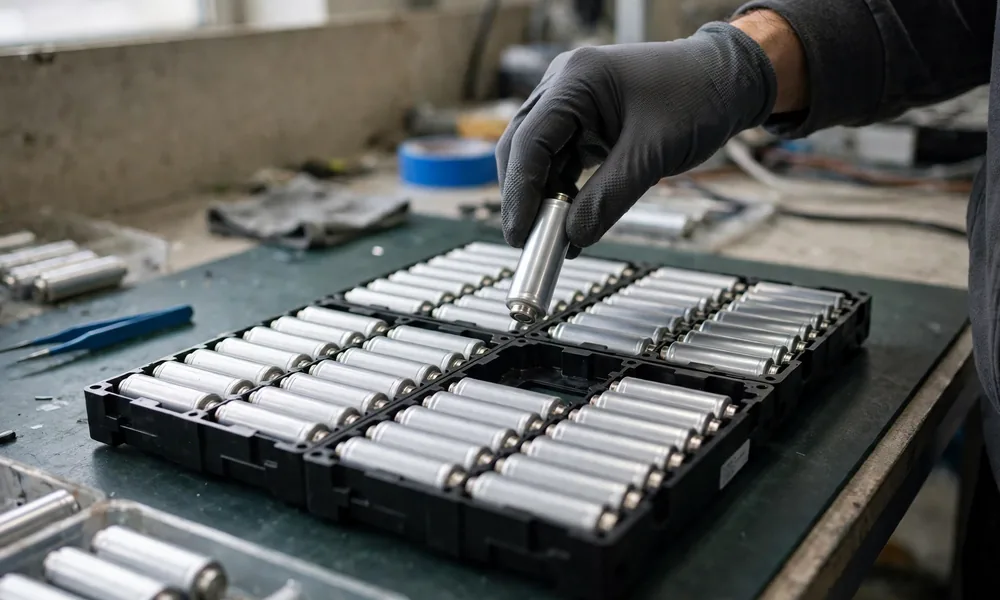
Step 3: Assembling the pack tray and cooling system
While the modules are built, the pack tray is prepared. This is the strong metal case that will carry the modules, protect them in a crash, and seal them against water and dust. Most trays are made from aluminium extrusions and castings, welded or bolted into a shallow, flat box that fits under the car floor. Inside the tray sits the cooling system — usually a network of thin channels carrying a water-and-glycol coolant, pressed against the bottom of the modules. The cooling plate is pressure-tested for leaks before a single module goes in.
Step 4: Fitting the modules and busbars
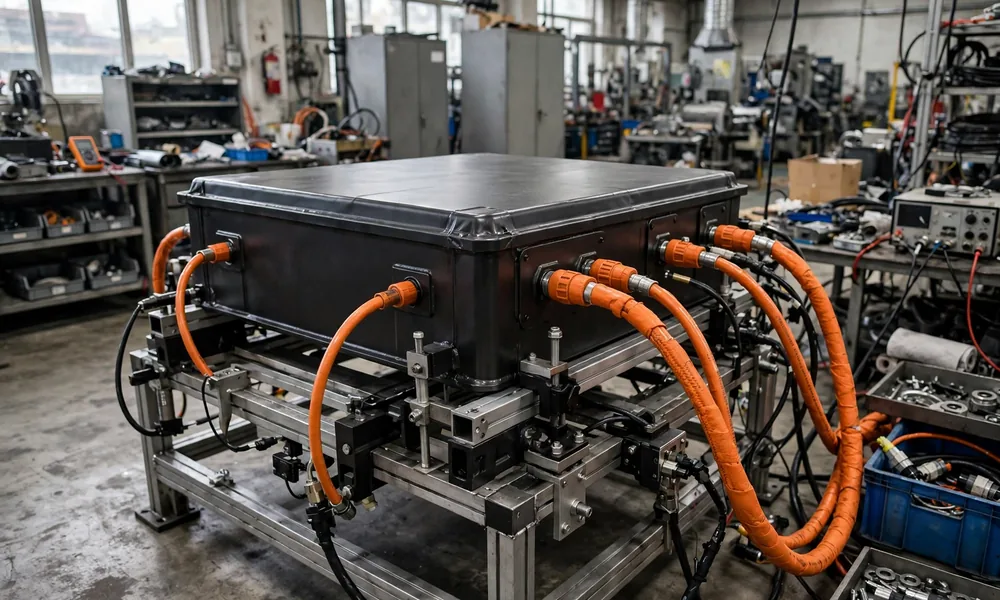
The modules are lowered into the tray, bolted down, and connected to each other with thick copper busbars that carry the full current of the pack. High-voltage cables, orange and heavily insulated, run from the modules to the main contactors — the big switches that connect the pack to the motor and disconnect it in a crash or a fault. A battery management system, a small computer with its own circuit board, is fitted and wired to every sensor in the pack. The work at this stage is careful and quiet: technicians wear insulated gloves, use insulated tools, and follow a strict order of operations, because a pack at this point can carry four hundred volts or more.
Step 5: Sealing the pack
Once the electrics are in, the pack is sealed. A lid is fitted with a gasket, bolted down in a set sequence, and the whole pack is tested for leaks — sometimes by pressurising it slightly with air and watching for a pressure drop, sometimes by dunking the seal area in water. The pack is then fitted with its external connectors, its cooling hose ports, and its mounting points, and given a final visual inspection. The way the finished pack is put together is part of what how an EV battery pack is made describes, and the sealing stage is where a pack stops being a collection of parts and becomes a single sealed unit.
Step 6: Charging, discharging, and testing
No pack leaves the factory untested. Each finished pack is connected to a test rig, charged to full, discharged under load, and charged again, while the battery management system records the voltage of every module. The pack is checked for capacity — it must store at least its rated energy — and for balance, meaning no module is far ahead of or behind the others. A pack that fails any test is opened, repaired, and tested again from the start. Only a pack with a clean test record is cleared for the car assembly line, where it will be bolted under the floor of a new electric car.
Specs
| Specification | Typical figure |
|---|---|
| Pack capacity | 60–100 kWh in a family EV |
| Number of cells | Several hundred to several thousand |
| Pack voltage | 400 volts, or 800 volts in newer cars |
| Cell type | Lithium-ion, cylindrical or pouch |
| Cooling | Liquid cooling plate under the modules |
| Pack weight | 400–600 kg |
| Sealing rating | Protected against dust and water jets |
| Management | Battery management system on every pack |
| Testing | Full charge and discharge before delivery |
Price
The battery pack is the most expensive single part of an electric car, and its price is usually given as an estimate per kilowatt-hour. As an estimate, a finished pack costs roughly $100 to $150 per kilowatt-hour to build, so a 75 kWh pack costs about $7,500 to $11,000 — roughly a third of the price of the whole car. These are estimates, and the real figure varies with chemistry, size, and volume — but the direction is clear: every year, the same money buys more range.
A Rare Fact
An EV battery pack is assembled in air so dry that a person working in the cell-handling area can feel it on their skin. Lithium-ion cells are extremely sensitive to moisture: even a small amount of water vapour inside a cell can cause unwanted chemical reactions that shorten its life. Some factories therefore dry the air in the cell rooms to a dew point below minus forty degrees, colder and drier than a winter day in the Arctic, and workers pass through airlocks to enter. It is one of the strangest sights in car manufacturing — a room that feels like a desert, built to protect batteries that will spend their lives sealed under a car floor.
The pack is the heart of the electric car, but it only makes sense alongside the parts it powers. The way the pack works in the car is explained in how an EV battery pack works, and the numbers behind its capacity and range are laid out in the EV battery pack specs explained guide. The next time an electric car glides away in silence, remember the sorted cells, the sealed tray, and the pack that was charged and discharged before it ever turned a wheel.


